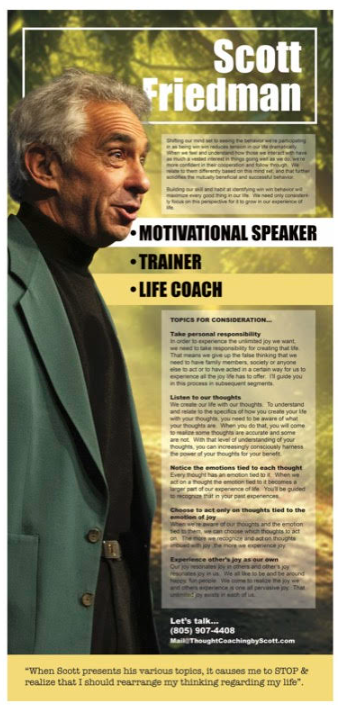
The Business Problem Most Ventura County Coaches Won't Tell You About
I've worked with business owners across Ventura County for a long time. From AgTech and biotech entrepreneurs near Camarillo to hospitality operators along the Ventura and Oxnard coast to professional services firms in Thousand Oaks and Westlake Village — I've seen the full range of what makes a Ventura County business succeed or stall.
And here's what I've found: the bottleneck is almost never what the owner thinks it is.
It's not the market. It's not the team. It's not the systems. Those things matter, and they're fixable with the right strategy. But before a business owner can implement a better strategy consistently, there's a layer that has to be addressed first: the way they think about themselves, their role, their limitations, and what's possible.
That's not a soft observation. It's the most practical thing I can tell a Ventura County business owner.
What a Business Coach in Ventura County Actually Does
The business coaching market in Ventura County is dominated by two types of providers: franchise advisory boards (where you pay to sit in a room with other business owners) and generic consultants who rename themselves "coaches."
Both have value in certain contexts. Neither addresses the underlying driver of most business stagnation: the owner's own patterns of thought.
A good business coach doesn't just review your P&L and help you build a growth plan. They help you see the places where your thinking is working against your intentions — where you're unconsciously sabotaging the outcomes you say you want.
This is work I do one-on-one, by phone or video, with business owners who are serious about growth and willing to look honestly at what's actually in the way.
The Ventura County Business Landscape: What Makes It Unique
Ventura County is not LA, and that's not an accident for the people who've built businesses here. The county has a distinct economic identity:
- Agriculture and AgTech — The Oxnard Plain is one of the most productive agricultural regions in the country. Tech-enabled farming operations, food distribution companies, and agricultural supply businesses make up a significant part of the local economy.
- Biotech and Pharma — Amgen's global headquarters in Thousand Oaks anchors a biotech cluster that draws highly educated professionals who often eventually launch their own ventures.
- Defense and Aerospace — Naval Base Ventura County and related defense contractors in the region create a dense population of engineers and project managers who transition into leadership and entrepreneurship.
- Healthcare — A large network of hospitals, clinics, and private practices makes healthcare one of the county's largest employment sectors, with a growing number of physician entrepreneurs and healthcare startup founders.
- Tourism and Hospitality — Channel Islands National Park, the wine country corridor, and the coastline generate a robust hospitality economy with its own leadership challenges.
I work with business owners across all of these sectors. The details differ. The fundamental coaching challenges are remarkably consistent.
The 5 Most Common Thinking Patterns That Cap Business Growth
After decades of working with entrepreneurs and executives, I've identified the thought patterns that show up most reliably as growth bottlenecks. Here they are, in plain language:
1. The Indispensability Trap
"If I don't do it, it won't get done right." This thought keeps brilliant founders personally executing tasks their team should own. It feels like dedication. It functions as a ceiling. Every hour you spend doing what someone else could do is an hour you're not doing what only you can do.
2. Revenue Guilt
Surprising how many Ventura County business owners feel vaguely guilty about charging what their service is worth — or about wanting to grow. Often rooted in beliefs about money absorbed from family or culture that have nothing to do with the actual value being delivered.
3. The Busyness Disguise
Staying perpetually busy is one of the most effective ways to avoid the decisions that would actually change the trajectory of a business. Busyness feels productive. It often isn't. The hardest and most valuable work is frequently the thinking work, not the doing work.
4. Conflict Avoidance at Leadership Level
The belief that avoiding a difficult conversation is kinder — or safer — than having it. In practice, avoided conversations accumulate and compound into structural dysfunction. The teams that perform best are those led by people who have learned to engage cleanly with conflict rather than route around it.
5. The Imposter Loop
The persistent sense that despite evidence to the contrary, you're not actually qualified for the level of success you've achieved — and that someone is going to figure this out. This belief doesn't disappear with more success. It tends to scale with it. Addressing it at the thought level is far more efficient than trying to outrun it with achievement.
How Thought Coaching Works for Business Owners
My approach isn't consulting and it isn't traditional coaching. It's a process of developing the awareness to see your own thought patterns clearly enough that they lose their automatic power over your decisions.
The three phases:
- Awareness — We surface the specific thoughts that are creating the specific outcomes you don't want. Not in a theoretical way — we identify the precise moment a thought hijacks a decision, a conversation, or an opportunity.
- Acceptance — We don't fight the thought or try to replace it with a positive affirmation. That approach usually doesn't work. Instead, we accept the thought as a thought — not a fact — which removes its grip without requiring you to believe something false.
- Automatic Improvement — When you can see a thought clearly and accept it as a thought rather than a truth, the behavior it was driving changes naturally. Better leadership decisions, cleaner conversations, more consistent execution — not because you're trying harder, but because the internal interference has been reduced.
What Business Coaching Looks Like in Practice
We meet by phone or video — typically 45–60 minutes per session, at a frequency that makes sense for what you're working on. There's no agenda you have to prepare. You bring what's most alive for you: the decision you're stuck on, the conversation you've been avoiding, the goal that keeps slipping.
I ask questions that most people haven't been asked before. Not because they're clever questions, but because they come from 40+ years of daily meditation practice and genuine curiosity about what's actually happening in the mind of the person I'm talking to.
Clients consistently report that the shift they experience is different from what they expected. They came looking for strategy. They found clarity. The strategy became obvious once the thinking cleared.
The Fee Model
Zero upfront. At the successful conclusion of coaching, you pay what you think it was worth — and what you can genuinely afford. This is a philosophical position, not a marketing tactic. I only succeed if you succeed. The incentive structure is clean.
For Ventura County business owners who have invested in coaches, consultants, and programs before with mixed results, this removes every barrier to finding out whether thought coaching actually works for your situation.
Is Business Coaching Right for You?
The clients who get the most from thought-based business coaching tend to share a few characteristics:
- They're intelligent and self-aware enough to know that the bottleneck might be internal, not external
- They've tried the strategy and systems approaches and still feel stuck at a certain ceiling
- They're willing to look honestly at their own thinking without getting defensive about what they find
- They want growth that feels aligned, not just growth for its own sake
If that sounds like you, a 30-minute discovery call will tell you quickly whether this is the right fit.
Frequently Asked Questions
What does a business coach in Ventura County cost?
Most business coaches in Ventura County charge $300–$800 per session or $2,000–$5,000 for multi-month packages. Scott Friedman charges nothing upfront — you pay what it was worth at successful conclusion.
How is business coaching different from consulting?
A consultant diagnoses your business and prescribes solutions. A business coach helps you develop the thinking capacity to identify and solve problems yourself. Consulting creates dependency. Coaching builds capability.
Can business coaching help if my company is already successful?
Often this is when it helps most. The patterns that got you to your current level of success are often the same patterns that cap the next level of growth. Thought coaching specifically addresses these transition points.
Does Scott work with startups or only established businesses?
Both. The specific challenges differ — a founder in year one has different pressures than a business owner in year fifteen — but the thought coaching process is equally relevant at every stage.
How long does business coaching typically last?
Most clients work with Scott for 2–5 months, though this varies significantly. Some specific situations resolve quickly. Others involve deeper patterns that take longer to shift. There's no required minimum commitment.
Does Scott Friedman serve all of Ventura County?
Yes — Camarillo, Thousand Oaks, Oxnard, Ventura, Simi Valley, Ojai, Moorpark, Westlake Village, Agoura Hills, and surrounding areas. All sessions are by phone or video.
Start With a Free Conversation
Thirty minutes. No pitch. Just a real conversation about where your business is, what's in the way, and whether thought coaching is the right tool for your situation.