The Gap Between Knowing and Doing in Leadership
Every serious leader has a library. They've read the books. They've attended the programs. They can articulate the principles of good leadership with precision — empathy, psychological safety, strategic clarity, authentic communication.
And then they get into a high-stakes meeting, a performance conversation, or a moment of organizational pressure — and the principles evaporate. The reactive pattern takes over. The voice gets sharper than intended. The decision gets made from urgency rather than judgment. The team reads the room and adjusts — downward.
This is the gap between knowing and doing in leadership. And it's not closed by more knowledge. It's closed by increased awareness — specifically, awareness of the thought patterns that take the wheel in high-pressure moments.
That is the territory of conscious leadership.
“Conscious leadership isn’t about being calm all the time. It’s about having enough awareness that you’re choosing your response rather than being chosen by it.”
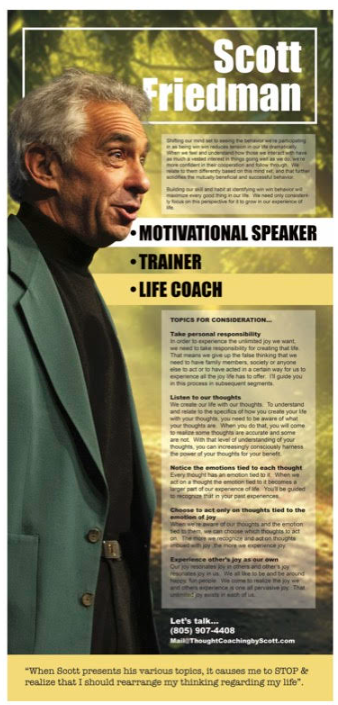
— Scott Friedman
What Conscious Leadership Is (and Isn't)
Conscious leadership has become something of a buzzword in certain circles — associated with mindfulness practices, vulnerability, and "leading with love." Some of that framing is useful. Some of it creates confusion.
Here's what I mean by conscious leadership, grounded in 40+ years of daily meditation practice and work with leaders across every kind of organization:
Conscious leadership is:
- The ability to notice your own reactive patterns before they take over — and make a choice about how to respond
- The capacity to be present with what's actually happening, rather than filtering it through the story your mind is generating about it
- Leading from genuine values and considered judgment rather than fear, ego, or the pressure of the moment
- Seeing your team, your organization, and your challenges with more accuracy because you're not seeing them through the distorting lens of your own unexamined assumptions
Conscious leadership is not:
- Being soft or avoiding difficult conversations — often the opposite is true; conscious leaders can have harder conversations more effectively because they're not driven by defensiveness or anxiety
- A personality type — it's a practice accessible to leaders across all styles and sectors
- A state you arrive at permanently — it's a capacity you develop through ongoing practice and reflection
The Three Dimensions of Conscious Leadership Practice
Self-awareness: Seeing your own patterns clearly
The foundation. You cannot lead consciously without an accurate picture of how you actually think, what triggers your reactive patterns, and what assumptions you're carrying into your leadership decisions. Most leaders significantly overestimate their self-awareness because they mistake self-knowledge for self-observation. Knowing your personality type is not the same as seeing your reactive patterns in real time.
Presence: Being actually here
Most leaders are physically present in their meetings and conversations while mentally processing something from an hour ago or planning something for two hours from now. The quality of attention a leader brings to each interaction is one of the most powerful leadership signals there is. People can feel it when you're actually there — and when you're not.
Responsibility: Owning the internal before the external
Conscious leaders have a high capacity for internal responsibility. They're willing to ask: "What is my role in this dynamic?" before defaulting to external attribution. This is not about self-blame. It's about recognizing that in any situation you're part of, you have some influence over the dynamic — and that influence starts with your own thinking.
How Thought Coaching Develops Conscious Leadership
The development of conscious leadership capacity requires working at the level of thought — not just behavior or skill. Here's the process:
Awareness: Surfacing the specific thought patterns that drive reactive leadership behavior. Not in theory, but in the specific contexts where they actually appear — the leadership situations where you most consistently don't show up the way you want to.
Acceptance: Removing the judgment and resistance that amplifies these patterns. Many leaders know their reactive tendencies but fight them — which, paradoxically, gives them more power. When you can see a pattern with genuine acceptance rather than self-criticism, it begins to lose its grip.
Automatic improvement: When the underlying patterns are seen clearly and held without resistance, behavioral change happens more naturally. You're not white-knuckling your way through difficult conversations — you're genuinely responding from a different internal state.
This process is grounded in 40+ years of daily meditation practice. Not as a relaxation technique — but as the most direct route I've found to genuine, sustained increase in conscious awareness.
From a Leader in the Program
“I used to read about conscious leadership and think: ‘that sounds good in theory.’ After working with Scott, I understand what it actually means to practice it. My team has noticed. My family has noticed. And honestly, so have I.”
— Director, Ventura County
Start the Conversation
If conscious leadership is something you want to develop — not as a concept, but as a daily practice that changes how you lead — a free discovery call is the place to start.
Book your free discovery call here, or call me directly at (805) 907-4408.
Scott Friedman is a leadership coach and thought coaching practitioner. 40+ years of daily meditation practice. 13 published books. Serving Ventura County and clients nationwide. Pay nothing upfront.