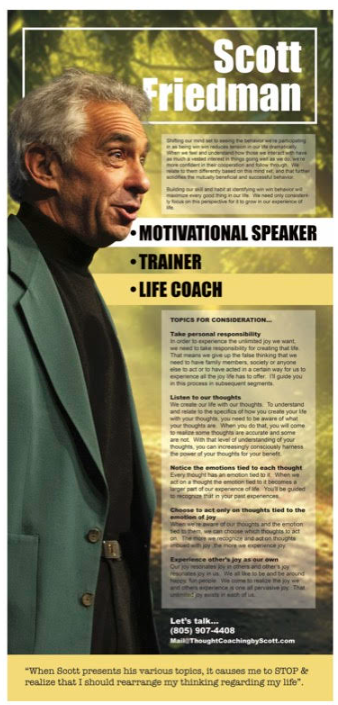
Most people who ask how to stay optimistic are actually asking how to feel better. Those are different questions, and confusing them is where the trouble starts. Positivity is a mood you manage. Optimism is a structural feature of how you relate to your own thought processes — and developing it requires dismantling something first, namely the belief that a better mental state is produced by selecting better-feeling thoughts about circumstances. Forty years of meditation practice and working with people across every conceivable life situation has made one thing clear to me: genuine optimism doesn't need good news to sustain itself, and any version that does isn't optimism — it's wishful thinking wearing optimism's clothes.
Optimism vs. Positivity: Why the Distinction Matters
The word optimism gets used for two entirely different things, and the conflation does real damage. One version is positivity: a mood management strategy in which you select good-feeling thoughts, avoid evidence that undermines them, and maintain a favorable frame on circumstances through deliberate effort. It works, briefly, as an intervention. When life is going reasonably well and the maintenance cost is low, it produces a better mood than its absence. But it's a managed state, not a stable one. The underlying thought layer hasn't changed. It's being supervised. And when reality is sufficiently difficult, or when you're too depleted to maintain the supervision, the managed frame collapses. Often it overshoots into pessimism precisely because the gap between the maintained frame and actual experience becomes suddenly visible.
Genuine optimism is structurally different. It's not a belief that things will be fine. It doesn't require favorable outcomes to sustain itself. It's a stable orientation toward whatever is actually here, maintained not by thought selection but by a different relationship to the thought layer itself. Martin Seligman's research on learned optimism identifies the cognitive patterns that fuel pessimism — permanence (this will always be this way), pervasiveness (everything is affected), personalization (this is about my fundamental inadequacy) — and his work is genuinely useful. But the mechanism matters more than the taxonomy. What makes those patterns so durable is that they don't feel like interpretive habits. They feel like accurate readings of reality. The person running the permanence pattern isn't experiencing themselves as catastrophizing. They're experiencing themselves as being appropriately realistic. That felt accuracy is what makes pessimism sticky and what makes cognitive reframing interventions feel hollow to the people who most need them.
Barbara Ehrenreich made the case against forced positivity culture in "Bright-Sided" from a different angle: she was critiquing the demand that people maintain positive affect in the face of genuinely bad circumstances, arguing that it functions as a way of suppressing legitimate criticism and avoiding structural problems by individuating them into attitude failures. She's right about what she's critiquing. The answer to forced positivity isn't cynicism, though. It's a more precise account of what genuine optimism actually is and what it's built on. Which is not a feeling you maintain. It's a relationship to your thought layer that you develop.
The practical difference shows up most clearly under pressure. A person relying on managed positivity hits a genuinely bad stretch and finds the management system failing at exactly the moment they most need it. A person with genuine optimism — the kind that comes from working with the thought layer directly — hits the same bad stretch and finds that their orientation isn't primarily dependent on the stretch being good. The difficulty is real. The mind's automatic extension of that difficulty into permanent, pervasive, personal catastrophe is what they've developed the capacity to notice rather than automatically inhabit. That's not the same experience at all.
What Pessimism Actually Is at the Thought Level
Pessimism almost never presents itself as a bias. It presents itself as realism. That's its defining feature and its most effective defense mechanism. The person who interprets ambiguous evidence negatively, who anticipates bad outcomes, who generalizes from specific setbacks to broad conclusions about the nature of things — that person typically experiences themselves as seeing clearly what optimists are choosing not to see. And because pessimism presents itself as epistemic virtue rather than emotional habit, challenging it feels like asking someone to be less accurate. It produces resistance that feels principled.
But pessimism is not more accurate than optimism. It's a different filter applied to the same incoming information. The filter does three things automatically, below the level of conscious awareness. It selects confirming evidence: the thing that went wrong, the person who behaved badly, the outcome that matched the anticipated failure. It dismisses disconfirming evidence: the thing that went right gets explained away (luck, temporary, doesn't count), the person who was kind gets characterized as an exception. And it generates anticipatory suffering: it extends bad outcomes forward in time, pre-experiencing future difficulties before they've arrived, as though rehearsing them will somehow help.
The anticipatory suffering is the most costly part of pessimism and the least examined. The pessimistic mind doesn't just respond to bad things. It generates bad experiences in advance of bad things that often never materialize. Research on worry — which is essentially anticipatory pessimism directed at specific future events — consistently finds that a substantial majority of what people worry about either doesn't happen or is manageable when it does. The suffering was real. The bad outcomes mostly weren't. The suffering was produced by the thought layer, not by events.
This matters for development because it means the goal isn't to become someone who has a more favorable view of how things will turn out. The goal is to develop the capacity to notice the thought layer running its patterns and to not be automatically governed by them. The pessimistic prediction isn't eliminated. It's seen for what it is: a thought, not a fact, with a traceable history that has more to do with past experience than with accurate future prediction.
The Attention Economy Is Designed to Make You Pessimistic
This isn't a conspiracy. It's an incentive structure. Human attention is more reliably captured by threat, conflict, and outrage than by safety, cooperation, and satisfaction. The ratio in academic research on negativity bias runs roughly 3:1 — negative events require three times the positive counterweight to produce equivalent emotional effect. News organizations, social media platforms, and political communication are all structured around capturing and holding attention, and the content that most reliably captures attention is threatening content. The result is a media environment that, for someone consuming a normal quantity of it, activates the threat-detection system multiple times per day for threats they cannot address, originating from places they will never go, involving people they will never meet.
NYU psychologist Adam Alter's research on addictive technology documents the behavioral effects of this architecture. Johann Hari's "Stolen Focus" addresses what sustained attention disruption does to mood and cognitive pattern over time. The cumulative effect of years of threat-activation content on baseline mood is not small. It produces a specific variety of learned helplessness about the state of the world that feels like accurate, well-informed realism but is actually the result of an information diet designed by engineers optimizing for engagement rather than for your psychological wellbeing.
For people in Ventura County specifically: the local news environment layers on top of the national one, and the local political climate in California — with its specific combination of housing cost anxiety, wildfire risk, and economic precarity alongside real natural beauty and community quality — creates a particular ambient tension that shows up in sessions regularly. People who moved here from elsewhere often bring the media habits of higher-density, higher-anxiety urban environments. People who've been here for decades carry accumulated anxiety about what the area is becoming. None of this is helped by the feed.
The practical implication is not to stop paying attention. It's to recognize that your information diet is shaping your thought layer, and that the thought layer is where your baseline orientation lives. Deliberate choices about what passes through your attention repeatedly are not naive — they're the same kind of intentionality you'd apply to any other environmental input that shapes how you function.
What 40 Years of Meditation Taught Me About Staying Grounded
The thing I've learned most clearly from forty years of daily practice is this: durable optimism has almost nothing to do with the quality of circumstances and almost everything to do with the quality of the relationship to one's own thought processes. That sounds abstract. Here's what it means in practice.
When you sit in meditation and watch what your mind does when you stop directing it, you see the catastrophizing patterns operating as patterns rather than as facts. The thought "this is always going to be difficult" arises. From outside of it — watching it rather than being inside it — you can see that it's a thought. A well-practiced thought. A thought with history. Not a verified prediction. That seeing doesn't immediately eliminate the thought. What it does is create a fracture in the automatic identification with it. The thought loses a fraction of its authority. And over time, across thousands of instances of that fracture, the thought has less grip. It still arises. But it no longer runs the show automatically.
Neuroscientist Richard Davidson's research at the University of Wisconsin has mapped this in fMRI studies. People with sustained meditation practice show higher baseline activation in prefrontal cortex regions associated with positive affect, faster emotional recovery from setbacks, and significantly reduced activation of threat-response circuits in ambiguous situations. The mechanism is exactly what I've described from the inside: reduced automatic identification with interpretive thought patterns creates more capacity for equanimity in the presence of difficulty. That's durable optimism, measured in brain activity rather than self-report.
None of this requires forty years to be useful. A modest, consistent practice — ten minutes daily of observing what your mind does when you stop directing it — begins producing observable effects within weeks for most people. The obstacle isn't complexity. It's the fact that the benefits accrue slowly in a culture that's structured entirely around immediate feedback, and most people stop before the results are visible. That's worth naming directly because it's the actual barrier, not any inherent difficulty with the practice.
What meditation revealed to me, over forty years, about staying grounded in a world that provides ample material for pessimism: the world has always provided ample material for pessimism. There has never been a period in human history when the news was uniformly good. What changes is not the external supply of difficulty. What changes is the relationship to the thought layer that interprets difficulty. Develop that relationship, and the external supply becomes less determinative of your baseline orientation than you'd have believed possible before you developed it.
The Thought Layer That Determines Your Default Orientation
The question of how to stay optimistic is often framed as a problem of maintaining a posture in the face of incoming bad information. That framing already concedes too much to the pessimistic model. It assumes the default state is neutral or negative, and that optimism requires sustained effort to push against the gravity of reality. My experience is different.
The default state of a person whose thought layer is relatively clear — not busy running automatic interpretive loops about past losses and anticipated failures — is something I'd describe as interested equanimity. Not high affect. Not performed happiness. Not indifference to outcomes. An orientation toward what's actually present rather than toward the mental constructs of what was or what might be. That orientation is inherently more toward life than against it. It's what genuine optimism looks like when you strip the positive-psychology branding from it.
What produces pessimism as a default state is an active thought layer running loops below awareness: rehearsing losses, anticipating failures, interpreting ambiguous information through a negative lens, and doing all of this automatically such that the accumulated emotional tone feels like an accurate response to external reality rather than the product of interpretive machinery. The machinery is real. Its outputs are experienced as perceptions. That's what makes them hard to question.
Working on the thought layer directly — developing the capacity to notice what the machinery is producing and to not be automatically run by it — is the most direct path to a genuine shift in baseline orientation. Not positivity. Not self-talk. Not gratitude practices, though those can be useful as supplements. The layer itself. This is the work that most approaches to optimism development never reach, because they address the outputs of the machinery rather than the machinery's relationship to the person running it.
Five Practices for Durable Optimism
Notice the difference between a thought and a fact. Pessimism runs almost entirely on thoughts that have been granted the authority of facts. "Things never work out for me." "The world is getting worse." "People are fundamentally selfish." None of those are facts. They're interpretations that have calcified into convictions through repetition. The practice is simple and not easy: when you notice a thought that sounds like a prediction or a verdict, ask whether you'd be willing to hold it as a hypothesis rather than a conclusion. That shift alone — hypothesis rather than conclusion — creates room for a different orientation to emerge without requiring you to pretend the thought isn't there.
Control your information diet with the intentionality you'd apply to food. You wouldn't eat whatever happened to be placed in front of you regardless of nutritional content. Most people consume whatever their phone serves them without equivalent intentionality. The thought layer is shaped by what repeatedly passes through it. An information diet dominated by threat, outrage, and catastrophe produces a thought layer that defaults to threat, outrage, and catastrophe. Not because the person is weak but because that's how pattern formation works. This isn't about avoiding reality. It's about recognizing that the algorithm serving your feed is optimizing for your engagement, not your psychological equilibrium, and making deliberate choices accordingly.
Separate what you can affect from what you can't. A significant portion of pessimism is free-floating anxiety about circumstances that are genuinely outside any individual's influence. Not because people are irresponsible, but because modern media delivers awareness of global problems at a scale that has no historical precedent and provides no corresponding channel for action. The anxiety is real. The utility of that anxiety is essentially zero. Separating "this is something I can actually do something about" from "this is something I'm aware of and cannot influence" is a practice requiring regular re-sorting, not a one-time decision. But the re-sorting is worth doing. It focuses energy where it can produce something and reduces the ambient drain of non-actionable awareness.
Build the capacity to tolerate uncertainty without resolving it into catastrophe. Much pessimism is essentially catastrophizing — taking genuine uncertainty and resolving it into the worst plausible outcome because the uncertainty itself is uncomfortable to hold. The mind wants certainty, and will accept a bad certainty over sustained uncertainty. The practice is to stay with "I don't know how this will turn out" as a complete statement rather than as an unresolved problem requiring a prediction. That tolerance develops through practice. But the payoff is significant: the automatic pessimistic resolution of open questions stops running below awareness, and the actual situation can be engaged with rather than the catastrophized version of it.
Spend regular time with people who are genuinely interested in being alive. Not happy people — interested people. People who are curious about what's happening rather than braced against it. Emotional orientation is genuinely contagious at the neurological level. Mirror neurons do what they do whether or not you're intentional about it. The emotional environment you inhabit most consistently shapes your default orientation over time. This isn't about avoiding difficult conversations or hard realities. It's about recognizing that the people around you are shaping your thought layer, and choosing, where you have the choice, the company of people whose relationship to life is fundamentally interested rather than fundamentally defended.
What This Looks Like for People in Ventura County
The specific flavor of pessimism I encounter varies significantly by community here, and the work looks different depending on the source.
In the Amgen and biotech corridor between Thousand Oaks and Camarillo, the dominant challenge is performance-related pessimism. Drug development involves years of work that may not produce favorable outcomes. The culture is rigorous and data-driven, which produces excellent science and a specific occupational hazard: the habit of evaluating everything, including one's own prospects, through the lens of probability and evidence. That lens, applied to personal life and career, tends to generate a pessimism that presents itself as statistical realism. I've worked with scientists and executives from these organizations who are genuinely confused about why their capacity for clear-eyed professional assessment becomes a liability in their personal lives. The answer is usually that the same interpretive habits that serve them in the lab are running in contexts where they produce a different result.
In the NBVC and defense community around Port Hueneme and Oxnard, professional training in threat identification becomes a default orientation that follows people home. Identifying what can go wrong, preparing for worst-case scenarios, maintaining vigilance — these are professional competencies that produce a specific kind of ambient pessimism in close personal relationships, where the same posture doesn't serve the same function. The people I've worked with from this community are often surprised to discover how their professional orientation is experienced by the people who live with them. It doesn't feel like pessimism from the inside. It feels like responsible preparation.
In Oxnard and the Santa Clara valley agricultural communities, the challenge is different: optimism has to be reconciled with real economic constraint rather than bypassing it. The question "how do I stay optimistic?" means something different when the circumstances generating pessimism are not interpretive habits but genuine structural limitations. What I've found is that the work is still at the thought layer — specifically, distinguishing between accurate assessment of real constraint and the extrapolation of that constraint into permanent conclusions about possibility. Those are different things, and the difference matters. Real constraint is real. The mind's conversion of real constraint into a verdict about what's permanently possible is something else.
In Westlake Village, I've worked with people for whom significant material achievement has paradoxically produced a kind of ambient pessimism. The forward momentum of working toward something provides a structure that looks, from the inside, like optimism. When you've gotten where you were going, that structure disappears, and what's underneath it becomes visible. Sometimes it's genuine satisfaction. More often, I find a thought layer that was never examined because the achievement trajectory was doing the work of keeping it below awareness. When the trajectory ends, the layer surfaces, and it often turns out to be more pessimistic than the person would have predicted about themselves. That's not a failure of character. It's just what was there all along, waiting for the scaffolding to come down.
| Approach | What It Does | What It Misses |
|---|---|---|
| Positive thinking / affirmations | Temporarily shifts mood by selecting better-feeling thoughts | Leaves the underlying thought layer unchanged; requires constant maintenance and collapses under real pressure |
| Gratitude journaling | Trains attention toward what's good; has genuine research support for mood elevation | Doesn't address automatic pessimistic interpretation patterns; can feel hollow when circumstances are genuinely difficult |
| News avoidance | Reduces daily exposure to threat-activation content | Doesn't develop capacity to stay grounded in the presence of difficult information; avoidance isn't resilience |
| Therapy | Addresses historical sources of pessimistic patterns, particularly trauma-based | Not primarily designed to develop day-to-day capacity to observe and not be governed by automatic thought patterns |
| Meditation practice | Develops capacity to observe the thought layer without being run by it; changes baseline affect over time | Results are slow; requires commitment before benefits are evident; no immediate feedback |
| Life/thought coaching | Works directly with the specific thought patterns producing pessimism; develops durable orientation change | Requires genuine willingness to examine what the pessimism is protecting; not for people who only want mood management |
How Life Coaching Develops Optimism at the Root
Life coaching, as I practice it, is not positive psychology and it's not therapy. It's a specific kind of conversation about what's actually happening in the thought layer when a person's default orientation keeps pulling them toward a pessimistic read of ambiguous situations. The work is direct: examining the automatic interpretive patterns, understanding their function and history, and developing the capacity to see them without being automatically governed by them.
This is different from cognitive behavioral therapy in a specific way. CBT works by identifying cognitive distortions and replacing them with more accurate thoughts. The replacement requires effort and maintenance. What I'm describing is developing a different relationship to the thought layer itself: not replacing the pessimistic thought, but developing the capacity to see it as a thought rather than as a fact. When that capacity exists, the thought arises and its grip is different. It's not eliminated. It just has less automatic authority.
It's also different from positive psychology interventions — gratitude practices, strength identification, best possible self exercises — which address the content of the thought layer by adding positive content to it. Those can be genuinely useful, particularly as supplements. But they don't change the machinery. The same interpretive habits that produced the pessimism are still running; they've just been given some counterweight. Under enough pressure, the counterweight stops doing the job.
Most people who come to this work don't arrive asking for optimism development. They come because something specific isn't working: a relationship that has stalled, a career decision that keeps not getting made, a pattern of response that they recognize as counterproductive and can't stop. Working on those specific things almost always involves examining the thought layer that's been generating pessimistic interpretation of ambiguous situations. And as that layer becomes more visible and less automatic, the baseline orientation shifts. Not toward naive positivity. Toward genuine interest in what's actually here. That's what optimism at its best actually is, and it's available to people who are willing to do the work of getting there from the inside rather than from the outside.
Frequently Asked Questions
Is optimism just denying how bad things actually are?
Genuine optimism is not denial. It's the capacity to hold difficult realities without letting the mind use those realities to generate automatic conclusions about all future realities. The pessimist and the genuine optimist can look at the same bad situation. The pessimist automatically extends it: this is how things are, this is how they'll stay, this is evidence for what I already knew about the world. The optimist holds it: this is what's here right now. That difference has nothing to do with accuracy and everything to do with the relationship to the thought layer interpreting what's present. Acknowledging difficulty is not pessimism. Generalizing from difficulty to permanent verdict is.
How do I stay optimistic when things are genuinely hard?
Genuine difficulty is real and deserves honest engagement. What I've found working with people through hard periods is that the suffering almost always has two layers: the difficulty itself, and the thought layer's interpretation of what the difficulty means about the future, about the person, about how life works. The first layer requires real response. The second layer is where the work on optimism happens. You can be fully honest about how hard something is without automatically letting the mind's interpretation of that difficulty run unchecked into permanent conclusions. Holding those two things separately is a skill. It takes practice to develop and it's genuinely available.
Do optimistic people just have better lives than pessimists?
There's solid evidence that optimistic people have better health outcomes, live longer, and report higher life satisfaction. But the causation is partly behavioral: optimists take more actions consistent with positive outcomes, persist longer through setbacks, and maintain social connections better under pressure. The pessimist who stops trying because failure seems inevitable creates the outcome they predicted. The optimist who keeps engaging is working with the actual situation rather than the anticipated worst version of it. It's not that optimists have better circumstances to start. It's that their default orientation tends to produce behavior that creates better circumstances over time.
What's the difference between optimism and wishful thinking?
Wishful thinking replaces accurate assessment with preferred outcomes. Genuine optimism doesn't require preferred outcomes to be predicted. It's a stable orientation toward the present that doesn't depend on the future being favorable. Wishful thinking is passive — it hopes without engaging with reality. Genuine optimism is compatible with clear-eyed assessment of what's difficult and active engagement with addressing it. Martin Seligman distinguishes between dispositional optimism — a stable orientation toward possibility — and specific outcome prediction. The former is healthy and developable. The latter is a cognitive bias in the favorable direction, which isn't better than pessimistic bias. It's just differently wrong.
How do I stop being affected by negative people?
The goal isn't to become unaffected by other people's emotional states — that would require a disconnection that isn't actually desirable or possible. The goal is a stable enough baseline orientation that other people's pessimism doesn't automatically pull you into their interpretive frame. That stability comes from the thought layer being clear enough to recognize when you've absorbed someone else's pattern rather than generated your own. When you can see the pattern clearly, you can engage with the person without being reshaped by their orientation. That's different from being unaffected. It's having enough groundedness to stay yourself while remaining genuinely connected.
Can therapy help with chronic pessimism?
Therapy can help significantly, particularly when pessimism is rooted in specific historical experiences of loss, betrayal, or trauma. CBT has a strong evidence base for addressing the cognitive distortions that drive pessimism. What therapy typically doesn't address is developing the day-to-day capacity to observe and not be governed by the thought layer — the moment-to-moment perceptual practice that changes baseline orientation over time. Contemplative practice and thought-based coaching address that layer more directly. Therapy and coaching often work well together for people dealing with both historical sources and current patterns. They're addressing different layers of the same structure.
Ready to Think About This Differently?
If you've been trying to stay optimistic through willpower or reframing and it keeps not sticking, there's usually a reason for that. A 30-minute conversation doesn't cost you anything. Pay nothing upfront, pay nothing until we're done, and only what you think it was worth.
Book a Free 30-Minute Call