The High-Achiever Ceiling Is Real — and It's Not What You Think
Agoura Hills attracts a particular kind of professional. Finance. Real estate. Entertainment. Entrepreneurship. The people who build careers and businesses here have usually done it through a combination of sharp intelligence, genuine drive, and the willingness to outwork everyone around them.
So when a ceiling appears — when growth stalls, when performance plateaus, when the strategies that produced results before stop working — the instinct is to do more of what worked before. More analysis. More effort. More optimization.
But often, that's exactly the wrong move.
“When an intelligent, capable person is stuck, adding more information or more effort rarely fixes it. What fixes it is changing the quality of the thinking underneath the effort.”
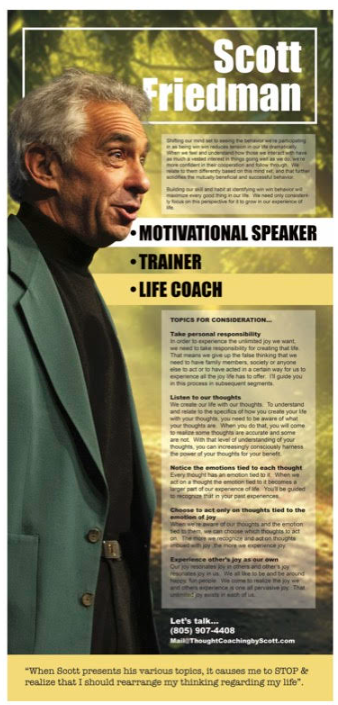
— Scott Friedman
The high-achiever ceiling isn't usually a skill gap. It isn't usually a strategy gap. It's almost always a thinking gap — a set of unconscious beliefs, reactive patterns, and self-limiting assumptions that have quietly accumulated over years of success and are now acting as a lid on what's possible.
What Actually Creates the Ceiling
Here are the most common internal patterns I see in Agoura Hills professionals who come to me feeling stuck despite significant external success:
Success-Driven Identity Anxiety
When your identity is fused with your performance metrics, any plateau feels like a personal failure — regardless of the objective situation. This anxiety quietly sabotages exactly the creative, risk-taking thinking that produced breakthrough results before.
The Competence Trap
High performers often default to areas of proven competence when under pressure. But growth, by definition, requires operating in zones of incompetence. The unconscious avoidance of this discomfort is one of the most common hidden limiters I encounter.
Relationship Pattern Repetition
The same interpersonal dynamic — with partners, clients, team members — keeps showing up in slightly different forms. This is never the other person's problem. It's a signal about an unconscious operating pattern that needs to be examined.
Misaligned Motivation
What originally drove your success may no longer be what you actually want. When the goals and the motivation are misaligned, performance suffers — and no amount of discipline or strategy corrects it.
How Thought Coaching Addresses This
Thought coaching doesn't add more information to an already information-rich mind. Instead, it does something more valuable: it changes the quality of the thinking that's already happening.
In practice, that looks like:
- Identifying the specific belief or assumption that's acting as a ceiling on a particular area of performance
- Examining it honestly — not to fight it or replace it with positive thinking, but to see whether it's actually true
- Discovering what naturally emerges when that belief loses its unconscious grip
This is not willpower-based change. It's awareness-based change — which is why it tends to be more durable.
From an Agoura Hills Client
“I’d already hit my financial goals but felt stuck. Not stuck in a dramatic way — just this persistent sense that there was more, and I couldn’t get there. Scott helped me understand what was actually in the way. It wasn’t what I expected.”
— Financial Advisor, Agoura Hills, CA
The Logistics
We work by phone or video. No commute. Sessions around your schedule. The financial model is straightforward: you pay nothing upfront. At the successful conclusion of coaching, you decide what it was worth and pay accordingly.
Your first call is free. 30 minutes. No pitch. We assess whether there's a genuine fit — and if there isn't, I'll say so.
Book your free discovery call or call (805) 907-4408.
Scott Friedman serves Agoura Hills, Westlake Village, Thousand Oaks, and all of Ventura County. 40+ years of daily meditation. 13 published books. Pay nothing upfront.