The Problem With Most "Mindset Coaching"
"Mindset coach" is one of the most searched and most diluted terms in the personal development space. Type it into Google and you'll find Instagram influencers, weekend workshop promoters, and certification programs promising to make you a mindset coach in 30 days.
This has created a legitimate skepticism among thoughtful professionals — exactly the people who could benefit most from this kind of work. They've been burned by motivational content that pumped them up for 48 hours and then evaporated. They've sat through workshops that confirmed everything they already believed and changed nothing.
Real mindset coaching — the kind that produces lasting, measurable change in how someone thinks, decides, and leads — is a different animal. This post is about what it actually is and why it works differently.
What Mindset Actually Means (Beyond the Buzzword)
"Mindset" has become a marketing term. It's worth reclaiming the substance beneath it.
Your mindset is the collection of beliefs, assumptions, and interpretive frameworks through which you process every experience and make every decision. You don't choose these consciously. They were built over a lifetime of experience, conditioning, and observation. They're largely invisible to you — which is exactly what makes them powerful.
When people say they want to "change their mindset," what they usually mean is: they want to stop responding in ways they can see aren't serving them, and start responding in ways that align with who they want to be. This is a legitimate and achievable goal. The problem is that most mindset coaching approaches work at the wrong level.
Why Positive Thinking Doesn't Work
The dominant approach to mindset change is substitution: replace negative thoughts with positive ones. Affirmations, vision boards, gratitude journals. These tools are not worthless — they have genuine applications. But as a primary strategy for changing deeply held beliefs, they fail for a simple reason:
You can't think your way out of a belief by thinking harder in the opposite direction.
If you believe, at a deep level, that you're not qualified for the role you're in, repeating "I am confident and capable" in the mirror doesn't change that belief. It adds a performance on top of it. The underlying belief remains intact — now with a layer of cognitive dissonance added.
This is why so many people who've done years of personal development work feel like they're running on a treadmill. They've acquired tools and frameworks, but the foundational beliefs that determine what they actually do haven't shifted.
The Thought Coaching Approach: What's Different
My approach starts with a different premise: a thought is a thought. It is not a fact.
This sounds simple. The implications are significant. Most of us experience our thoughts as reality — as accurate reports about the world and ourselves. When a leader thinks "my team doesn't take me seriously," that thought arrives with the phenomenal quality of a fact. It feels true. And so they act from it — becoming either overly assertive or withdrawn, depending on their specific pattern.
But the thought is not a fact. It's a thought. It may have some correspondence to reality. It may be almost entirely wrong. The point is that treating it as a fact — as most of us do automatically — gives it authority it hasn't earned.
Thought coaching works in three phases:
- Awareness — Developing the capacity to notice thoughts in real time, rather than being run by them automatically. This is a trainable skill. It's the foundation of 40+ years of daily meditation practice, and it's teachable to anyone who's willing to develop it.
- Acceptance — Not fighting the thought, not suppressing it, and not replacing it with a positive alternative. Simply accepting it as a thought — one possible interpretation of reality, not reality itself. This sounds passive. It's actually the most powerful intervention available. When a thought loses its claim to being fact, it loses its automatic authority over behavior.
- Automatic Improvement — When awareness and acceptance become consistent practices, behavior changes without effort or willpower. The old reactive pattern simply has less grip. Better decisions, cleaner communication, more aligned action — not because you're trying harder, but because the interference has been reduced.
Who Needs Mindset Coaching in Ventura County
The honest answer is: almost everyone who has hit a ceiling they can't explain with external factors.
More specifically, the clients who come to mindset coaching in Ventura County tend to fit one of these profiles:
- High achievers who keep undershooting their own potential — They're smart, hardworking, and capable. By most measures, successful. But there's a consistent gap between what they achieve and what they sense is possible. The gap isn't skills. It's a belief structure that quietly caps every effort.
- Leaders whose effectiveness is being limited by reactivity — They know they respond to certain situations in ways they regret. They've tried to "manage" those responses. The management works for a while, then breaks down under pressure. They need to address the thought at the root, not manage the behavior at the surface.
- Entrepreneurs stuck at a growth ceiling — The business has reached a level and stopped. The strategies aren't the problem. The owner's beliefs about what they deserve, what's possible, and what they're capable of are the problem.
- Professionals in transition — Career changes, leadership promotions, returning to work after time away. These transitions are rarely just logistical. They're identity events. The mindset work is the core work.
Why the Ventura County Context Matters
Ventura County has a distinctive professional culture — ambitious enough to have built real careers, self-aware enough to want more than pure productivity, close enough to the natural world (coast, mountains, agricultural land) to value something that isn't just hustle.
Across the county's communities — from the biotech professionals of Thousand Oaks to the agricultural entrepreneurs of Oxnard to the creative class of Ojai to the executive community of Westlake Village — I see the same underlying tension: people who've built significant external success and are now asking harder questions about what it's actually for and who they actually are.
This is exactly where thought coaching is most effective. Not when someone is in crisis, but when someone is ready to do the real work of becoming who they already sense they are.
Scott Friedman: The Credentials Behind the Methodology
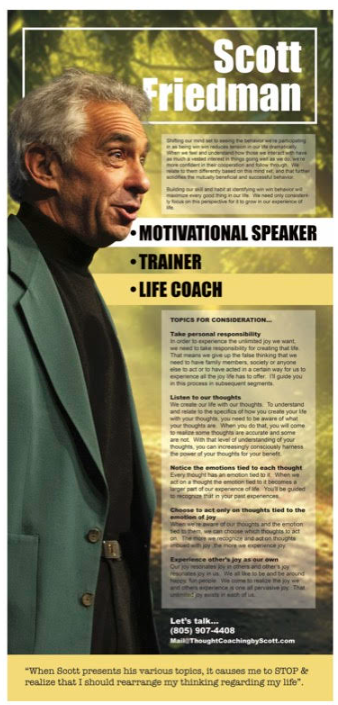
I'm not a weekend-certified mindset coach. I've maintained a daily meditation practice for more than 40 years. I've written 13 books on thought coaching and personal development. I've worked with thousands of professionals, executives, business owners, and leaders across Ventura County and nationally.
The methodology isn't borrowed from a training program. It emerged from lived practice — from sitting with my own thoughts long enough to understand how they work, and from decades of coaching conversations that tested and refined every element of the approach.
This matters because mindset work done poorly can be harmful — it can reinforce avoidance, enable magical thinking, or replace one form of self-deception with another. Done well, by a practitioner who genuinely understands the terrain, it's among the most efficient personal and professional investments available.
The Fee Model
Nothing upfront. At the successful conclusion of coaching, you pay what you think it was worth — and what you can afford. This is the actual model, not a promotional offer. It reflects a genuine conviction: I should only be compensated if you genuinely benefited.
Frequently Asked Questions
What is a mindset coach and what do they do?
A mindset coach helps you identify the beliefs and thought patterns that are limiting your performance, relationships, or sense of possibility — and develop the awareness to change them at the source rather than just managing their effects.
How is mindset coaching different from positive thinking?
Positive thinking tries to replace negative thoughts with positive ones. Mindset coaching — specifically thought coaching — works at a deeper level: accepting thoughts as thoughts rather than facts, which removes their automatic authority over behavior. This produces more durable change.
How long does mindset coaching take?
Most clients notice a meaningful shift within the first few sessions. Complete engagements typically run 2–4 months. The timeline depends on the depth of the patterns being addressed and the consistency of the practice between sessions.
Is mindset coaching the same as therapy?
No. Therapy addresses clinical conditions and processes the past. Mindset coaching works with present patterns to enable future possibilities. They serve different purposes and often complement each other.
Does Scott Friedman work with clients throughout Ventura County?
Yes — Camarillo, Thousand Oaks, Oxnard, Ventura, Simi Valley, Ojai, Moorpark, Westlake Village, Agoura Hills, and surrounding areas. All sessions are by phone or video.
What makes Scott's mindset coaching approach unique?
The combination of 40+ years of daily meditation practice, 13 published books, and a fee model where you pay nothing upfront — only what you think it was worth at successful conclusion. The methodology emerged from lived practice, not a certification program.
Find Out If This Is the Right Fit
A 30-minute discovery call — free, no obligation — is the best way to find out whether thought coaching is right for your situation.