Why Most Personal Development Goals Don't Produce Lasting Change
The personal development industry is built around a premise that turns out to be only partially true: that if you set the right goals, create the right systems, and apply sufficient discipline, you'll produce the changes you're after.
The problem isn't the goals, or the systems, or the discipline. The problem is that all of those tools operate at the level of behavior. And behavior is downstream of thought. If the underlying thought patterns don't change, the behavior will drift back to its previous baseline regardless of how good the system is.
This is why the same person can read ten personal development books and still find themselves in the same patterns five years later. The books are often excellent. The problem is the application layer — and the application layer is thought-based, not technique-based.
“You can’t willpower your way past a thought pattern. Willpower is fighting the current. Changing the underlying thought is changing the current itself.”
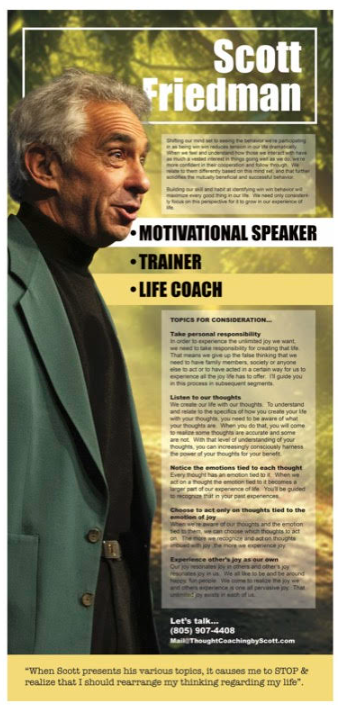
— Scott Friedman
The Real Reason Personal Development Goals Fail
Here are the three most common underlying causes I see in 40+ years of working with people on personal change:
The goal addresses the symptom, not the cause
"I want to be more confident" is a symptom-level goal. The thought patterns generating the lack of confidence are the cause. Addressing the symptom directly — through affirmations, power poses, or exposure therapy — produces limited and temporary results because the cause is still operating.
The goal is built for inspiration, not for reality
Goals set during peak motivation are calibrated to how you feel at that moment — not to the friction you'll encounter three weeks in. When the friction arrives (and it always does), the goal feels like a reminder of failure rather than a source of direction.
The "why" behind the goal is fear-based, not desire-based
Goals driven by "I have to change or something bad will happen" burn differently than goals driven by genuine desire for something more. Fear-based motivation is powerful in short bursts but exhausting over time. It also produces the characteristic feeling of running as hard as you can and still not feeling like you're getting anywhere.
A Different Approach to Personal Development Goals
Rather than setting more goals and trying harder to hit them, here's a different approach:
Start with awareness, not objectives. Before deciding what you want to change, invest in understanding what's currently driving you. Not the surface-level story — the actual underlying patterns. What are the thoughts that arise when you consider the change you want? What's the quality of motivation behind the goal?
Set process goals, not just outcome goals. "I want to be less reactive in difficult conversations" is an outcome goal. "I will spend five minutes each morning noticing what thoughts are present before I engage with external demands" is a process goal. Process goals build the awareness capacity that makes outcome goals achievable.
Let insight precede action. Most personal development advice moves quickly to action. But for people who have tried many times and found the results don't stick, more action isn't the answer. More insight is. Specifically: insight into the thought patterns that have been generating the current results.
Track internal shifts, not just external metrics. External metrics are important. But they're lagging indicators. The leading indicator of lasting behavioral change is the quality of your awareness and the degree to which your actions are coming from conscious choice versus unconscious reaction.
The Role of Coaching in Personal Development
The most valuable thing a coach provides in personal development work isn't accountability or guidance — though those have value. It's a mirror. Someone who is genuinely skilled at reflecting back what they observe, including the patterns you can't see from the inside.
Blind spots are, by definition, things you can't see on your own. A good coaching relationship shortens the timeline from "operating from this pattern" to "seeing this pattern clearly enough to have a different relationship with it."
From a Client on Personal Development
“I’d been working on personal development seriously for years. Read widely. Tried different systems. Made progress but kept hitting the same ceiling. What Scott showed me in the first few sessions was the specific thought pattern that had been setting that ceiling — and once I saw it, the ceiling lifted.”
— Professional, Ventura County
Start With a Free Conversation
If personal development goals matter to you but the results haven't matched the effort, a 30-minute discovery call is the most efficient way to understand whether a different approach might produce different results.
Book your free discovery call here, or call directly at (805) 907-4408.
Scott Friedman is a life coach and thought coaching practitioner serving Ventura County, CA — Camarillo, Thousand Oaks, Ojai, Ventura, Simi Valley, and beyond — and clients nationwide. 40+ years of daily meditation. 13 published books. You pay nothing upfront.