After forty years of sitting with people who are trying to get better at managing their emotions, I can tell you the answer directly. The reason you struggle with your emotions is not that you lack emotional regulation skills. You have probably read the books, tried the breathing exercises, downloaded the apps, and practiced the techniques. The reason you struggle is that the entire framework most people use for emotion management is built on a misunderstanding of where emotions come from. That misunderstanding makes the problem worse, not better, no matter how disciplined you are about applying the techniques.
The emotions are not the problem. The thoughts producing them are the problem. And the thoughts are not addressable by managing the emotions they produce. They are addressable only by being seen for what they are.
Why Most Emotion Management Advice Fails
The standard advice for managing emotions falls into three categories. None of them work the way you have been told they do.
The first category is suppression. You feel anger rising and you push it down. You feel anxiety and you try to think about something else. Suppression works for about thirty seconds. Then the emotion comes back stronger, because you have been fighting it, and fighting an emotion is fuel. The suppression also has a cost. Pushed-down emotions do not disappear. They accumulate. They show up later as tension in your body, reactivity in your relationships, and exhaustion at the end of the day. You are not managing the emotion. You are storing it.
The second category is expression. You vent. You journal. You talk it out. The theory is that emotions need to be released. The reality is that expressing an emotion often reinforces it. When you tell the story of why you are angry, you rehearse the narrative that produced the anger. The anger does not leave. It deepens, because you have given it more material to work with. Venting feels good in the moment. It does not produce lasting change. The same trigger will produce the same emotion next week because the thought that produced it was never addressed.
The third category is technique. You breathe slowly. You count to ten. You use a grounding exercise. These techniques can lower the intensity of an emotion in the moment. They do not address why the emotion arose in the first place. So you become dependent on the technique. You need to breathe through every difficult conversation. You need to count through every stressful morning. The technique becomes a crutch. The underlying mechanism keeps running. You are managing symptoms, not causes.
All three categories share the same flaw. They treat the emotion as the problem. The emotion is not the problem. The emotion is the output. The input is a thought. Until you address the thought, you are managing the output of a process you cannot see.
Where Emotions Actually Come From
Let me be specific about what I mean, because the phrase "emotions come from thoughts" gets used loosely and I do not mean it loosely. Every emotion you experience is preceded by a thought. Most of those thoughts are automatic. You do not choose them. They arise from patterns formed by your history, your conditioning, and your current state. The thought arises first. You believe it. The emotion follows. You experience the emotion as a response to the situation. But the emotion was not a response to the situation. It was a response to your thought about the situation.
Here is an example I have seen hundreds of times. Two people receive the same email from their boss. The email says the project needs significant revision. The first person reads it and feels a spike of anxiety. The second person reads it and feels a wave of irritation. Same email. Different emotions. Why? Because each person had a different thought. The first person thought: "My competence is being questioned." That thought produced anxiety. The second person thought: "They keep changing the scope without understanding the work." That thought produced irritation. The email did not produce either emotion. The thought about the email did.
This is not a philosophical point. It is a mechanical one. If you want to change your emotional life, you do not work on the emotions. You work on the thoughts that produce them. But you cannot work on the thoughts the way you work on the emotions, because the thoughts are not addressable by suppression, expression, or technique. They are addressable only by awareness.
The Mistake Hiding in the Question
The question "how do I get better at managing my emotions" contains an assumption worth examining. The assumption is that emotions are things that need to be managed. That assumption treats emotions as unruly objects that must be controlled, directed, or contained. It puts you in a permanent adversarial relationship with your own interior. You are the manager. The emotions are the employees. Your job is to keep them in line.
This framing is exhausting because it requires constant vigilance. You can never stop managing. The moment you relax, the emotions misbehave. So you spend your life policing your own mind, and the policing itself becomes a source of stress, which produces more emotions to manage. The loop feeds itself.
The alternative is not to stop caring about your emotions. The alternative is to understand what they are. An emotion is a feeling produced by a thought. It is not a fact. It is not a command. It is not a signal about reality. It is a signal about a thought. When you see it that way, the adversarial relationship drops. You stop fighting the emotion because you stop treating it as an enemy that needs controlling. You start looking at the thought that produced it, because that is where the actual leverage is.
What Actually Works
The approach I am about to describe is the core of thought coaching. It is not a technique. It is a shift in understanding. The shift is this: a thought is a thought. It may or may not be true. Most of the thoughts that produce difficult emotions are not true. But their truth or falsity is not the point. The point is that they are thoughts, not perceptions. When you see a thought as a thought, the emotion it produces loses its grip. Not because you fought the emotion. Because you stopped fueling the thought.
Here is what this looks like in practice. The next time a difficult emotion arises, do not try to suppress it. Do not try to express it. Do not reach for a technique. Instead, look behind the emotion for the thought that produced it. The thought is there. It arose before the emotion. You may have to look for it, because it was fast and automatic. But it is there.
When you find the thought, do not argue with it. Do not replace it with a positive thought. Do not try to determine whether it is true or false. Just look at it. Notice that it is a thought. Notice that you did not choose it. Notice that it arose on its own from a pattern you did not design. Notice that it feels like perception but it is not perception. It is a mental event. It has no more authority than any other mental event. The only authority it has is the authority you give it by believing it.
This sounds simple. It is simple. Simple does not mean easy. The patterns have been running for decades. They will not stop because you saw through them once. But each time you see a thought as a thought instead of as reality, the pattern weakens. Not because you weakened it. Because it depends on being mistaken for perception. The moment it is recognized as thought, it loses its primary mechanism of control.
Five Shifts That Change Your Relationship to Emotion
These are not techniques to use when you feel bad. They are shifts in how you understand what an emotion is. Each one removes a layer of misunderstanding that has been making the problem worse.
Shift 1: Stop treating emotions as facts about reality
The next time you feel angry, notice the assumption that the anger is telling you something true about the situation. It is not. The anger is telling you something about a thought you had about the situation. The thought may or may not be accurate. The anger does not know the difference. The anger is just the feeling the thought produced. When you stop treating the emotion as evidence, you stop acting on it as if it were evidence. You create a gap between the feeling and the response. That gap is where choice lives.
Shift 2: Look for the thought behind the emotion
Every difficult emotion has a thought behind it. The thought is usually some variation of "this should not be happening" or "this means something bad about me" or "this person is doing this on purpose." The thought arose automatically. You did not choose it. When you find it, you have something specific to look at. You are no longer drowning in an amorphous feeling. You are looking at a sentence in your mind. A sentence is easier to examine than a feeling. The examination is not analysis. It is just recognition. "That is a thought." That recognition is what loosens the grip.
Shift 3: Let the emotion be there without acting on it
The instinct when a difficult emotion arises is to do something about it. Fix it, express it, suppress it, escape it. Each of those responses confirms that the emotion is a problem requiring action. It is not. It is a feeling. It will pass on its own if you stop fueling it. When you let the emotion sit without acting on it, without fixing it, without running from it, it loses its urgency. Not because you suppressed it. Because you stopped treating it as an emergency. The emotion was never the emergency. The thought that it was an emergency was the emergency.
Shift 4: Notice that the same trigger produces different emotions on different days
If your emotions were accurate responses to reality, the same trigger would produce the same emotion every time. It does not. The same person saying the same thing to you produces anger on Monday and amusement on Friday. Why? Because the thought you had about the trigger was different on Monday than on Friday. The trigger did not change. The thought did. This inconsistency proves the emotion is not a response to the trigger. It is a response to the thought about the trigger. The trigger is the occasion. The thought is the cause. Seeing this clearly is what stops you from blaming the trigger for the emotion.
Shift 5: Stop identifying with the emotion
The language we use reveals the problem. We say "I am angry" or "I am anxious" or "I am sad." The phrasing treats the emotion as an identity. You are not angry. You are experiencing anger. The anger is a passing weather pattern. You are the sky. The sky does not become the weather. The sky contains the weather. When you stop identifying with the emotion, you stop being owned by it. You can feel anger without being angry. You can feel anxiety without being anxious. The feeling is real. The identity is a thought. The thought is optional.
What This Is Not
This approach is not emotional bypass. I am not telling you to ignore your feelings or pretend everything is fine. The feelings are real. They deserve to be felt. What I am telling you is that the feelings are not telling you what you think they are telling you. They are not reports on reality. They are reports on your thoughts. Feeling them fully while understanding what they are is very different from feeling them while believing they are facts.
This approach is also not therapy. If you are dealing with trauma, clinical anxiety, or depression that interferes with your daily functioning, you should work with a licensed mental health professional. What I do is complementary to that work, not a replacement for it. But the mechanism I am describing operates at every level. A thought arises, it is mistaken for perception, and an emotion follows. Seeing the thought as a thought does not erase the past. It removes the past's ongoing ability to produce your present emotional experience without your awareness.
What This Looks Like in Ventura County
I work with people across Ventura County, and the patterns show up everywhere. In the tech and biotech corridors of Thousand Oaks and Agoura Hills, the dominant pattern is performance anxiety. The thought says "my worth depends on my output" and the emotion that follows is a low-grade dread that never fully resolves because the output is never finished. In the creative and wellness communities of Ojai, the pattern takes a different shape. The thought says "I should be more evolved than this" and the emotion is a specific kind of shame about having ordinary human feelings while being perceived as spiritually advanced. In the working communities of Santa Paula and Fillmore, the pattern often runs through family obligation. The thought says "I am failing the people who depend on me" and the emotion is a guilt that cannot be reasoned with because it was never produced by reason in the first place.
The content of the thought changes by community and by person. The mechanism does not. The mechanism is always the same. A thought arises, it is mistaken for perception, and an emotion follows that feels like a response to reality when it is a response to a thought. The coaching I do does not change by geography. We look at the thought layer together. We do not try to manage the emotions. We do not try to fix the past. We bring the thoughts into view so they stop running undetected.
Sessions are by phone or video. You do not need to drive anywhere. The work is interior, and it can be done from anywhere in the county or anywhere in the country.
How Spiritual Coaching Addresses Emotion
Spiritual coaching, the way I practice it, is not about adopting a belief system or performing rituals. It is about seeing what is already true about your mind. The capacity to observe a thought as a thought, rather than experiencing it as reality, is a spiritual capacity. It does not require any particular faith or tradition. It requires only the willingness to look honestly at what is happening inside you.
Most people live inside their emotions without recognizing that they are inside them. The emotion feels like the room they are in. It feels like the air they are breathing. They do not see it as a mental event because they are too close to it. Spiritual coaching creates distance. Not by pushing the emotion away, but by helping you see the thought that produced it. The seeing is what creates the distance. The distance is what changes the relationship. The relationship is what changes the emotional life.
If you want to explore this, learn more about spiritual coaching or book a free discovery call. You pay nothing upfront. At the successful conclusion of coaching, you pay what you think it was worth. That model exists because I am confident the work works, and I would rather you find out for yourself than take my word for it.
Frequently Asked Questions
Is managing emotions the same as suppressing them?
No. Suppression is pushing an emotion down, which makes it stronger over time. Managing emotions, the way I mean it, is not managing the emotions at all. It is seeing the thoughts that produce them. When the thought is seen as a thought, the emotion it produces loses its grip on its own. You are not suppressing the emotion. You are removing the fuel that was keeping it going.
What if my emotions are justified?
They often are. If someone treats you badly, anger is a natural response. The question is not whether the emotion is justified. The question is whether the thought producing the emotion is accurate, and whether acting from the emotion will produce the result you want. Seeing the thought as a thought does not invalidate the emotion. It gives you the space to decide whether to act on it. Sometimes the answer is yes. Sometimes the answer is no. Without that space, you have no choice. You just react.
How is this different from mindfulness?
Mindfulness is the practice of paying attention to the present moment without judgment. It is a valuable practice and I have done it daily for over forty years. Thought coaching is more specific. It directs attention to a particular kind of mental event: the thought that produces the emotion. Mindfulness notices the emotion. Thought coaching looks behind the emotion for the thought that created it. Both are useful. They address different layers.
Can this help with anxiety and anger specifically?
Yes. Anxiety and anger are both produced by thought. Anxiety is produced by thoughts about the future. Anger is produced by thoughts about what should or should not be happening. Both loosen when the thought behind them is seen as a thought rather than as a fact. This is not a claim that the approach replaces medical treatment for clinical anxiety. It is a description of the mechanism that produces the feeling, and the mechanism is addressable through awareness.
How long does it take to see a change in my emotional life?
Some people see through a pattern in the first conversation. For others, it takes several sessions of looking before the pattern starts to loosen. The timeline is not about the emotions, which are not the problem. It is about how entrenched the thought patterns are and how willing you are to look at them honestly. Most people notice a shift within the first few sessions, not because their emotions changed, but because their relationship to the thoughts producing them changed.
Do you work with people outside Ventura County?
Yes. Sessions are by phone or video. I work with clients across the country. The thought patterns I see in Camarillo are the same patterns I see in clients in New York, Chicago, and Seattle. The content varies. The mechanism does not.
How much does spiritual coaching cost?
You pay nothing upfront. At the successful conclusion of coaching, you pay what you think the work was worth and what you can afford. There is no set fee. The first discovery call is free and there is no obligation to continue. This model is not a marketing tactic. It is how I have practiced for forty years.
Ready to Look at What Is Actually Happening?
If you have been trying to manage your emotions through suppression, expression, or technique, and none of it has produced lasting change, the reason is not that you lack discipline. The reason is that you have been working on the wrong layer. The emotions are not the problem. The thoughts producing them are the problem. And the thoughts are not addressable by effort. They are addressable by awareness.
If you are ready to stop fighting your own interior and start seeing what is actually running it, book a free discovery call. We will look at the thought layer together. You will see, probably for the first time, that the emotions you have been trying to manage are not facts about you or about your life. They are outputs. And the inputs producing them are thoughts. A thought is just a thought. And a thought can be seen.
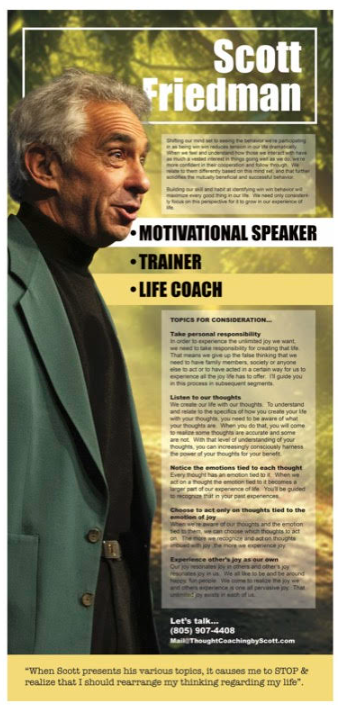
Scott Friedman has maintained a daily meditation practice for over 40 years and has authored 14 books on thought coaching and conscious living. His coaching model is unique: you pay nothing upfront. At the successful conclusion of coaching, you pay what you think it was worth. Learn more about Scott or book a free call.