People sometimes use 'high vibration' to describe feeling more hopeful, connected, or at ease. It is a metaphor, not a medical measure of a person's emotional state. If the phrase is meaningful to you, consider what helps you feel grounded and engaged rather than trying to force a particular feeling.
Let me explain what I mean, because the distinction is the entire answer. The standard teaching on high vibration says that everything is energy, that you vibrate at a frequency, and that you can raise your frequency by doing certain things, thinking certain thoughts, and avoiding certain people and foods. The goal is to resonate at a higher level so that you attract higher-quality experiences. I am not going to dismiss this teaching, because the people teaching it are pointing at a real experience, and the practices they recommend sometimes work. But they work for a different reason than the one being given, and understanding the real reason is what makes the difference between occasionally stumbling into the state and being able to find it reliably.
The research is useful here, even though it uses different language. What people call a high vibration, researchers have studied under names like flow, positive affect, and autonomic coherence. Flow states, documented across decades of research, are characterized by an elevated sense of control, high positive subjective experience, and a co-activation of the parasympathetic and sympathetic branches of the nervous system. A ten-year longitudinal study found that people in flow states were five hundred percent more productive. Research published in Nature found that flow proneness is protective against depression and anxiety. Studies on experienced meditators show increased theta phase-locking in the brain. People who experienced stronger flow during the COVID quarantine had better well-being than those who did not. All of this is describing the same quality that the high-vibration teachers are pointing at. The difference is that the research describes the condition that produces it, and the condition is not a frequency. The condition is a particular relationship between attention and thought.
When Common Advice Falls Short
The standard advice for getting into a high vibration goes like this. Practice gratitude. Spend time in nature. Eat clean food. Avoid negative people. Listen to uplifting music. Meditate. Visualize what you want. Raise your frequency through positive thinking.
Some of these practices are useful, and I will come back to why. But the advice as a whole fails for a specific reason. It treats the high-vibration state as something you produce by adding positive inputs, and it treats the low-vibration state as something you fall into by being exposed to negative inputs. This is the adding model. The problem is that the state people are calling high vibration is not produced by addition. It is produced by subtraction. It is what is left when the thought layer that has been covering it is no longer running. And you cannot subtract a thought layer by adding gratitude lists on top of it. You can only subtract it by seeing it as a thought, which is what withdraws its power to cover the quality underneath.
Here is what I have seen across forty years. A person who practices gratitude to raise their vibration feels better for the duration of the practice, and then the thought layer reactivates, and the state drops. A person who avoids negative people to protect their vibration feels better around the people they have selected, and then the thought layer reactivates in their own company, and the state drops. A person who visualizes to raise their frequency feels elevated during the visualization, and then the thought layer reactivates when the visualization ends, and the state drops. The practices produce a temporary lift because they temporarily redirect attention away from the thought layer. They do not address the thought layer. The thought layer is the problem, and the practices do not touch it. This is why the state is unreliable for people who use the adding model. The state depends on the inputs being present. When the inputs are absent, the state is absent, because the thought layer was never addressed.
There is a second reason the advice fails, and it is the one that matters most. The adding model keeps the person dependent on external conditions for an internal state. If your high vibration depends on clean food, uplifting music, and positive people, then your state is not yours. It belongs to the conditions. The person who understands the real mechanism is not dependent on the conditions, because the state they are accessing is not produced by the conditions. The conditions can support it, but they do not produce it. What produces it is the thinning of the thought layer, and the thinning of the thought layer is an interior event that does not require any particular external condition. This is the difference between a person who can find the state anywhere and a person who can only find it in a curated environment. The first person is free. The second person is managing their environment to compensate for a thought layer they have not addressed.
What May Be Happening
Let me explain what is actually happening, because understanding the mechanism is what makes the state accessible. The quality people call high vibration is the default quality of a human mind when it is not being obstructed by a layer of thought. The mind, when the obstructing layer is thin, naturally settles into a state of clarity, presence, and aliveness. This is not something the mind has to do. This is what the mind does when it is not being interfered with. The interference is the thought layer, and the thought layer is not a perception of reality. It is an interpretation of reality that runs fast and below awareness and feels like a perception.
Consider what happens when you are in nature and you feel what people call a high vibration. The standard teaching says the nature raised your frequency. But the nature did not add anything to you. What happened is that the natural environment gave your mind nothing to argue with, and the thought layer that had been running in the office, the one arguing with deadlines and emails and what someone said, went quiet because it had nothing to work on. The quality that emerged was not produced by the trees. It was produced by the absence of the thought layer that had been covering it. The trees were the condition that allowed the subtraction to happen. They were not the cause of the quality. The cause of the quality was the thinning of the thought layer, and the trees were what made the thinning possible.
This is the mechanism, and understanding it changes everything. The quality is always available, because the mind is always capable of settling when the thought layer thins. The question is not how to raise your vibration. The question is how to thin the thought layer that is covering the quality that people are calling high vibration. And the answer to that question is not an addition. It is a seeing. When you see the thought layer as a thought layer rather than experiencing it as a perception of reality, it thins. Not because you suppressed it. Because a thought that is seen as a thought stops running undetected, and a thought that stops running undetected stops covering the quality underneath.
Three Thought Patterns That Produce the Low State
After forty years, the patterns that cover the quality take a limited number of forms. Here are the three I see most often in people who are trying to get into a high vibration and finding it unreliable.
1. The resistance thought
The thought says: this should not be happening, or this is wrong, or I do not want this. This thought argues with what is happening in the present moment. It is the most common cover over the quality people call high vibration, because it runs almost continuously in most people and it directly obstructs the mind's capacity to settle. The resistance thought can be about anything. It can be about the weather, about traffic, about what someone said, about what the body is doing, about what the mind is doing. The content varies. The mechanism does not. The mechanism is the mind arguing with the present, and the argument is what keeps the mind turbulent, and the turbulence is what covers the quality. When the resistance thought is seen as a thought rather than experienced as a perception, the argument loosens, and the mind settles, and the quality emerges. Not because you made it emerge. Because you stopped arguing with the present, and the mind, no longer interfered with, returned to its natural state.
2. The comparison thought
The thought says: I am not where I should be, or they are further along, or I am not enough. This thought measures the self against a template, and the template is always an ideal, and the actual self always loses the comparison. The comparison thought covers the quality by pulling attention out of the present and into a measurement, and the measurement produces a low state that people then try to raise with gratitude lists and visualizations. But the comparison thought is still running underneath the gratitude list, which is why the gratitude list produces a temporary lift and then fails. When the comparison thought is seen as a thought, the template loses its authority, and the measurement stops, and attention returns to the present, and the quality emerges. The comparison was the cover. Seeing the comparison as a thought is what removes the cover.
3. The threat thought
The thought says: something is wrong, or something is going to go wrong, or I am not safe. This thought interprets neutral stimuli as danger. It is the thought layer that produces the low-grade anxiety that most people carry continuously and mistake for their baseline state. The threat thought covers the quality by keeping the nervous system in a low-grade activation that is incompatible with the settled state people call high vibration. The research on flow is relevant here. Flow requires a particular relationship between the sympathetic and parasympathetic branches of the nervous system, and the threat thought prevents that relationship by keeping the sympathetic branch activated. When the threat thought is seen as a thought, the activation drops, the nervous system settles, and the quality becomes available. Not because you calmed yourself down. Because you stopped believing a thought that was telling you there was something to be activated about.
Ideas Worth Trying
The solution is not a technique for raising a frequency. The solution is a shift in your relationship to the thoughts that have been covering the quality. That shift is not forced. It is what happens when a thought is seen clearly as a thought rather than experienced as a fact. Here is what that looks like in practice.
Step 1: Notice when the quality drops
The quality drops in specific moments. It drops when the resistance thought arrives, or the comparison thought, or the threat thought. The drop feels like a perception of the situation, but it is a thought about the situation. You can learn to catch it. Not by arguing with it. By noticing it. The noticing is what loosens it. You do not need to raise your vibration. You need to see the thought that lowered it. When you see it, it stops running undetected, and the quality returns on its own, because the quality is the default state of a mind that is not being interfered with.
Step 2: Find the thought behind the drop
Every drop has a thought behind it. The thought is usually one of the three above. It is saying this should not be happening, or I am not enough, or something is wrong. The thought is fast. It feels like the situation. But it is a thought about the situation. When you catch the drop, ask what the drop is telling you. The answer is the thought. You do not need to replace the thought with a positive one. You just need to see it as a thought. When you see it, the drop changes, because the drop was the mind responding to the thought, and the mind stops responding the same way once it sees the thought is a thought.
Step 3: Stop trying to add the quality
If you have been trying to raise your vibration by adding practices, understand that the practices are not producing the quality. The practices are temporarily redirecting attention away from the thought layer, which allows the quality to surface for the duration of the redirection. This is why the practices work temporarily and then fail. The quality is not something you add. It is something you uncover by seeing the thought layer that has been covering it. The practices can support the uncovering, but they cannot substitute for it. A person who meditates for an hour and then spends the other twenty-three hours running an unexamined thought layer is not going to live in the quality. A person who sees the thought layer as a thought layer throughout the day is going to live in the quality regardless of whether they meditate, because the quality is the default state of their mind when the layer is not running.
Step 4: Let the quality emerge on its own
The quality does not need to be produced. It needs to be uncovered. When the thought layer thins, the quality emerges, because the quality is what the mind is when it is not being obstructed. You do not have to do anything to make it emerge. You have to stop doing the thing that has been preventing it from emerging, and the thing you have to stop doing is believing the thought layer is a perception of reality rather than a thought about reality. This is the entire practice, and it is the practice I have done for forty years. It is not a practice of addition. It is a practice of subtraction, and the subtraction is done by seeing, not by effort.
What This Is Not
This is not an argument against the practices. Gratitude, time in nature, clean food, uplifting music, and meditation are all useful, and I practice several of them daily. The point is not to stop practicing. The point is to understand what the practices are doing and what they are not doing. The practices are supporting the thinning of the thought layer by redirecting attention and by giving the mind less to argue with. They are not producing the quality. The quality is produced by the thinning, and the thinning is produced by seeing the thought layer as a thought layer. The practices support the seeing. They do not substitute for it.
This is also not an argument that the quality is always available regardless of physical condition. The body and the mind are not separate, and a body that is exhausted, malnourished, or in chronic pain will have a harder time accessing the quality than a body that is rested and cared for. The thought layer and the physical condition interact. Addressing one without the other is incomplete. If your physical condition is the primary obstruction, the first step may be practical, and it may include rest, medical care, or changes in how you are treating the body. Thought coaching addresses the thought layer. It does not address the physical condition. The two are different layers, and both may need attention.
And this is not a replacement for mental health care. If the low state you are trying to lift out of is persistent, severe, or accompanied by symptoms of depression or anxiety, the first step is professional evaluation. What people call a low vibration can be a thought layer, and it can also be a clinical condition, and the two are not always distinguishable from the inside. Thought coaching addresses the thought layer. It does not treat clinical conditions. A licensed therapist or psychiatrist is the right resource for those, and the two approaches can work together.
What This Looks Like in Ventura County
I work with people across Ventura County who are trying to find this quality and finding it unreliable, and the patterns shift by life context. In the spiritual and wellness communities of Ojai, the adding model is dominant. People have been practicing for years, and the practices are producing temporary lifts that are not stabilizing into a reliable state, because the thought layer underneath the practices has not been addressed. In the professional and executive communities around Thousand Oaks and Westlake Village, the comparison thought is the primary cover. People who are high achievers carry a continuous measurement of themselves against where they think they should be, and the measurement produces a low state that no amount of nature time fully resolves, because the measurement is still running in the nature. In the caregiving and service communities around Ventura and Oxnard, the threat thought is common. People who are holding a lot of responsibility carry a continuous low-grade activation that they mistake for their baseline, and the activation covers the quality regardless of how many gratitude practices they do.
The content of the pattern changes by context. The mechanism does not. The mechanism is always a thought layer covering a quality that is already present. The coaching I do does not change by community. We look at the thought layer together. We do not try to replace the thoughts. We bring them into view so they stop covering the quality undetected.
Sessions are by phone or video. You do not need to leave your home. The work is interior, and it can be done from anywhere in the county or anywhere in the country.
How Spiritual Coaching Addresses This
Spiritual coaching, the way I practice it, is non-religious and non-dogmatic. It is not about belief systems, doctrines, or rituals. It is about the direct experience of the quality people are pointing at when they use words like high vibration, presence, or awakening. The work I do addresses the thought layer that has been covering that quality. The thought layer is where I work.
What I do is help you see the thoughts that have been covering the quality. The resistance thought. The comparison thought. The threat thought. Once you see them as thoughts rather than as perceptions of reality, the quality starts to emerge on its own, because the quality is the default state of a mind that is not being obstructed. You do not need to raise anything. You need to stop obscuring what is already there, and you stop obscuring it by seeing the obscuring layer as a thought rather than as a fact. That is the work, and it is the work I have done for forty years.
If you want to explore this, learn more about spiritual coaching or book a free discovery call. You pay nothing upfront. At the successful conclusion of coaching, you pay what you think it was worth. That model exists because I am confident the work works, and I would rather you find out for yourself than take my word for it.
Frequently Asked Questions
How do you get into a high vibration?
The experience people call a high vibration is real, but it is not produced by raising a frequency. It is the default quality of a human mind when a layer of thought is not obstructing it. You access it not by adding practices but by seeing the thought layer that has been covering it. When the thought layer is seen as a thought rather than experienced as a perception, it thins, and the quality emerges on its own. You do not raise anything. You stop obscuring what is already there.
Is high vibration a real frequency?
The frequency framing is a metaphor, not a literal mechanism. What researchers call flow, positive affect, and autonomic coherence describes the same quality the high-vibration teachers are pointing at. Flow states involve a co-activation of the parasympathetic and sympathetic nervous system branches. A ten-year study found people in flow were five hundred percent more productive. Research in Nature found flow proneness is protective against depression and anxiety. The quality is real. The mechanism is a relationship between attention and thought, not a vibrational frequency.
Why does gratitude not keep me in a high vibration?
Gratitude produces a temporary lift because it redirects attention away from the thought layer, which allows the quality to surface for the duration of the redirection. But the thought layer is still running underneath the gratitude practice, which is why the state drops when the practice ends. Gratitude supports the thinning of the thought layer. It does not address the thought layer. The state becomes reliable when the thought layer is seen directly, not when it is temporarily redirected away from.
What are the thoughts that lower your vibration?
Three patterns cover the quality most often. The resistance thought argues with what is happening in the present. The comparison thought measures the self against an ideal and always loses. The threat thought interprets neutral stimuli as danger and keeps the nervous system activated. All three cover the quality by keeping the mind turbulent. Seeing any of them as a thought rather than as a perception is what allows the mind to settle and the quality to emerge.
Do I need to avoid negative people to keep my vibration high?
Avoiding negative people can support the quality by giving the mind less to argue with, but it does not address the thought layer that produces the low state in the first place. A person who has addressed the thought layer can be in any environment without losing the quality, because the quality is not dependent on the environment. A person who has not addressed the thought layer will lose the quality even in a curated environment, because the thought layer is internal and travels with them.
Is a low vibration always a thought problem?
No. The body and the mind are not separate, and a body that is exhausted, malnourished, or in chronic pain will have a harder time accessing the quality. The thought layer and the physical condition interact. If the physical condition is the primary obstruction, the first step may be practical and may include rest, medical care, or changes in how you are treating the body. Thought coaching addresses the thought layer. It does not address the physical condition. Both layers may need attention.
Is this a replacement for therapy or mental health care?
No. If the low state is persistent, severe, or accompanied by symptoms of depression or anxiety, the first step is professional evaluation. What people call a low vibration can be a thought layer, and it can also be a clinical condition, and the two are not always distinguishable from the inside. Thought coaching addresses the thought layer. It does not treat clinical conditions. A licensed therapist or psychiatrist is the right resource for those, and the two approaches can work together.
How much does spiritual coaching cost?
You pay nothing upfront. At the successful conclusion of coaching, you pay what you think the work was worth and what you can afford. There is no set fee. The first discovery call is free and there is no obligation to continue. This model is not a marketing tactic. It is how I have practiced for forty years.
Ready to See What Is Actually Covering the Quality?
If you have been trying to raise your vibration by adding practices, and the state has not become reliable, the reason is not that you have not found the right practice. The reason is that the state is not produced by addition. It is produced by subtraction, and the subtraction is done by seeing the thought layer that has been covering the quality, not by adding more practices on top of it. That thought layer can be seen. And a thought that is seen is a thought that stops covering the quality from below awareness.
If you are ready to stop trying to add your way into the state and start seeing what is actually covering it, book a free discovery call. We will look at the thought together. You will see, probably for the first time, that the quality you have been chasing was never going to be reached by raising a frequency. It was going to be uncovered by seeing the thought that was telling you the present was wrong, or you were not enough, or something was about to go wrong. Seeing it is the work. The work is what changes everything.
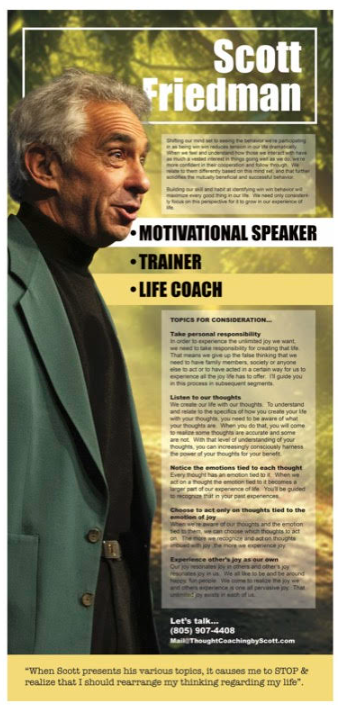
Scott Friedman has maintained a daily meditation practice for over 40 years and has authored 14 books on thought coaching and conscious living. His spiritual coaching is non-religious and non-dogmatic. You pay nothing upfront. At the successful conclusion of coaching, you pay what you think it was worth. Learn more about Scott or book a free call.