After forty years of coaching people who feel other people's emotions so strongly that they cannot tell which feelings are their own, I can tell you the answer directly. You are not absorbing other people's emotions. You are absorbing thoughts you are mistaking for other people's emotions. The experience feels identical from the inside, which is why the standard advice never works. The standard advice treats the problem as an energy problem or a boundary problem. The problem is a thought problem. And a thought can be seen.
Let me be careful with that first sentence, because it is the one that will sound wrong to anyone who has lived this experience for decades. I am not saying your experience is not real. The heaviness you feel after a conversation with someone who is struggling is real. The anxiety that rises in you when you walk into a room where people are tense is real. The exhaustion that follows a day of being around other people's distress is real. I am saying the mechanism producing those experiences is not what you think it is, and because the mechanism is different, the solution is different. What you have been calling absorption is a thought you are obeying without knowing it is a thought. When you see it as a thought, the absorption stops. Not because you built a wall. Because the thing that was producing the wall's necessity is no longer running.
Why the Standard Advice Fails
The standard advice for people who absorb others' emotions goes like this. You build energetic shields. You visualize a protective barrier around yourself. You cut energetic cords. You set firmer boundaries. You limit contact with draining people. You practice grounding exercises.
This advice treats the problem as something coming at you from outside that you need to defend against. It assumes emotions are substances that travel through space and attach to people, and that sensitive people are more permeable to these substances. The advice is intuitive. It matches the felt experience, which is that you feel fine before the interaction and heavy after it, so something must have come at you during it. The advice is also wrong about the mechanism, and because it is wrong about the mechanism, it produces a life of constant defense rather than actual freedom.
Here is what I have seen across forty years. A person who is told to build shields spends the rest of their life building shields. The shields work for a while, in the sense that the person feels less overwhelmed. But the person has to maintain the shields constantly. The shields become a second job. The person cannot relax around other people because relaxing would mean dropping the shield. Their relationships become more guarded. Their empathy, which was a genuine capacity, becomes something they are afraid of. They have not solved the problem. They have built a permanent defense against a problem they still do not understand.
The boundary advice has the same issue. Telling someone to set firmer boundaries with draining people assumes the draining is coming from the other person. Sometimes it is. But the person who feels drained after every conversation, including conversations with people who are not draining, is not being drained by other people. They are being drained by a thought they are running in every conversation. The boundary advice does not address the thought. It just reduces the number of conversations in which the thought runs. That is a smaller life, not a freer one.
What Is Actually Happening When You Feel Someone Else's Emotion
Let me explain the mechanism, because understanding it is what makes the solution possible. Research on emotional contagion, beginning with the work of Elaine Hatfield and her colleagues in the 1990s, established that people automatically mimic and align with the emotional expressions of people around them. This happens through mirror neuron systems and autonomic nervous system responses that activate when you observe someone else's emotional state. The mimicry is real. The physiological alignment is real. This is why you feel something in your body when someone near you is upset. Your nervous system is responding to their state.
But here is the part the standard advice misses. The physiological response is not the absorption. The absorption is what happens next, in thought, and it happens so fast you do not experience it as a thought. The sequence is this. You perceive that someone is upset. Your body responds with a subtle physiological shift. A thought arises, something like "they are upset and I am now feeling what they are feeling" or "their emotion has entered me" or simply "I am upset now." The thought is not examined. It is obeyed. And the obeying is what turns a physiological response into an emotional absorption. The body shifted. The thought said the shift means you are now carrying their emotion. You believed the thought. The emotion became yours.
The difference between a person who feels someone else's distress as information and a person who absorbs it as their own is not sensitivity. Both people have the same physiological response. The difference is the thought that arises after the response. The first person's thought says "they are upset, and I am noticing that in my body." The second person's thought says "they are upset, and I am now upset, and I cannot stop being upset until they stop." The first thought produces empathy. The second thought produces absorption. The physiological input is the same. The thought about the input is different. That thought is the entire mechanism, and it is the thing no one has taught you to look at.
The Thought Patterns That Produce Absorption
After forty years, I can tell you that the patterns take a limited number of forms. Here are the four I see most often in people who feel others' emotions as their own.
1. The merger thought
The thought says: "their emotional state and my emotional state are the same thing. If they are upset, I am upset." This thought produces a complete collapse of the boundary between self and other at the emotional level. The person does not experience themselves as a separate being who is perceiving another being. They experience themselves as an extension of the other person's emotional field. When the other person's state shifts, the person's state shifts, and the person experiences this as evidence that the merger is real. It is not evidence. It is the thought being obeyed repeatedly until it feels like a law. When the thought is seen as a thought, the merger dissolves. The person can feel the other person's state without becoming it. Empathy remains. Absorption stops.
2. The responsibility thought
The thought says: "if they are upset and I am not upset, I am not caring for them properly. My distress is proof of my compassion." This thought turns absorption into a moral position. The person believes that feeling the other person's pain is what love looks like. They resist letting go of the absorption because letting go would mean they do not care. This is the cruelest pattern, because it locks the person into suffering as a condition of love. The thought has it exactly backwards. Compassion does not require joining someone in their distress. It requires being present with them in it. Presence is harder when you are as overwhelmed as they are. The most useful thing you can bring to someone who is suffering is a steady state, not a merged one. When the responsibility thought is seen as a thought, the person can care fully without collapsing into the other person's state. Their compassion deepens. Their suffering decreases. The two were never the same thing, but the thought made them feel inseparable.
3. The identity thought
The thought says: "I am an empath. Absorbing is what I do. It is who I am." This thought turns a pattern into a self. The person has adopted the label as an identity, and the identity now maintains the pattern, because letting go of the pattern would mean letting go of the self. This is why people who identify as empaths often resist the idea that absorption is optional. If it is optional, the identity is not fixed, and that is disorienting for a person who has built their self-understanding around the trait. The identity thought is not malicious. It is a person trying to make sense of a real experience. But the label solidifies the pattern by making it feel like a constitution rather than a conditioning. When the thought is seen as a thought, the person can keep their sensitivity without being defined by its painful expression. They are still sensitive. They are no longer fused.
4. The sponge thought
The thought says: "I am a sponge. I cannot help absorbing. It is just how I am wired." This thought is a resignation. It says the pattern is a hardware problem, so no software change will help. The person stops looking for a real solution and instead manages the symptoms through avoidance, shielding, and recovery time. The sponge thought is self-fulfilling. Because the person believes they cannot help absorbing, they do not examine the thoughts that produce the absorption, so the absorption continues, which confirms the thought. When the thought is seen as a thought, the person discovers that the wiring is not the problem. The thought about the wiring is the problem. The absorption decreases not because the person became less sensitive but because they stopped obeying the thought that said the absorption was inevitable.
What Actually Works
The solution is not a technique you apply in the moment. The solution is a shift in your relationship to the thoughts that produce the absorption. That shift is not forced. It is what happens when a thought is seen clearly as a thought rather than experienced as a fact. Here is what that looks like in practice.
Step 1: Notice the physiological response without interpreting it
When you are near someone who is upset, your body will respond. This is normal. This is the mirror neuron system doing what it does. The response is information. It tells you something about the other person's state. The mistake is not the response. The mistake is the thought that arises immediately after it, the one that says the response means you are now carrying their emotion. When you can notice the bodily response and let it be a response rather than a merger, the absorption does not happen. The body shifts. The shift is felt. The shift is not obeyed as a new emotional state. It passes. You remain you.
Step 2: See the merger thought when it arises
The thought that says "their emotion is now my emotion" arises fast. It has arisen thousands of times. It feels like perception rather than thought. But it is a thought. You can learn to catch it. Not by fighting it. By noticing it. The noticing is what loosens it. You do not need to replace it with a better thought. You do not need to argue with it. You just need to see it as a thought instead of as a fact. When you see it, it loses its authority. The body still responds. The merger does not happen.
Step 3: Separate compassion from absorption
The deepest shift is the one around the responsibility thought. When you see that compassion and absorption are not the same thing, everything changes. You can be fully present with someone who is suffering without joining them in the suffering. Your presence is more useful to them than your merger would be, because a merged person cannot help. They can only suffer alongside. A present person can listen, can respond, can hold space. The responsibility thought says absorption is love. Seeing through it reveals that absorption is actually a less effective form of love, because it removes your capacity to be the steady presence the other person needs.
Step 4: Let the label go
You do not need to stop being sensitive. You need to stop being defined by the painful expression of sensitivity. The label of empath or sponge is a thought about who you are. It is not who you are. You are a person with a sensitive nervous system and a pattern of thoughts that has been turning that sensitivity into suffering. When the label is seen as a thought, the sensitivity remains and the suffering decreases. You do not lose anything real. You lose a story that was costing you.
What This Is Not
This is not an argument against empathy. Empathy is a real and valuable capacity. The capacity to feel what others are feeling, at the physiological level, is part of being human and it is part of what makes relationships work. What I am pointing at is not the absence of empathy. It is the presence of a thought that turns empathy into absorption. Empathy is feeling someone's state as information. Absorption is taking their state as your own. The first is a gift. The second is a pattern. The difference is a thought, and the thought can be seen.
This is also not an argument that you should not limit contact with people who are genuinely harmful to you. Some relationships are draining because the other person is manipulative, abusive, or relentlessly negative. Reducing contact in those cases is wise. But if you find that you are drained by every relationship, including healthy ones, the problem is not the relationships. The problem is the thought you are running in all of them. No amount of contact reduction solves a thought that travels with you.
What This Looks Like in Ventura County
I work with people across Ventura County who carry this pattern, and it shows up in every context. In the healthcare and caregiving professions concentrated around Ventura and Oxnard, the responsibility thought is dominant. People who entered the field out of genuine compassion have been absorbing patient distress for years and are now burning out, and they believe the burnout is the price of caring. It is not. It is the price of a thought that equates caring with merging. In the helping professions and education sectors across Camarillo and Thousand Oaks, the merger thought runs through the work. Therapists, teachers, and social workers go home carrying the emotional weight of everyone they saw that day, and they believe this is unavoidable. It is not. It is a pattern, and patterns can be seen through. In the creative and healing arts communities of Ojai, the identity thought is common. People have built a self-understanding around being an empath or a sensitive, and the identity maintains the pattern because letting go of the pattern would feel like letting go of the self.
The content of the pattern changes by context. The mechanism does not. The mechanism is always the same. A physiological response occurs, a thought arises that interprets the response as absorption, the thought is obeyed, and the person experiences the other's state as their own. The coaching I do does not change by profession. We look at the thought layer together. We do not try to replace the thoughts. We bring them into view so they stop producing absorption undetected.
Sessions are by phone or video. You do not need to leave your home. The work is interior, and it can be done from anywhere in the county or anywhere in the country.
How Spiritual Coaching Addresses Emotional Absorption
Spiritual coaching, the way I practice it, is not about energy work, shielding, or cutting cords. I am not going to teach you to visualize protective barriers or clear your energetic field. Those approaches treat the symptom and require constant maintenance. They also keep your attention on the level of the problem rather than the level of the solution. The solution is not on the energy level. It is on the thought level, and the thought level is where I work.
What I do is help you see the thoughts that have been producing the absorption. The merger thought. The responsibility thought. The identity thought. The sponge thought. Once you see them as thoughts rather than as facts about your nature, the absorption starts to decrease on its own. Not because you built a shield. Because the thing that made the shield necessary is no longer running. Your sensitivity remains. Your compassion deepens. The suffering that came with them falls away. That is the work, and it is the work I have done for forty years.
If you want to explore this, learn more about spiritual coaching or book a free discovery call. You pay nothing upfront. At the successful conclusion of coaching, you pay what you think it was worth. That model exists because I am confident the work works, and I would rather you find out for yourself than take my word for it.
Frequently Asked Questions
How do I stop absorbing other people's emotions?
You stop by seeing the thoughts that produce the absorption. The absorption is not caused by energy entering you. It is caused by a thought that arises after your body responds to someone else's state, a thought that says their emotion is now your emotion. When that thought is seen as a thought rather than experienced as a fact, the absorption stops. Your sensitivity remains. The suffering decreases. The mechanism is thought, and thought can be seen.
Am I really an empath, or is something else happening?
You may have a sensitive nervous system that responds strongly to others' emotional states. That is real. What is not real is the idea that this sensitivity requires you to absorb. The label of empath is a thought about who you are. It can be useful as a description. It becomes a problem when it becomes an identity that maintains the absorption. You can keep your sensitivity without being defined by its painful expression.
Do shields and visualization techniques work?
They can reduce overwhelm in the short term, but they require constant maintenance and they keep your attention on the level of the problem. They treat the absorption as something coming at you from outside. The absorption is actually produced by a thought inside you. When the thought is seen, the shield becomes unnecessary because the thing that made it necessary is no longer running.
Is it wrong to feel other people's emotions strongly?
No. Feeling others' emotions strongly is part of empathy, and empathy is valuable. The problem is not the feeling. The problem is the thought that turns the feeling into absorption. Empathy is feeling someone's state as information. Absorption is taking their state as your own. The first is a gift. The second is a pattern. You can have the first without the second.
Can I be compassionate without absorbing someone's pain?
Yes, and you will be more compassionate, not less. Absorption actually reduces your capacity to help because it makes you as overwhelmed as the person you are with. A steady presence is more useful to someone who is suffering than a merged state. Compassion and absorption are not the same thing. Seeing that they are different is what allows you to care fully without collapsing.
Is this different from therapy for empathy overload?
Therapy can help with the emotional consequences of chronic absorption and with boundary patterns. Thought coaching goes to the level of the thoughts that produce the absorption in the first place. When those thoughts are seen, the absorption decreases without requiring constant boundary management. The two approaches can complement each other. This is not a replacement for clinical mental health care.
Do you work with people outside Ventura County?
Yes. Sessions are by phone or video. I work with people across the country. The thought patterns I see in Ojai are the same patterns I see in people in New York, Chicago, and Seattle. The context varies. The mechanism does not.
How much does spiritual coaching cost?
You pay nothing upfront. At the successful conclusion of coaching, you pay what you think the work was worth and what you can afford. There is no set fee. The first discovery call is free and there is no obligation to continue. This model is not a marketing tactic. It is how I have practiced for forty years.
Ready to See What Is Actually Producing the Absorption?
If you have been building shields, cutting cords, limiting contact, and still feeling other people's emotions as your own, the reason is not that your shields are not strong enough. The reason is that the absorption is not produced by energy coming at you. It is produced by thoughts inside you that you have never been taught to look at. Those thoughts are not permanent. They are just unseen. And a thought can be seen.
If you are ready to stop defending against a problem you do not understand and start seeing what is actually producing it, book a free discovery call. We will look at the thought layer together. You will see, probably for the first time, that the absorption you have been fighting for years is being produced by thoughts you did not know you were having. Seeing them is the work. The work is what changes everything.
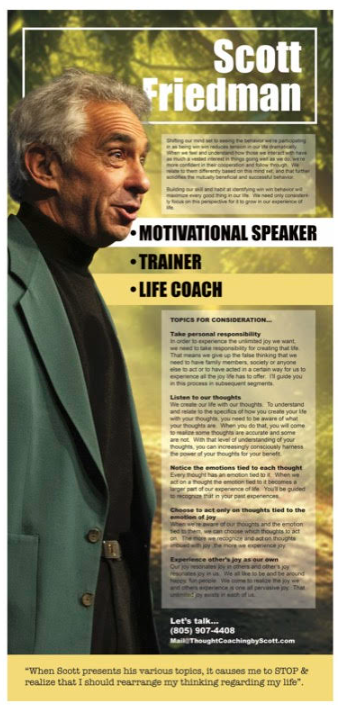
Scott Friedman has maintained a daily meditation practice for over 40 years and has authored 14 books on thought coaching and conscious living. His spiritual coaching model is unique: you pay nothing upfront. At the successful conclusion of coaching, you pay what you think it was worth. Learn more about Scott or book a free call.