After forty years of coaching people who ask this question, I can tell you the answer directly. The obstacle to increasing your self-worth is almost never what you think it is. It is not a lack of achievement. You have already accomplished more than enough to feel worthy. It is not a lack of positive thinking. You have probably read the books and repeated the affirmations. The obstacle is a specific set of thought patterns running below the level of your awareness, directing how you evaluate yourself in ways you cannot see, and producing a sense of inadequacy you keep attributing to not being far enough along.
Until you see those patterns, no achievement produces lasting worth. Once you see them, the worth you already have stops being hidden from you.
The Question Has a Flaw in It
The question "how do I increase my self-worth" contains an assumption that is worth examining before you try to answer it. The assumption is that your self-worth is currently low and needs to be raised. That assumption is produced by a thought. The thought is: "I am not worth enough yet."
Here is what I have seen across forty years of sitting with people in this exact conversation. The worth is not low. The worth is not missing. The worth is being covered by a layer of thought that tells you it is conditional. The thought says: you are worth what you produce, what you earn, what you weigh, what you own, what other people think of you, what you have achieved relative to whoever you are comparing yourself to. That thought is not true. But it feels true because it runs automatically, below awareness, and you have been obeying it for so long that you experience its conclusions as perception rather than thought.
So the real question is not how to increase your self-worth. The real question is how to stop covering the worth you already have with conditions that were never yours to begin with.
Self-Worth Is Not What You Think It Is
Most people use self-worth and self-esteem interchangeably. They are not the same thing, and the difference matters.
Self-esteem is evaluative. It goes up when you succeed and down when you fail. It is tied to outcomes. If you base your sense of yourself on self-esteem, you are on a roller coaster that you do not control. The roller coaster goes up and down based on events, and you are left trying to manage your interior state from the outside.
Self-worth is different. Self-worth is the recognition that your value as a person is not produced by anything. It is not earned. It is not achieved. It is not granted by other people. It is not contingent on your performance, your appearance, your income, your relationship status, or your productivity. It is intrinsic. It is already present. The reason you cannot feel it is not that it is absent. The reason you cannot feel it is that a layer of thought is standing between you and it, telling you that worth must be earned and that you have not earned enough of it yet.
This is why people who achieve extraordinary things still feel inadequate. The achievement raised their self-esteem temporarily. It did not touch the thought layer that says worth is conditional. So the esteem fades, the thought layer reasserts itself, and the person is back where they started, looking for the next achievement to feel okay.
| Self-Esteem | Self-Worth |
|---|---|
| Goes up and down based on outcomes | Stable because it is not based on outcomes |
| Earned through achievement | Already present, not earned |
| Depends on comparison to others | Independent of comparison |
| Temporary; fades after the event | Constant; only hidden by thought |
| Managed from the outside in | Uncovered from the inside out |
| Can be damaged by failure | Cannot be damaged by anything |
What Is Actually Running Underneath
Let me be specific about what I mean by "the thought layer" because the phrase gets used vaguely and I do not mean it vaguely. Every evaluation you make of yourself is preceded by a thought. Most of those thoughts are automatic. You do not choose them. They arise, you believe them, and you experience the resulting feeling as your own honest assessment of yourself. But the thought came first, and the thought was produced by a pattern, and the pattern was formed by your history.
Here is an example I have seen hundreds of times. A person finishes a project at work. It goes well. They receive genuine praise. For a few hours they feel good. Then a thought arises: "They are just being nice. The work was not that good. If they really knew what I was capable of, they would not be impressed." The feeling of worth drops. The person assumes the drop is an accurate reading of reality. They assume they are seeing themselves clearly. What actually happened is that an automatic thought arose, produced by a pattern formed earlier in their life, and they mistook the thought for perception.
The pattern was likely formed decades ago. Maybe a parent who could not give praise without qualification. Maybe a school environment where nothing was ever quite enough. Maybe a cultural message that worth is earned through productivity. The origin does not matter as much as you might think. What matters is that the pattern is still running, it is producing thoughts that feel like perception, and you are obeying those thoughts as if they were facts.
Three Thought Patterns That Cap Your Worth
After forty years, I can tell you that the patterns take a limited number of forms. Here are the three I see most often.
1. Worth as achievement
The thought says: "I am worth what I produce." This is the most common pattern among the professionals I work with in Ventura County. The thought runs quietly in the background of every workday. When you produce, you feel worthy. When you do not, you feel like a burden. The problem is not the producing. The problem is that your worth has been attached to it. When the producing stops, the worth does not go away. The thought telling you it went away is what you are feeling. The worth itself was never contingent on the producing. You just learned to believe it was.
2. Worth as comparison
The thought says: "I am worth more or less than the person next to me." This pattern is intensified by social media, but it existed long before. The thought automatically ranks you against others and produces a feeling based on where you land. If you land above, you feel a temporary swell. If you land below, you feel a deflation. Both feelings are produced by thought, not by reality. The ranking itself is a thought. Your worth is not a position on a ladder. The ladder is a mental construction. You are not on it. You only think you are.
3. Worth as approval
The thought says: "I am worth what other people think of me." This pattern makes your interior state dependent on the interior states of others, which you cannot actually read. You guess what they think, and your guess is usually wrong, and your worth fluctuates based on the guess. The pattern is exhausting because the variable you are tracking, other people's opinions, is both invisible and constantly shifting. You can never get stable because you are measuring yourself against something you cannot measure.
Why Affirmations and Positive Thinking Do Not Work
If you have tried to increase your self-worth through affirmations, you have probably noticed the problem. You repeat "I am worthy" and a voice in your head says "no you are not." You repeat it louder. The voice gets louder. You try to override the negative thought with a positive one. The negative thought wins because it has more evidence behind it, or at least it feels like it does.
Affirmations fail because they fight the thought layer instead of seeing it. Fighting a thought strengthens it. The act of fighting confirms that the thought has power worth fighting. The thought says "you are not worthy" and you respond with "yes I am" and the argument is now about whether the thought is true. The argument itself keeps the thought in the center of your attention. You cannot get rid of a thought by arguing with it. You can only get rid of its grip by seeing it as a thought.
This is the core of thought coaching. A thought is a thought. It may or may not be true. Most of the thoughts that cap your self-worth are not true. But their truth or falsity is not the point. The point is that they are thoughts, not perceptions. When you see a thought as a thought, its grip loosens. Not because you fought it. Because you stopped treating it as a fact.
What Actually Moves Self-Worth
Nothing moves self-worth because it does not need to be moved. It needs to be uncovered. The uncovering happens through awareness, not effort. Here is what that looks like in practice.
The next time a thought arises that says you are not enough, do not argue with it. Do not replace it with a positive thought. Do not try to push it away. Just look at it. Notice that it is a thought. Notice that it arose on its own. Notice that you did not choose it. Notice that it feels like perception but it is not perception. It is a mental event. It has no more authority than any other mental event. The only authority it has is the authority you give it by believing it.
This sounds simple. It is simple. Simple does not mean easy. The pattern has been running for decades. It will not stop running because you saw through it once. But each time you see through it, the pattern weakens. Not because you weakened it. Because it cannot survive being seen. It depends on being mistaken for perception. The moment it is recognized as thought, it loses its primary mechanism of control.
Five Shifts That Change How You See Yourself
These are not techniques. They are shifts in understanding. Each one removes a condition that has been placed on your worth.
Shift 1: Stop trying to earn what you already have
The effort to earn worth is the thing hiding it. You are working to acquire something that is not acquirable because it is not absent. The effort itself implies that the worth is not yet present, which reinforces the thought that it is missing. When you stop trying to earn it, the trying drops, and what was always there becomes visible. This is counterintuitive. The mind says "but I have to do something." The doing is the obstacle.
Shift 2: See the comparison thought as a thought
The next time you compare yourself to someone and feel worse, look at the comparison itself. The comparison is a thought. You did not choose to make it. It arose. The feeling of being worse followed the thought, not the reality. The person you are comparing yourself to has their own thought layer producing the same inadequacy. You are comparing your interior to their exterior. The comparison is not real. It is a mental event. Seeing it as a mental event is what dissolves its grip.
Shift 3: Notice that the worth feeling comes and goes
If your worth were actually contingent on achievement, it would be stable when you were achieving and absent when you were not. But it does not work that way. The feeling of worth comes and goes regardless of what you are doing. Sometimes you feel worthy while doing nothing. Sometimes you feel unworthy while achieving. This inconsistency proves the worth is not tied to the doing. The fluctuation is in the thought layer, not in the worth itself. The worth is the constant. The thoughts about it are the variable.
Shift 4: Stop defending
When someone criticizes you, notice the impulse to defend. The impulse comes from a thought that says "their criticism can damage my worth." It cannot. Nothing can damage your worth. The defense is an attempt to protect something that needs no protection. The defense also confirms that you believe the criticism has the power to hurt you, which strengthens the thought that your worth is in other people's hands. When you stop defending, you are not accepting the criticism as true. You are refusing to engage with the premise that your worth is on trial.
Shift 5: Let the inadequate feeling be there without acting on it
The feeling of inadequacy is uncomfortable. The instinct is to fix it, usually by achieving something, seeking approval, or distracting yourself. Each of those responses confirms that the feeling is a signal about your actual worth. It is not a signal. It is a feeling produced by a thought. When you let the feeling sit without acting on it, without fixing it, without running from it, it loses its urgency. Not because you suppressed it. Because you stopped fueling it with the belief that it means something about you.
What This Looks Like in Ventura County
I work with people across Ventura County, from Camarillo to Thousand Oaks to Ojai, and the patterns I am describing show up in every community. In the biotech corridor of Thousand Oaks, the achievement pattern is dominant. Worth is tied to title, compensation, and organizational standing. In the creative and wellness communities of Ojai, the comparison pattern takes a different form. Worth is tied to how spiritually advanced you appear, how conscious your language sounds, how far along the path you seem to be relative to others on the same path. In the agricultural and working-class communities of Santa Paula and Fillmore, the approval pattern often runs through family and community expectations that are never explicitly stated but felt constantly.
The specific content of the thought layer changes by context. The mechanism does not. The mechanism is always the same: a thought arises, it is mistaken for perception, and worth is experienced as conditional when it is not. The coaching I do is the same regardless of which community you are in. We look at the thought layer together. We do not try to replace the thoughts. We do not try to fix the past. We simply bring the thoughts into view so they stop running undetected.
Sessions are by phone or video. You do not need to drive anywhere. The work is interior, and it can be done from anywhere in the county or anywhere in the country.
How Life Coaching Addresses Self-Worth
Life coaching, the way I practice it, is not advice. I am not going to tell you to make a gratitude list or repeat positive statements or visualize success. Those approaches treat the symptom. They try to produce a better feeling to replace the inadequate feeling. The inadequate feeling is not the problem. The thought producing it is the problem, and the thought is not addressable by replacing it with a different thought.
What I do is help you see the thought layer that has been running your evaluation of yourself. Once you see it, it starts to lose its grip on its own. Not because I tell you it should. Because that is what happens when a thought is seen as a thought instead of experienced as reality. The coaching is not about adding anything to you. It is about removing the obstruction to what is already there.
If you want to explore this, learn more about life coaching or book a free discovery call. You pay nothing upfront. At the successful conclusion of coaching, you pay what you think it was worth. That model exists because I am confident that what I do works, and I would rather you find out for yourself than take my word for it.
Frequently Asked Questions
Can you increase self-worth, or is it fixed?
Self-worth is not fixed and it is not something you increase. It is something you uncover. The worth is already there. What changes is your ability to see it, which happens when the thought layer covering it is recognized as thought rather than perception. This is not a semantic distinction. It is the difference between spending your life trying to earn something you already have and simply having it.
How long does it take to see a difference?
Some people see through a pattern in the first conversation. For others, it takes several sessions of looking before the pattern starts to loosen. The timeline is not about the worth, which does not change. It is about how entrenched the thought layer is and how willing you are to look at it honestly. Most people notice a shift within the first few sessions, not because the worth increased, but because the covering thinned.
What if my low self-worth comes from real trauma?
Thought coaching does not replace therapy. If you have experienced trauma that requires clinical treatment, you should work with a licensed therapist. What I can tell you is that the mechanism is the same regardless of the origin. A thought arises from the experience, it is mistaken for perception, and it produces a feeling of inadequacy. Seeing the thought as a thought does not erase the experience. It removes the experience's ongoing ability to define your worth in the present.
Is this the same as self-compassion?
Self-compassion is a related practice and a useful one. It involves treating yourself with kindness. Thought coaching goes one step further. It asks where the harshness is coming from. The harshness is coming from thought. Self-compassion adds kindness to counterbalance the harshness. Thought coaching removes the harshness at its source by seeing it as thought. Both are valuable. They address different layers.
Do you work with people outside Ventura County?
Yes. Sessions are by phone or video. I work with clients across the country. The thought layer does not change by geography. The patterns I see in Camarillo are the same patterns I see in clients in New York, Chicago, and Seattle. The content varies. The mechanism does not.
How much does life coaching cost?
You pay nothing upfront. At the successful conclusion of coaching, you pay what you think the work was worth and what you can afford. There is no set fee. The first discovery call is free and there is no obligation to continue. This model is not a marketing tactic. It is how I have practiced for forty years.
Ready to Look at What Is Actually Happening?
If you have been trying to increase your self-worth through achievement, approval, or positive thinking, and none of it has produced lasting change, the reason is not that you have not tried hard enough. The reason is that you have been working on the wrong layer. The worth is not the problem. The thought covering it is the problem. And the thought is not addressable by effort. It is addressable by awareness.
If you are ready to stop trying to earn what you already have, book a free discovery call. We will look at what is actually running underneath. You will see, probably for the first time, that the inadequacy you have been feeling is not a fact about you. It is a thought. And a thought is just a thought.
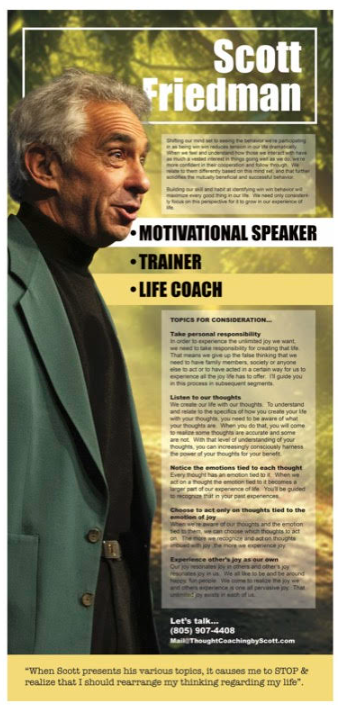
Scott Friedman has maintained a daily meditation practice for over 40 years and has authored 14 books on thought coaching and conscious living. His coaching model is unique: you pay nothing upfront. At the successful conclusion of coaching, you pay what you think it was worth. Learn more about Scott or book a free call.