Wanting life to improve sooner is understandable. It may help to separate urgent financial needs from goals that take time, and to identify one realistic step you can take now. There is room for ambition and patience without pretending that every delay is merely a thinking problem.
Let me explain what I mean, because the distinction is the answer. The standard framing says that people who want money fast are being impatient, and that impatience is a character flaw that discipline and delayed gratification will correct. The research tells a more useful story. A 2023 study published by the American Psychological Association found that when people feel their resources are scarce, they do not become irrational or shortsighted. They make reasonable decisions based on their circumstances. They prioritize short-term gains over long-term gains only when the scarcity threatens an immediate need. When the scarcity is about a longer-term need, they do not become more impatient. The researchers concluded that scarcity, on its own, does not cause greater impatience. What causes the urgency is the perception of what is threatened.
This changes the entire question. The person asking how to get money and a better life without waiting a lifetime is not failing at patience. They are responding, reasonably, to a thought that is telling them something is threatened. The thought says the present is unacceptable, or they are behind, or the better life is located in the future and the present is the obstacle to it. The urgency is the mind responding to that thought the way it responds to any perceived threat, which is to seek resolution now. The problem is not the urgency. The problem is the thought producing the urgency. And you cannot fix a thought problem with discipline, because discipline does not address the thought. Discipline addresses the behavior. The behavior is not the problem. The thought driving the behavior is the problem.
When Common Advice Falls Short
The standard advice for someone who wants money and a better life fast goes like this. Be patient. Delay gratification. Play the long game. Start early and let compounding work. Invest consistently. Live below your means. Avoid get-rich-quick schemes. Build the habits that produce wealth over decades.
Some of this advice is financially accurate. Compounding does work. Time is the most reliable ally of long-term wealth building. The marshmallow test and decades of follow-up research have shown that the capacity to delay gratification correlates with better life outcomes, including higher income. None of this is wrong. The problem is that the advice assumes the person hearing it is a person who can simply choose to be patient, and the person asking the question is not that person. The person asking the question is a person whose present experience has been rendered unacceptable by a thought layer, and the patience the advice recommends requires them to remain in an unacceptable present for decades. That is not a reasonable ask, and the mind will not do it. The mind will continue generating urgency until the thought producing the urgency is addressed.
Here is what I have seen across forty years. A person who is told to be patient tries to be patient, and the patience lasts until the thought layer reactivates, at which point the urgency returns and the patience collapses. A person who is told to delay gratification delays gratification for a while, and then the thought layer says the delay is the problem, and they break the delay with a decision that sets them back. A person who is told to play the long game starts playing the long game, and the thought layer says the long game is too long, and they abandon it for a short game that promises faster results. The advice fails because it treats the urgency as the problem. The urgency is not the problem. The urgency is the symptom. The thought producing the urgency is the problem, and the advice does not address it.
There is a second reason the advice fails, and it is the one that matters most. The advice assumes the better life is in the future and that money is the bridge to it. The person who believes this spends their present building a bridge to a future they cannot reach, because the future is not a place you reach. The future is a direction. The better life, if it is going to exist, exists in the present, or it does not exist at all. The person who postpones the better life to the future arrives at the future and finds that the future has become the present, and the thought layer that made the present unacceptable is still running, and it makes the new present unacceptable too. The advice does not address this. It gives the person a project, which is building wealth, and it does not address the thought layer that is making the project feel like a prison sentence rather than a choice.
What May Be Happening
Let me explain what is actually happening, because understanding the mechanism is what makes the solution possible. The urgency is being produced by a thought layer that is interpreting the present as unacceptable and the future as the location of the acceptable. The thought layer is not a perception of reality. It is an interpretation of reality. The interpretation feels like a perception because it runs fast and below awareness, but it is a thought, and a thought can be seen. When the thought is seen as a thought rather than experienced as a perception, the urgency changes. Not because you disciplined it. Because the thing producing it is no longer producing it undetected.
Consider what happens when you are building something that takes time. You are saving, or you are building a business, or you are developing a skill that will increase your income. At the start, the project feels fine. You are doing the work. The work is the work. Then a thought arrives. The thought says this is taking too long, or you should be further along by now, or other people are further along. The project has not changed. The work has not changed. What changed is the thought layer. The thought layer arrived and interpreted the present as insufficient, and you experienced the interpretation as a quality of the present rather than as a thought about the present. The urgency is the mind responding to the interpretation. The interpretation is the problem, not the timeline.
This is the mechanism. The urgency is not produced by the timeline. The urgency is produced by a thought about the timeline. The timeline is neutral. The thought is what gives the timeline the quality of being too long or too slow. When the thought is seen as a thought rather than experienced as a perception, the timeline stops being experienced as a threat, and the urgency drops, and the work continues without the suffering. Not because you became patient. Because you stopped believing a thought that was manufacturing impatience.
Three Thought Patterns That Produce the Urgency
After forty years, the patterns take a limited number of forms. Here are the three I see most often in people who want money and a better life without waiting.
1. The "I am behind" thought
The thought says: I should be further along by now, and the distance between where I am and where I should be is the problem. This thought operates by holding a template of where you should be at your age or stage, usually derived from what you see of other people or from an expectation you set years ago, and then comparing your actual position to that template. The actual position always loses the comparison, because the template is an ideal and the actual position is real. The thought then produces urgency as the response to the gap. But the gap is not real. The template is a thought. The actual position is where you are, and where you are is the only place from which anything can be built. When the "I am behind" thought is seen as a thought, the template loses its authority, and the actual position stops being experienced as a deficit. The urgency drops, because the urgency was the response to a gap that the thought was manufacturing. The building continues. It continues better, because it is no longer being driven by the suffering of a false comparison.
2. The "present is unacceptable" thought
The thought says: this present is not the life I want, and the future is where the life I want is located. This thought turns the present into a waiting room. The person carrying this thought experiences their current life as a thing to be endured rather than lived, and they experience the future as the location of the real life. The urgency is the mind trying to escape the waiting room. But the future is not a location. The future is a direction. And the present is not a waiting room. The present is the only place where life is actually happening. The person who postpones the better life to the future is not building a bridge to the better life. They are training themselves to experience every present as unacceptable, and they will arrive at the future and find that the training has made the future unacceptable too. When the "present is unacceptable" thought is seen as a thought, the present stops being a waiting room, and the better life, or the beginnings of it, becomes available in the present, which is the only place it was ever going to be available.
3. The "money produces the better life" thought
The thought says: the better life is produced by money, and therefore the speed of getting money is the speed of getting the better life. This thought treats money as the cause of the better life and the better life as the effect. It makes the urgency about money feel rational, because if money produces the better life, then getting money faster gets you the better life faster. But money does not produce the better life. Money removes certain obstacles. It does not produce the qualities that make a life good. The research on this is consistent. Beyond a point where basic needs are met, the correlation between income and life satisfaction is weaker than most people assume. The qualities that make a life good, things like presence, alignment, connection, meaning, are not produced by money. They are available regardless of money, and they are often more available when the thought layer that is chasing money is not running. When the "money produces the better life" thought is seen as a thought, the urgency about money drops, because the mind stops believing that the better life is locked behind a financial threshold. The building of wealth continues, if that is what you want to do. But it continues without the suffering of believing the better life is on the other side of a number you have not yet reached.
Ideas Worth Trying
The solution is not a technique for becoming patient. The solution is a shift in your relationship to the thoughts that are producing the urgency. That shift is not forced. It is what happens when a thought is seen clearly as a thought rather than experienced as a fact. Here is what that looks like in practice.
Step 1: Notice the urgency when it arises
The urgency arises in specific moments. It arises when you see someone further along than you. It arises when you look at your accounts. It arises when you think about how many years the plan requires. The urgency is fast. It feels like a perception of the situation. But it is a thought about the situation. You can learn to catch it. Not by arguing with it. By noticing it. The noticing is what loosens it. You do not need to suppress the urgency. You do not need to replace it with patience. You just need to see it as a thought instead of as a fact about your situation. When you see it, it loses its authority to drive your decisions from below awareness.
Step 2: Find the thought behind the urgency
Every urgency has a thought behind it. The thought is usually one of the three above. It is saying you are behind, or the present is unacceptable, or money produces the better life. The thought is fast. It feels like the situation. But it is a thought about the situation. When you catch the urgency, ask what the urgency is telling you. The answer is the thought. You do not need to replace the thought with a better one. You just need to see it as a thought. When you see it, the urgency changes, because the urgency was the mind responding to the thought, and the mind stops responding the same way once it sees the thought is a thought.
Step 3: Stop postponing the better life to the future
If you have been treating the present as a waiting room, stop. Not because the present is perfect. Because the present is the only place the better life can actually be experienced. The better life is not a set of circumstances you arrive at. It is a quality of your relationship to your circumstances. That quality is available now, or it is not available. The person who trains themselves to find it now will have it now and will have it when the money arrives. The person who postpones it to the future will have neither. This is not an argument against building wealth. It is an argument against building wealth on the assumption that the wealth will produce a quality that the wealth cannot produce.
Step 4: Let the building happen without the suffering
Wealth building, when it is done well, takes time. The time is not the problem. The suffering about the time is the problem. When the thought layer is not running, the time stops being experienced as a threat, and the building continues without the urgency. You still save. You still invest. You still build the business or develop the skill. You just do it without the thought layer telling you every day that you are behind and the present is unacceptable. The building becomes something you do rather than something you endure. That is the difference, and it is the entire difference. The person who builds without the suffering builds better, because their decisions are not being distorted by a thought layer that is screaming for resolution.
What This Is Not
This is not an argument against wealth building. Building wealth is a reasonable thing to do. Compounding works. Time is an ally. The habits that produce long-term wealth are worth developing. The point is not to stop building. The point is to stop building on a foundation of suffering, because the suffering distorts the building and often undermines it.
This is also not an argument that money does not matter. Money removes real obstacles. It provides security, options, and the capacity to act on choices that would otherwise be unavailable. The point is not that money is irrelevant. The point is that money is not the producer of the better life. It is a tool that, used well, removes obstacles to the better life. The better life itself is produced by something else, and that something else is available regardless of your current financial position. When you see this, the urgency about money drops, and the building of wealth continues, if you want it to, without the suffering.
And this is not a replacement for financial advice. If your financial situation is severe, if you are dealing with debt, instability, or the threat of not meeting basic needs, the first step is practical and may include professional financial guidance, credit counseling, or social services. Thought coaching addresses the thought layer that produces the urgency. It does not address the practical realities of a financial situation. The two are different layers, and both may need attention.
What This Looks Like in Ventura County
I work with people across Ventura County who carry these patterns, and the content shifts by life stage and profession. In the tech and professional-services corridors around Thousand Oaks and Agoura Hills, the "I am behind" thought is dominant. People who have been high achievers arrive at a point where the achieving has not produced the position they expected, and the gap between expectation and reality produces an urgency that drives short-term decisions that undermine long-term building. In the healthcare and established-profession communities around Ventura and Oxnard, the "present is unacceptable" thought is common. People who are earning well but not experiencing the life they expected treat their current life as a waiting room and push for the financial threshold that will unlock the real life, and the threshold keeps moving. In the entrepreneurial and creative communities of Ojai and Santa Barbara, the "money produces the better life" thought runs. People who are building something of their own tie the quality of their life to the financial success of the project, and the project becomes the source of both the urgency and the suffering, regardless of how the project is actually going.
The content of the pattern changes by context. The mechanism does not. The mechanism is always a thought layer interpreting the present as insufficient and the future as the location of the acceptable. The coaching I do does not change by profession. We look at the thought layer together. We do not try to replace the thoughts. We bring them into view so they stop producing the urgency undetected.
Sessions are by phone or video. You do not need to leave your home. The work is interior, and it can be done from anywhere in the county or anywhere in the country.
How Money Mindset Coaching Addresses the Urgency
Money mindset coaching, the way I practice it, is not about giving you a financial plan or a budget or an investment strategy. I am not a financial advisor, and the work I do is not a substitute for one. The work I do addresses the thought layer that is producing the urgency. The thought layer is where I work.
What I do is help you see the thoughts that have been producing the urgency. The "I am behind" thought. The "present is unacceptable" thought. The "money produces the better life" thought. Once you see them as thoughts rather than as facts about your situation, the urgency starts to drop on its own. Not because you disciplined it. Because the thing producing it is no longer producing it undetected. Your wealth building continues, if that is what you want to do. It continues better, because it is no longer being distorted by a thought layer that is screaming for resolution. That is the work, and it is the work I have done for forty years.
If you want to explore this, learn more about money mindset coaching or book a free discovery call. You pay nothing upfront. At the successful conclusion of coaching, you pay what you think it was worth. That model exists because I am confident the work works, and I would rather you find out for yourself than take my word for it.
Frequently Asked Questions
I want money and a better life but I don't want to wait a lifetime. What can I do?
First, understand that the urgency is not a discipline problem. It is a thought problem. The urgency is being produced by a thought layer interpreting the present as unacceptable and the future as the location of the acceptable. The standard advice fails because it tries to fix the urgency with patience, and patience does not address the thought. The solution is to see the thought producing the urgency as a thought rather than as a fact, which withdraws the fuel the urgency is running on.
Is wanting money fast a sign of impatience?
Not necessarily. A 2023 study published by the American Psychological Association found that when people feel their resources are scarce, they do not become irrational or shortsighted. They make reasonable decisions based on their circumstances, prioritizing short-term gains only when the scarcity threatens an immediate need. The urgency is often a reasonable response to a perceived threat. The problem is the perception of what is threatened, not the responsiveness.
Why does the advice to be patient and play the long game not work for me?
Because the advice assumes you can simply choose to be patient, and the person asking the question is someone whose present has been rendered unacceptable by a thought layer. Patience, for that person, means remaining in an unacceptable present for decades, and the mind will not do it. The patience collapses every time the thought layer reactivates. The advice addresses the behavior. The behavior is not the problem. The thought driving the behavior is the problem.
Does money produce the better life?
Money removes real obstacles. It provides security, options, and the capacity to act on choices. But money does not produce the qualities that make a life good. Research on income and life satisfaction is consistent on this. Beyond a point where basic needs are met, the correlation between income and life satisfaction is weaker than most people assume. The qualities that make a life good are available regardless of money, and they are often more available when the thought layer chasing money is not running.
How do I build wealth without the suffering?
By seeing the thought layer that is producing the suffering. The suffering is not produced by the timeline. It is produced by a thought about the timeline. When the thought is seen as a thought, the timeline stops being experienced as a threat, and the building continues without the urgency. You still save, invest, and build. You just do it without the thought layer telling you every day that you are behind and the present is unacceptable. The building becomes something you do rather than something you endure.
Is this a replacement for financial advice?
No. If your financial situation is severe, if you are dealing with debt, instability, or the threat of not meeting basic needs, the first step is practical and may include professional financial guidance, credit counseling, or social services. Money mindset coaching addresses the thought layer that produces the urgency. It does not address the practical realities of a financial situation. The two are different layers, and both may need attention.
Do you work with people outside Ventura County?
Yes. Sessions are by phone or video. I work with people across the country. The patterns I see in Ojai are the same patterns I see in people in New York, Chicago, and Seattle. The content varies. The mechanism does not.
How much does money mindset coaching cost?
You pay nothing upfront. At the successful conclusion of coaching, you pay what you think the work was worth and what you can afford. There is no set fee. The first discovery call is free and there is no obligation to continue. This model is not a marketing tactic. It is how I have practiced for forty years.
Ready to See What Is Actually Driving the Urgency?
If you have been trying to discipline your way out of the urgency, and the urgency has not stopped, the reason is not that you have not found the right discipline. The reason is that the urgency is not a discipline problem. It is a thought problem. The urgency is being produced by a thought layer that you have been experiencing as a perception rather than as a thought. That thought layer can be seen. And a thought that is seen is a thought that stops producing the urgency from below awareness.
If you are ready to stop trying to discipline your way out of a thought problem and start seeing what is actually driving the urgency, book a free discovery call. We will look at the thought together. You will see, probably for the first time, that the urgency you have been fighting was never going to be defeated by patience. It was going to be defeated by seeing the thought that was telling you the present was unacceptable and the future was the only place the better life could be. Seeing it is the work. The work is what changes everything.
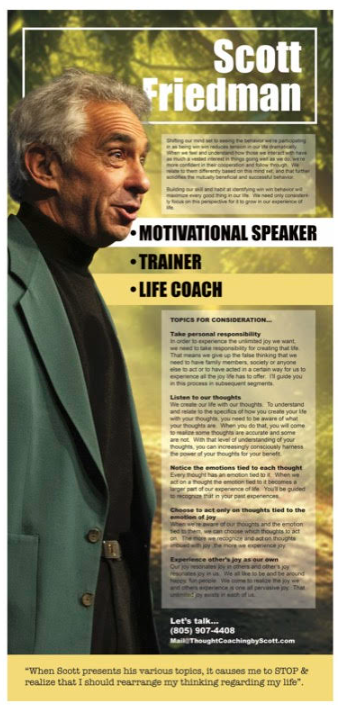
Scott Friedman has maintained a daily meditation practice for over 40 years and has authored 14 books on thought coaching and conscious living. His money mindset coaching model is unique: you pay nothing upfront. At the successful conclusion of coaching, you pay what you think it was worth. Learn more about Scott or book a free call.