After forty years of coaching people who are trying to balance saving, debt, family, and actually enjoying life, I can give you the answer directly, and it begins with a distinction that almost no advice on this subject makes. The tension is real. The competing demands are real. The feeling that you cannot do all four at once is real. What is not real, though it feels more real than anything, is the interpretation your mind has produced about what the tension means and what you need to do about it. The standard advice tells you to budget better, prioritize, find balance, and practice moderation. Some of that advice is practically useful. But the advice fails for a specific reason. It treats the tension as a math problem, when the tension is a thought problem wearing a math costume. The feeling that you cannot save enough, pay down debt fast enough, provide for your family well enough, and enjoy life at the same time is not produced by the numbers. It is produced by a thought layer that interprets every demand as urgent and every choice as a test you are failing. Seeing the thought layer as a thought rather than as a perception is what changes the relationship to the tension, and the change in relationship is what allows the tension to release.
Let me explain what I mean, because the distinction is the entire answer. The research on financial stress is solid and growing. The American Psychological Association's Stress in America surveys have found that money has been a consistent top source of stress for adults across every survey going back to 2007, and the 2024 survey found that seventy-seven percent of adults cite money as a source of stress, with forty percent saying it is a primary source. The Federal Reserve's Survey of Household Economics and Decisionmaking has found that a meaningful share of adults would struggle to cover a four-hundred-dollar emergency expense, and that the struggle correlates more strongly with financial anxiety than with income level. The research is descriptively accurate. People are stressed about money, the stress is increasing, and the stress affects decisions, relationships, and health. The problem is that the research describes what is happening. It does not describe what is producing it. And the standard advice, which tells you to make a budget, prioritize your goals, and find work-life balance, treats the tension as a planning failure, when the tension is actually what is left when a thought layer has been covering the natural capacity to make clear financial decisions without anxiety.
The research from the behavioral economics side points at the same thing from a different angle. The work of Eldar Shafir at Princeton and Sendhil Mullainathan, published in their book Scarcity, established that financial stress produces a cognitive pattern they called a scarcity mindset, and the pattern narrows attention and reduces decision quality. The research found that the scarcity mindset is not a character flaw. It is a cognitive response to perceived insufficiency, and the response is the same across income levels. People who perceive their resources as insufficient make worse decisions, not because they are less capable, but because the perception of insufficiency consumes the mental bandwidth that better decisions require. All of this is accurate. But notice what every one of these findings has in common. They are all descriptions of a condition that is present when something is absent. Clear financial decision-making is present when the scarcity thought is absent. The capacity to enjoy life while saving is present when the guilt thought is absent. The balance is not an addition. It is what is left when the subtraction happens. And the subtraction happens not by effort but by seeing the thought layer that has been producing the addition's opposite.
Why the Standard Advice Fails
The standard advice for balancing saving, debt, family, and enjoying life goes like this. Make a budget. Prioritize your goals. Pay yourself first. Automate your savings. Use the debt snowball or avalanche method. Set aside guilt-free spending money. Practice work-life balance. Communicate with your partner about money.
Some of this advice is practically useful, in the sense that budgets and automation and debt payoff methods are real tools that can help. But the advice fails for a specific reason. It treats the tension as a planning failure, and it ignores the thought layer that is producing the tension. A person who is told to make a budget makes a budget, and the budget feels like a cage, because the thought layer producing the cage is still running. A person who is told to set aside guilt-free spending money sets aside guilt-free spending money, and the spending still feels guilty, because the thought layer producing the guilt is still running. A person who is told to practice work-life balance practices work-life balance, and the balance feels like another obligation, because the thought layer producing the obligation is still running. The advice produces a performance of balance, and the performance is detectable by the person doing it, and the detection is what makes the person feel worse than before they tried. The balance is not produced by performing it. It is produced by the absence of the thought layer that has been covering it.
Here is what I have seen across forty years. A person who is told to pay themselves first pays themselves first, and the saving feels like deprivation, because the thought layer producing the deprivation is still running. A person who is told to use the debt snowball uses the debt snowball, and the debt payoff feels like punishment, because the thought layer producing the punishment is still running. A person who is told to communicate with their partner about money communicates with their partner about money, and the communication turns into an argument, because the thought layer producing the defensiveness is still running. The advice gives the person the behavior without addressing the thought layer producing the effort, and the effort is what makes the behavior feel worse than not doing it.
There is a second reason the advice fails, and it is the one that matters most. The advice keeps the person in what one assessment framework usefully calls the insufficiency register. The insufficiency register is the mode of operating where you are measuring your resources against your demands and finding the resources wanting, evaluating your progress against an imagined ideal and finding the progress inadequate, and monitoring every financial decision for whether it was the right one. The insufficiency register is what produces the tension that the balance advice is trying to resolve. And the insufficiency register is produced by a thought layer that says there is not enough, that you are behind, that enjoyment is a threat to responsibility, and that the future requires sacrifice now. The standard advice does not address this thought layer. It gives you behaviors to perform on top of it, and the thought layer continues running underneath the behaviors, and the behaviors feel depleting because the thought layer is still producing the insufficiency. The person who finds genuine balance is the person who has shifted out of the insufficiency register, and the shift happens not by performing different behaviors but by seeing the thought layer that has been keeping them in the register.
The Real Mechanism
Let me explain what is actually happening, because understanding the mechanism is what makes the shift possible. The capacity to save, pay down debt, provide for family, and enjoy life simultaneously is the default capacity of a mind that is not being obstructed by a layer of self-referential thought. The mind, when the obstructing layer is thin, naturally settles into a state of clarity about what matters and what does not, and the clarity produces decisions that serve all four priorities without the tension. This is not something the mind has to do. This is what the mind does when it is not being interfered with. The interference is the thought layer, and the thought layer is not a perception of your financial situation. It is an interpretation of your financial situation that runs fast and below awareness and feels like a perception.
Consider what happens when you watch a person who has the quality you are trying to develop. They save for the future, and the saving does not feel like deprivation. They pay down debt, and the debt payoff does not feel like punishment. They provide for their family, and the providing does not feel like sacrifice. They enjoy life, and the enjoyment does not feel like guilt. The standard analysis says they have good financial habits and a healthy relationship with money. But watch more carefully. What you are actually seeing is the absence of something. You are seeing the absence of the self-referential thought layer that produces the scarcity, the guilt, the obligation, and the future fixation. The person is not adding discipline. They are not performing balance. They are simply present, without the thought layer running that would otherwise be telling them there is not enough, that enjoyment is wasteful, that they are behind, and that the future requires suffering now. The presence, without that layer, is what reads as balance. The quality is not an addition. It is what is left when the subtraction has happened.
The Thought Patterns That Produce the Tension
After forty years of coaching people through this, I can tell you that the tension between saving, debt, family, and enjoying life is produced by a small number of thought patterns that run below awareness, and the patterns are more visible in the person experiencing them than in the numbers they are interpreting. Here are the ones I see most often.
The first is the scarcity thought. The thought says: there is not enough, or I am behind, or any spending that is not essential is a threat to my future. The thought produces a relationship to money where every dollar out feels like a loss, and the relationship makes saving feel like deprivation and enjoyment feel like danger. The scarcity thought is what Shafir and Mullainathan's research identified. The thought narrows attention to the perceived insufficiency and consumes the mental bandwidth that clear decisions require. The scarcity thought can be activated by anything. A bill that was higher than expected. A comparison to a peer who seems further ahead. A news cycle about economic uncertainty. The content varies. The mechanism does not. The mechanism is the mind interpreting a manageable financial situation as an unmanageable one, and the interpretation produces a physiological activation that is incompatible with the clarity that good decisions require. When the scarcity thought is seen as a thought, the activation drops, the narrowing releases, and the decisions that follow are made from clarity rather than fear.
The second is the guilt thought. The thought says: enjoyment is wasteful, or I do not deserve this until the debt is paid, or spending on myself is a failure of discipline. The thought produces a relationship to enjoyment where every pleasure carries a tax of self-judgment, and the tax makes the enjoyment cost more than it returns. The guilt thought is what makes the balance advice fail, because the person who sets aside guilt-free spending money still feels the guilt, and the guilt is what makes the spending feel worse than not spending. When the guilt thought is seen as a thought, the tax drops, and the enjoyment becomes what it was always capable of being, which is restorative rather than depleting.
The third is the obligation thought. The thought says: I must provide, or I must save more, or I must pay this off faster, or I must do better. The thought produces a relationship to financial responsibility where every action is driven by compulsion rather than choice, and the compulsion makes the responsibility feel like a prison rather than a purpose. The obligation thought is what makes the providing for family feel like sacrifice, because the thought layer producing the compulsion is telling you that you have no choice, and the lack of choice is what makes the action feel like suffering. When the obligation thought is seen as a thought, the compulsion drops, and the same action, done from choice rather than compulsion, becomes an expression of care rather than a sentence.
The fourth is the future thought. The thought says: enjoyment is for later, or I will enjoy life when the debt is paid, or I will relax when I have saved enough, or the future requires sacrifice now. The thought produces a relationship to the present where the present is always a means to a future end, and the relationship makes the present feel like a waiting room rather than a life. The future thought is the one that feels most responsible and most defensible, which is what makes it the hardest to see as a thought. The future is real and planning for it is wise. But the thought that says enjoyment is for later is not a plan. It is an interpretation that sacrifices the present for a future that, when it arrives, will be interpreted the same way. When the future thought is seen as a thought, the present becomes available, and the availability is what allows the enjoyment that restores the capacity that the saving and the debt payoff and the providing require.
What Actually Works
The standard advice tells you to budget, prioritize, and find balance. The direct answer is that you do not produce balance by performing it. You stop obscuring it. The capacity to save, pay down debt, provide for family, and enjoy life is the default capacity of a mind in which the obstructing thought layer has thinned, and the thinning happens by seeing the thought layer as a thought rather than as a perception. This is the work, and it is the work whether the financial situation is comfortable or tight, because the thought layer runs the same way in every case and the capacity is the same in every person.
Here is what I tell the people I coach. Start by noticing the thought layer in yourself, because the thought layer is the one thing you can see directly, and it is the one thing producing the tension. When you feel the urge to save at the expense of everything else, notice the thought that says there is not enough. When you feel the guilt after enjoying something, notice the thought that says enjoyment is wasteful. When you feel the obligation driving your providing, notice the thought that says you must. When you feel the future pulling you out of the present, notice the thought that says enjoyment is for later. The thought is not a perception. It is an interpretation. And an interpretation that is seen as an interpretation stops producing the behavior that was covering the balance the situation requires.
Then notice what happens when the thought is seen. The scarcity thought, seen as a thought, stops producing the deprivation. The guilt thought, seen as a thought, stops producing the tax on enjoyment. The obligation thought, seen as a thought, allows the same action to be done from choice rather than compulsion. The future thought, seen as a thought, allows the present to become available without abandoning the future. This is not a technique. It is a seeing. And the seeing is what coaching develops, because the seeing is the one capacity that the standard advice does not teach.
The practical tools still matter. A budget is useful. A debt payoff method is useful. Automation is useful. Communication with your partner is useful. But the tools work when the thought layer is thin, and the tools fail when the thought layer is thick, and the thickness or thinness is not produced by the tools. It is produced by the seeing, and the seeing is what coaching develops. The person who has addressed the thought layer can use the same budget that felt like a cage and have it feel like a map. The person who has not addressed the thought layer will use the same budget and have it feel like a cage, because the thought layer producing the cage is still running underneath the budget.
The research confirms this without naming it. The Shafir and Mullainathan scarcity research found that the cognitive pattern is produced by the perception of insufficiency, not by the insufficiency itself, and that the perception can shift without the circumstances changing. The APA stress research found that financial stress correlates more strongly with the interpretation of financial situations than with the situations themselves. The conditions are produced by seeing the thoughts, and seeing the thoughts is what coaching does.
A Note on Financial Advice
There is a distinction that matters and that I want to make clearly. The tension between saving, debt, family, and enjoying life can be produced by thought patterns, and it can also be produced by genuine financial hardship that requires practical intervention. If you are unable to meet basic needs, if you are facing collection actions or legal consequences of debt, or if you need help structuring a repayment plan or an investment strategy, the appropriate response is to consult a licensed financial advisor or a credit counselor. Coaching and financial advice are different layers, and both may be needed. What I am describing in this article is the thought layer that produces the tension in people whose financial situation is manageable, and the seeing that thins the layer. If you are unsure which applies to you, a financial professional can help you make that determination.
What This Means for You
If you are someone who has been trying to balance saving, debt, family, and enjoying life, and the balance has not become organic, the standard analysis says you have a planning problem. The direct answer is that you have a thought problem, and the thought problem is running in you, and the tension is the visible output of the invisible pattern. The seventy-seven percent of adults who cite money as a source of stress are not all failing to budget. They are running a thought layer that interprets their financial situation as insufficient, and the interpretation produces the stress, and the stress produces the decisions that the budget was trying to fix.
The people I coach across Ventura County and the rest of the country are dealing with this every day. In the technology and professional-services corridors around Thousand Oaks and Agoura Hills, the future thought is dominant. People who are earning well arrive at a point where the saving for the future has consumed the present, and the consumption has produced a life that feels responsible and empty at the same time. In the healthcare and helping-profession communities around Ventura and Oxnard, the obligation thought is common. People who are providing for families carry a compulsion that they mistake for love, and the compulsion makes the providing feel like a sentence rather than a choice. In the entrepreneurial and creative communities of Ojai and Santa Barbara, the guilt thought runs. People who have built something of their own arrive at a layer where enjoying the fruits of their work feels like a betrayal of the discipline that produced them, and the guilt makes the enjoyment cost more than it returns.
If you want to explore this, learn more about money mindset coaching or book a free discovery call. You pay nothing upfront. At the successful conclusion of coaching, you pay what you think it was worth. That model exists because I am confident the work works, and I would rather you find out for yourself than take my word for it.
Frequently Asked Questions
How do I balance saving, debt, family, and enjoying life?
The standard advice says to budget, prioritize, and find balance. The direct answer is that the tension is not a math problem. It is a thought problem. The tension is produced by a thought layer that interprets every financial demand as urgent and every choice as a test you are failing. Four thought patterns produce the tension: scarcity, guilt, obligation, and future fixation. Seeing the thoughts as thoughts is what thins the layer and allows the natural capacity for clear financial decisions to return.
Why does budgeting make me feel worse, not better?
Because a budget made on top of the scarcity thought feels like a cage, and the cage is produced by the thought layer, not by the budget. The same budget, made from a mind in which the scarcity thought has thinned, feels like a map. The difference is not the budget. The difference is the thought layer running underneath it. Seeing the scarcity thought as a thought is what allows the budget to become a tool rather than a prison.
What is the insufficiency register and how does it affect financial decisions?
The insufficiency register is a mode of operating where you are measuring your resources against your demands and finding the resources wanting, evaluating your progress against an imagined ideal and finding the progress inadequate, and monitoring every financial decision for whether it was the right one. It is produced by a thought layer that says there is not enough. The insufficiency register is what produces the tension that the balance advice is trying to resolve, because the self-monitoring never turns off. Seeing the insufficiency thought as a thought is what shifts the mind out of the register.
Why do I feel guilty when I spend money on myself?
Because the guilt thought is running, and the guilt thought says enjoyment is wasteful or that you do not deserve enjoyment until the debt is paid. The guilt thought produces a tax on every pleasure, and the tax makes the enjoyment cost more than it returns. The guilt is not produced by the spending. It is produced by the thought layer interpreting the spending as a failure of discipline. Seeing the guilt thought as a thought is what drops the tax and allows the enjoyment to become restorative rather than depleting.
What does the research say about financial stress and decision-making?
The American Psychological Association found that seventy-seven percent of adults cite money as a source of stress. The work of Eldar Shafir and Sendhil Mullainathan established that financial stress produces a cognitive pattern called a scarcity mindset, which narrows attention and reduces decision quality. The pattern is not a character flaw. It is a cognitive response to perceived insufficiency, and the response is the same across income levels. The research found that the pattern is produced by the perception of insufficiency, not by the insufficiency itself, and the perception can shift without the circumstances changing.
Is it selfish to enjoy life while I still have debt?
The thought that says enjoyment is selfish while debt exists is the future thought, and the future thought sacrifices the present for a future that, when it arrives, will be interpreted the same way. The debt is real and paying it down is wise. But the thought that says all enjoyment must wait until the debt is gone is not a plan. It is an interpretation that produces a life that feels responsible and empty at the same time. Seeing the future thought as a thought is what allows the present to become available without abandoning the future.
Is this a replacement for financial advice or credit counseling?
No. If you are unable to meet basic needs, facing collection actions, or needing help structuring a repayment plan or investment strategy, consult a licensed financial advisor or credit counselor. Coaching addresses the thought layer that produces the tension in people whose financial situation is manageable. The two are different layers, and both may be needed. A person who has addressed the thought layer but lacks financial knowledge will have clarity without a plan. A person who has a plan but has not addressed the thought layer will have a plan that feels like a cage. The balanced person has both.
How much does money mindset coaching cost?
You pay nothing upfront. At the successful conclusion of coaching, you pay what you think the work was worth and what you can afford. There is no set fee. The first discovery call is free and there is no obligation to continue. This model is not a marketing tactic. It is how I have practiced for forty years.
Ready to See What Is Actually Covering Your Balance?
If you have been trying to balance saving, debt, family, and enjoying life by performing the behaviors of balance, and the balance has not become organic, the reason is not that you have not found the right budget or the right debt payoff method. The reason is that the balance is not produced by performing it. It is produced by subtraction, and the subtraction is done by seeing the thought layer that has been covering it, not by adding more behaviors on top of it. That thought layer can be seen. And a thought that is seen is a thought that stops covering the balance from below awareness.
If you are ready to stop performing your way into balance and start seeing what is actually covering it, book a free discovery call. We will look at the thought together. You will see, probably for the first time, that the balance you have been chasing was never going to be reached by finding the right budget. It was going to be uncovered by seeing the thought that was telling you there was not enough, that enjoyment was wasteful, that you must, and that enjoyment was for later. Seeing it is the work. The work is what changes everything.
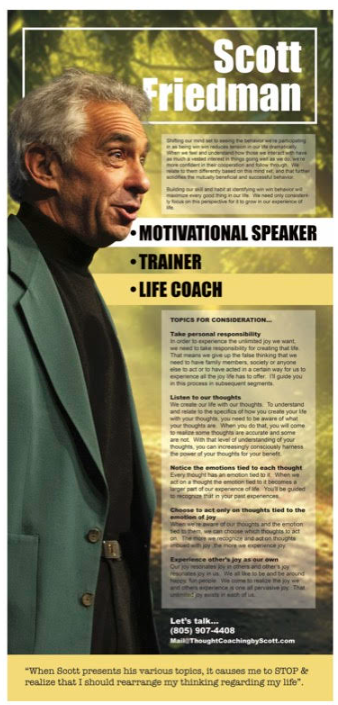
Scott Friedman has maintained a daily meditation practice for over 40 years and has authored 14 books on thought coaching and conscious living. His money mindset coaching model is unique: you pay nothing upfront. At the successful conclusion of coaching, you pay what you think it was worth. Learn more about Scott or book a free call.