When the same question keeps circling in your mind, you may feel worn out without getting closer to a decision. Try writing down what you know, what you cannot know yet, and the smallest useful next action. Noticing the thought loop can be part of responding more gently to yourself.
Let me explain what I mean, because the distinction is the answer. Thinking is the active engagement of attention with a question that has an answer. You think through a problem at work. You think through what to say in a difficult conversation. You think through a decision. The thinking has a direction, a question, and a termination point. When the answer arrives, or when you decide you have done enough for now, the thinking stops. That is thinking. It is a tool. It has a job. When the job is done, the tool goes back in the drawer.
Overthinking is different. Overthinking does not have a question. It has the appearance of a question, but the question is never answered because the question was never the point. The point of overthinking is the loop itself. The loop produces a feeling of doing something about the underlying concern, without ever actually addressing it. The loop is a substitute for action. It feels productive. It is not productive. It is the same circuit running the same content with no resolution, and the reason it has no resolution is that resolution was never its function. Its function is to keep running.
This is the paradox at the center of overthinking, and it is the reason every approach that tries to solve overthinking with more thinking fails. You cannot think your way out of a loop that is not thinking. The loop is not a problem to be solved. It is a pattern to be seen. When it is seen as a pattern rather than experienced as thinking, the pattern loosens. Not because you out-thought it. Because you stopped feeding it the attention it was mistaking for thinking.
When Common Advice Falls Short
The standard advice for overthinking goes like this. Distract yourself. Journal it out. Set a timer for worrying and then stop. Challenge the thoughts with evidence. Practice mindfulness. Get some exercise. Break the pattern with a physical action. Reframe the thought. Replace it with a positive one.
Some of these work, temporarily, for some people. A walk in nature has been shown in research to reduce self-reported rumination and to decrease activity in the subgenual prefrontal cortex, a brain region associated with the self-focused withdrawal that rumination produces. Mindfulness-based interventions have accumulated evidence for reducing rumination and related symptoms. Rumination-focused cognitive behavioral therapy, which trains people to recognize rumination as a mental habit and identify its triggers, has shown benefits in clinical trials. I am not dismissing these approaches. They have real value, and for someone whose overthinking is severe enough to meet the threshold for an anxiety disorder, depression, or obsessive-compulsive disorder, professional treatment is the appropriate first step, not self-help and not coaching.
But here is what I have seen across forty years. The person who tries to distract themselves from the loop finds the loop waiting for them when the distraction ends. The person who journals the loop out finds the loop has produced more content to journal. The person who sets a worry timer spends the timer filling up with worry and then continues worrying after the timer goes off. The person who challenges the thoughts with evidence finds the thoughts producing new evidence to be challenged. The person who tries to replace the thoughts with positive ones finds the positive thoughts being absorbed into the loop and converted into more material to overthink. The advice fails because it treats the loop as a content problem. The content is not the problem. The loop is the problem. And you cannot fix a loop by changing what runs inside it.
There is a second reason the advice fails, and it is the one that matters most. The advice assumes the person asking the question is a person who can choose to stop thinking. The advice says: stop thinking. The person says: I am trying. The trying is the loop. The loop is the attempt to stop the loop. The person who is trying to stop overthinking is overthinking about stopping overthinking. The advice does not address this. It gives the person a new thing to overthink about, which is how to stop overthinking. The loop absorbs the advice and continues. This is why the advice fails for the person actually asking the question. The person actually asking the question is not someone who has not yet tried the right technique. The person actually asking the question is someone whose relationship to their own thinking has become the loop.
What May Be Happening
Let me explain what is actually happening, because understanding the mechanism is what makes the solution possible. The loop is being driven by a thought that has not been seen as a thought. The thought says something needs to be figured out, or something is wrong, or more thinking will help. The thought feels like a perception of the situation rather than an interpretation of the situation. As long as the thought is experienced as perception, the loop continues, because the thought is telling the mind that the loop is necessary. The loop is the mind obeying the thought. When the thought is seen as a thought rather than as a fact about the situation, the loop loses its reason to run, and it slows and stops on its own. Not because you stopped it. Because the fuel was withdrawn.
Consider what happens when you are caught in a loop about a conversation you had. The loop replays what was said. It generates what you should have said. It imagines what the other person meant. It predicts what they will do next. It rehearses what you will say next. The loop feels like it is working on the conversation. It is not working on the conversation. The conversation is over. The loop is working on a thought about the conversation, and the thought says the conversation is not finished, or you handled it wrong, or something needs to be resolved. The thought is what is keeping the loop running. The conversation does not need the loop. The thought needs the loop. When the thought is seen as a thought, the loop stops, because the mind no longer believes the conversation requires the processing.
This is the mechanism. The loop is not produced by the situation. The loop is produced by a thought about the situation. The situation is neutral. The thought is what gives the situation the quality of requiring a loop. When the thought is seen as a thought rather than experienced as a perception, the requirement drops, and the loop stops. Not because you resolved the situation. Because you stopped believing a thought that was telling you the situation needed more processing than it actually needed.
Three Thought Patterns That Drive the Loop
After forty years, the patterns take a limited number of forms. Here are the three I see most often in people who cannot stop overthinking.
1. The "I need to figure this out" thought
The thought says: this situation requires figuring out, and if I keep thinking about it, I will figure it out. This thought treats the loop as a problem-solving process. It tells the mind that the loop is productive work, and that stopping the loop would mean giving up on the solution. The person carrying this thought believes that if they just think a little longer, or from a slightly different angle, the answer will arrive. The answer does not arrive, because the loop is not a problem-solving process. The loop is a replay process. It is running the same content in the same configuration and producing the same non-answer. The person is not figuring anything out. They are rewatching the same scene. When the "I need to figure this out" thought is seen as a thought, the mind stops expecting the loop to produce a solution, and the loop stops, because the expectation was the only thing keeping it running.
2. The "something is wrong" thought
The thought says: something is wrong, and I need to find it. This thought runs the loop as a scanning process. The mind is searching for the wrong thing, the threat, the error, the danger. The search feels like vigilance. It feels responsible. It feels like the mind doing its job of keeping you safe. But the search has no termination condition, because the thought has not defined what the wrong thing is. The thought is searching for wrongness in general, and wrongness in general is always available, because the mind can always generate a new interpretation of something that could be wrong. The search never concludes because the search was never looking for a specific thing. It was looking for the feeling of having looked, which is what the loop produces. When the "something is wrong" thought is seen as a thought, the mind stops scanning for an undefined threat, and the loop stops, because the scan was the loop.
3. The "if I just think harder" thought
The thought says: the problem is that I have not thought hard enough, and if I apply more thinking, the problem will yield. This thought is the one that makes overthinking self-reinforcing. It tells the mind that the solution to too much thinking is more thinking. The person carrying this thought responds to the discomfort of the loop by leaning into the loop. They think harder. They focus more. They concentrate. And the loop responds to the increased fuel by running faster. The person concludes that they need to think even harder. The loop runs even faster. This is the spiral. The spiral is not a malfunction. It is the logical output of a mind that believes more thinking is the solution to the suffering that more thinking is producing. When the "if I just think harder" thought is seen as a thought, the person stops applying more fuel, and the loop slows, because the fuel was the only thing sustaining it.
Ideas Worth Trying
The solution is not a technique you apply to stop the loop. The solution is a shift in your relationship to the thoughts that are driving the loop. That shift is not forced. It is what happens when a thought is seen clearly as a thought rather than experienced as a fact. Here is what that looks like in practice.
Step 1: Recognize the loop as a loop, not as thinking
The first shift is the one that makes every other shift possible. When the loop is running, recognize that it is a loop. It is not thinking. It is not problem-solving. It is not productive. It is a pattern running the same content with no resolution. You do not need to stop it. You need to see what it is. The seeing is what changes your relationship to it. When you see it as a loop, you stop expecting it to produce an answer, and you stop feeding it the attention that comes from believing it is working on something. The loop does not need to be stopped. It needs to be recognized. Recognition is what withdraws the fuel.
Step 2: Find the thought that is driving the loop
Every loop has a thought behind it. The thought is usually one of the three above. It is saying you need to figure something out, or something is wrong, or you need to think harder. The thought is fast. It feels like the situation. But it is a thought about the situation. You can learn to catch it. Not by arguing with it. By noticing it. The noticing is what loosens it. You do not need to replace it with a better thought. You do not need to generate a feeling of calm to counter it. You just need to see it as a thought instead of as a fact about the situation. When you see it, it loses its authority to keep the loop running.
Step 3: Stop trying to solve the loop with the loop
If you have been trying to think your way out of the loop, stop. The trying is the loop. The attempt to solve overthinking by overthinking about overthinking is the loop consuming itself. When you stop trying to solve the loop, you will feel uncomfortable. The discomfort is the driving thought reacting to the withdrawal of its fuel. Let the discomfort be there. Do not fill it with a new round of thinking. The discomfort will pass, and what is on the other side of it is the quiet that was being blocked by the loop. This is counterintuitive. It is also accurate. You cannot think your way out of a loop that is not thinking. You can only stop feeding it.
Step 4: Let the loop run out of fuel
A loop that is not fed does not run forever. It runs out of fuel and stops. Your job is not to stop the loop. Your job is to not feed it. Not feeding it means not believing the thought that says it needs to run. When the thought is seen as a thought, the fuel is withdrawn, and the loop slows and stops on its own. You do not have to force it. You do not have to fight it. You do not have to replace it. You just have to stop giving it the attention it was mistaking for thinking. The quiet that arrives is not something you produced. It is what was there underneath the loop the entire time.
What This Is Not
This is not an argument against thinking. Thinking is one of the most valuable capacities a human being has. The point is not to stop thinking. The point is to stop the loop that is impersonating thinking. When the loop stops, actual thinking becomes more available, not less, because the mind is no longer occupied with running a pattern that was producing nothing.
This is also not an argument against techniques. Distraction, journaling, exercise, and mindfulness have real value, and the research supports them for reducing rumination in the short term. The point is that techniques address the content of the loop. They do not address the loop. If you find that techniques work temporarily and the loop returns, the reason is not that you have not found the right technique. The reason is that the thought driving the loop has not been seen. Seeing the thought is what allows the techniques to work, or makes the techniques unnecessary, depending on the person.
And this is not a replacement for professional care. Chronic rumination is linked to anxiety disorders, depression, and obsessive-compulsive disorder, and research indicates that when rumination is not specifically targeted in treatment, it can slow symptom improvement and weaken treatment response. If your overthinking is persistent, severe, affecting your sleep or your ability to function, or accompanied by other symptoms, the first step is a professional evaluation. Thought coaching addresses a layer that clinical treatment may not, but it is not a substitute for clinical care. The two can complement each other. Know which layer you are dealing with.
What This Looks Like in Ventura County
I work with people across Ventura County who carry these loops, and the content of the loop shifts by life stage and profession. In the tech and professional-services corridors around Thousand Oaks and Agoura Hills, the "I need to figure this out" loop is dominant. People whose work rewards thorough analysis arrive home and apply the same analytical engine to their relationships, their health, and their future, and the engine does not turn off because it was never given a termination condition. In the healthcare and caregiving professions concentrated around Ventura and Oxnard, the "something is wrong" loop is common. People who are responsible for catching errors and anticipating complications carry the scanning process home with them, and the scan continues looking for wrongness in contexts where there is nothing to catch. In the creative and retirement communities of Ojai and Santa Barbara, the "if I just think harder" loop runs. People who have the time and space to reflect find that reflection becomes a loop, and the loop becomes the suffering they were trying to reflect their way out of.
The content of the loop changes by context. The mechanism does not. The mechanism is always a thought driving a pattern that is impersonating thinking. The coaching I do does not change by profession. We look at the thought together. We do not try to replace the thought. We bring it into view so it stops driving the loop undetected.
Sessions are by phone or video. You do not need to leave your home. The work is interior, and it can be done from anywhere in the county or anywhere in the country.
How Life Coaching Addresses Overthinking
Life coaching, the way I practice it, is not about giving you techniques to manage your thoughts. I am not going to give you a thought-stopping exercise or a worry journal or a mindfulness protocol. Those approaches treat the loop as a content problem, and the loop is not a content problem. The loop is a pattern being driven by a thought that has not been seen. The thought is where I work.
What I do is help you see the thoughts that have been driving the loop. The "I need to figure this out" thought. The "something is wrong" thought. The "if I just think harder" thought. Once you see them as thoughts rather than as facts about your situation, the loop starts to slow on its own. Not because you out-thought it. Because the thing that was driving it is no longer driving it undetected. Your mind continues to think when thinking is called for. The loop stops running when it is not. That is the work, and it is the work I have done for forty years.
If you want to explore this, learn more about life coaching or book a free discovery call. You pay nothing upfront. At the successful conclusion of coaching, you pay what you think it was worth. That model exists because I am confident the work works, and I would rather you find out for yourself than take my word for it.
Frequently Asked Questions
How do I stop overthinking?
First, recognize that overthinking is not thinking. It is a loop. The loop is being driven by a thought that has not been seen as a thought, usually the thought that you need to figure something out, that something is wrong, or that more thinking will help. The standard advice fails because it tries to solve the loop with more thinking, which is the loop consuming itself. The solution is to see the driving thought as a thought rather than as a fact, which withdraws the fuel the loop was running on.
Why can't I just stop overthinking by trying to stop?
Because the trying is the loop. The attempt to stop overthinking by thinking about stopping overthinking is overthinking about overthinking. The loop absorbs the attempt and continues. You cannot think your way out of a loop that is not thinking. You can only stop feeding it, which happens when the thought driving the loop is seen as a thought rather than experienced as a perception.
Is overthinking the same as anxiety?
Not exactly, but they are related. Overthinking, or rumination, is a pattern of repetitive negative thinking. Chronic rumination is linked to anxiety disorders, depression, and obsessive-compulsive disorder, and research indicates that when rumination is not specifically targeted in treatment, it can slow symptom improvement. If your overthinking is persistent, severe, or affecting your ability to function, the first step is a professional evaluation. Thought coaching addresses a layer that clinical treatment may not, but it is not a substitute for clinical care.
Does distraction help with overthinking?
Temporarily, for some people. A walk in nature has been shown in research to reduce self-reported rumination and decrease activity in a brain region associated with the self-focused withdrawal that rumination produces. Distraction can interrupt the loop in the short term. But if the loop returns when the distraction ends, the reason is not that you have not found the right distraction. The reason is that the thought driving the loop has not been seen. Seeing the thought is what allows the loop to stop, whether or not you use distraction.
What is the difference between thinking and overthinking?
Thinking is the active engagement of attention with a question that has an answer. It has a direction and a termination point. When the answer arrives, the thinking stops. Overthinking is a loop. It has the appearance of a question, but the question is never answered because the question was never the point. The point of the loop is the loop itself. The loop produces a feeling of doing something about the underlying concern without ever actually addressing it. Recognizing this difference is the first shift that makes every other shift possible.
How is this different from therapy?
Therapy can address the clinical layer, including anxiety, depression, and obsessive-compulsive disorder, and rumination-focused cognitive behavioral therapy has shown benefits in clinical trials. Thought coaching addresses the thought that is driving the loop in the present moment. The two approaches can complement each other. This is not a replacement for professional mental health care, and if you suspect the clinical layer is involved, start there.
Do you work with people outside Ventura County?
Yes. Sessions are by phone or video. I work with people across the country. The loops I see in Ojai are the same loops I see in people in New York, Chicago, and Seattle. The content varies. The mechanism does not.
How much does life coaching cost?
You pay nothing upfront. At the successful conclusion of coaching, you pay what you think the work was worth and what you can afford. There is no set fee. The first discovery call is free and there is no obligation to continue. This model is not a marketing tactic. It is how I have practiced for forty years.
Ready to See What Is Actually Driving the Loop?
If you have been trying to stop overthinking by thinking about it, and the loop has not stopped, the reason is not that you have not found the right technique. The reason is that overthinking is not thinking, and you cannot solve a loop with the loop. The loop is being driven by a thought that you have been experiencing as a perception rather than as a thought. That thought can be seen. And a thought that is seen is a thought that stops driving the loop from below awareness.
If you are ready to stop trying to think your way out of a loop that is not thinking and start seeing what is actually driving it, book a free discovery call. We will look at the thought together. You will see, probably for the first time, that the loop you have been fighting was never going to be defeated by more thinking. It was going to be defeated by seeing the thought that was telling you it needed to run. Seeing it is the work. The work is what changes everything.
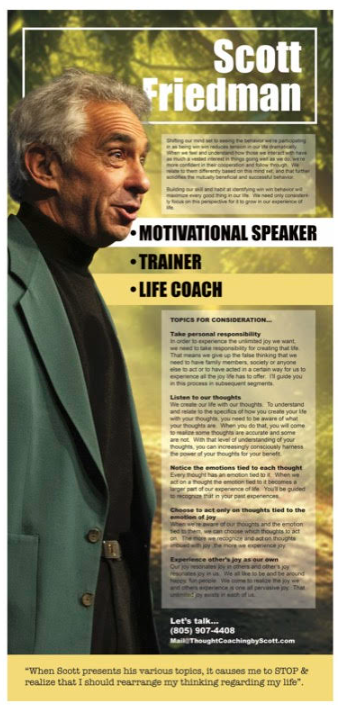
Scott Friedman has maintained a daily meditation practice for over 40 years and has authored 14 books on thought coaching and conscious living. His life coaching model is unique: you pay nothing upfront. At the successful conclusion of coaching, you pay what you think it was worth. Learn more about Scott or book a free call.