If you are thinking about working with a life coach, it is natural to wonder what you would talk about. Perhaps something in your life feels unsettled, or you would simply like to understand yourself better. You do not have to arrive with a polished goal or a neatly explained problem.
A coaching conversation is a place to explore what matters to you. You can talk about work, a change you are considering, a relationship, a recurring worry, or the feeling that you are ready for something different. The conversation should move at a pace that respects you.
What usually happens in a first session?
Most coaches begin by learning what brought you there. You might be asked what has been on your mind, what you would like to change, and what a helpful conversation would look like. There should be room for you to ask questions about how coaching works, scheduling, privacy, and payment before deciding whether to continue.
The International Coaching Federation's guide to a coaching session describes an approach built around the client's priorities and thoughtful, open-ended questions. No two sessions need to look exactly alike.
Do I need to know what I want to work on?
No. It can be helpful to bring one question, but uncertainty is a perfectly reasonable starting point. You might say, “I have been feeling stuck, and I am not sure why,” or “Things are going well on paper, but I do not feel particularly happy.”
A helpful coach will not rush to tell you what is wrong. Instead, you can explore the experience together and notice what becomes clearer.
How is Scott Friedman's approach different?
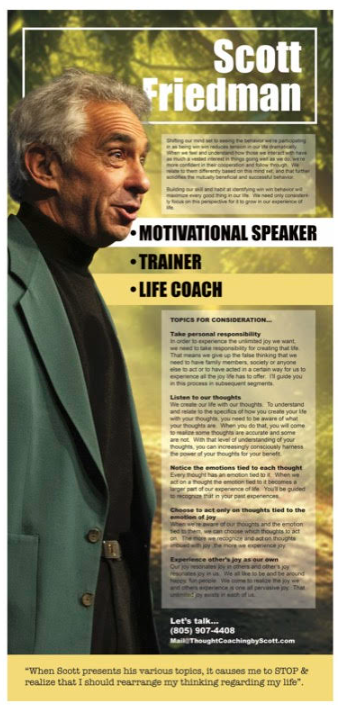
Scott calls his work thought coaching. A central idea is simple: a thought is a thought. It may be true, partly true, or not true at all. Yet we often respond to our thoughts as if they are unquestionable facts.
Imagine you are considering a new opportunity, but a familiar thought appears: “I am not the sort of person who can do that.” Scott's approach invites you to notice that sentence without fighting it or automatically obeying it. The small space between having a thought and believing it can make room for a more conscious choice.
His philosophy brings together awareness, acceptance, and the belief that greater awareness can support positive change. It is grounded in his long-standing personal meditation practice and writings on living with greater peace.
What might we talk about?
Topics vary widely. Someone may want to feel more comfortable speaking up at work. Another person may be navigating retirement, a career change, or a difficult decision. Someone else might simply want to be less hard on themselves.
Sometimes a useful question is, “What am I telling myself about this situation?” At other times, it may help to ask, “What would I choose if I were not so worried about getting it wrong?” You are not required to arrive with the answers.
Will I leave with an action plan?
Possibly, but a good session is not measured only by how many tasks you take away. You might leave with a decision, a different perspective, one small action, or a clearer understanding of a thought that has been affecting you. You and the coach can decide what would be helpful.
How much does it cost to begin with Scott?
Scott offers a free introductory conversation. His published coaching arrangement is unusual: there is no upfront payment, and at the successful conclusion of coaching, you pay what you believe the experience was worth and what you can afford. It is sensible to ask about the precise terms in your introductory conversation.
Is coaching the same as therapy?
No. Life coaching can support reflection, personal goals, and decision-making, but it is not a replacement for mental-health treatment. If you are dealing with persistent depression, significant anxiety, trauma, or another mental-health concern, a licensed mental-health professional may be the more appropriate first step. Coaching and therapy can also serve different purposes at different times.
Three questions you can bring to an introductory call
- How do you help someone who is not yet sure what they want to change?
- What would our conversations be like, and how would we decide whether they are helping?
- What are your expectations around privacy, scheduling, and payment?
You do not need to make a commitment simply because you have had a call. The right coaching relationship should feel like a respectful, useful conversation.
A gentle place to begin
If Scott's approach speaks to you, you can learn more about his life coaching and background, or schedule a free introductory conversation. The first step can be as small as asking a question.