If negative thoughts feel overwhelming right now, begin with something small: pause, notice where you are, and give yourself permission not to solve everything at once. You can name what you are experiencing, take care of an immediate need, and reach out to someone you trust. You do not have to force yourself to feel positive before taking a helpful step.
Feeling overwhelmed can happen when worries pile up, sleep is poor, or life brings real pressure. It does not mean you have failed at managing your thoughts. Some situations need practical changes or professional support, not simply a different attitude.
What can help in the first few minutes?
Start with the basics. Sit somewhere safe if you can. Feel your feet on the floor, notice a few things around you, and breathe at a pace that feels comfortable. If you have not eaten, rested, or had water in a while, attend to what you need.
You might quietly say, “I am having a difficult moment, and I do not need to settle everything right now.” This is an acknowledgment, not a demand to make the feeling disappear. If your mind is racing, focus on one ordinary task, such as making tea or sending a message to someone you trust.
These suggestions are ways to steady yourself, not medical treatment. The U.S. Substance Abuse and Mental Health Services Administration also recommends small, supportive actions and connection with other people when mental health feels difficult.
Scott's experience with feeling overwhelmed
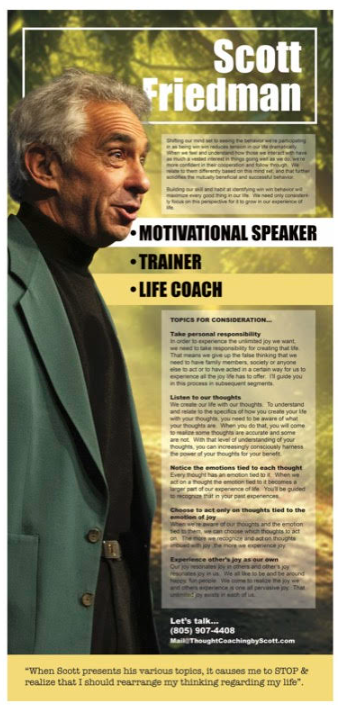
In the published description of his podcast episode “Recovering From Negative Overwhelm,” Scott Friedman describes a day when he felt overwhelmed by negative thoughts. He first tried to identify the thought behind his despair but did not find an answer. Instead of pushing harder, he returned to something simpler: acknowledging that he was overwhelmed in that moment.
Scott says he then repeated a personal mantra and pictured the life he hoped to create. In his account, that helped him feel better. This is Scott's personal experience, not evidence that a mantra or visualization will resolve everyone’s distress. You can take the useful part of his story without feeling obliged to copy his exact practice.
Notice a thought without having to fight it
Scott's approach to thought coaching centers on awareness and acceptance. He encourages people to recognize that a thought is something they are experiencing, not necessarily a fact they must believe or act on.
For example, a thought such as “I cannot handle this week” may appear after several difficult days. You do not need to scold yourself for having it. You might ask, gently, “What is making this week hard? Is there one thing I can change, postpone, or ask for help with?” The circumstances still matter. The aim is to respond to them with a little more room to choose.
If examining your thoughts makes you feel worse, you can stop the exercise. Returning attention to your surroundings, resting, or speaking with someone supportive may be more helpful in that moment.
Choose one manageable action, not a complete life overhaul
When many things are pressing on you, it may help to separate them into three groups: what needs attention today, what can wait, and what you cannot control alone. Choose one item from the first group.
Perhaps you need to reply to one important message, make a doctor's appointment, ask a colleague to share a workload, or tell a family member that you need some quiet time. These actions may not remove every difficult feeling, but they can address a real part of what is weighing on you.
If you want to explore feelings more deeply, Scott also has an article on processing difficult emotions. If you are caught in repetitive mental loops rather than feeling flooded, the guide to overthinking may be a closer fit.
When is additional support important?
Life coaching can be useful for reflecting on choices, habits, and personal goals. It is not a substitute for psychotherapy, medical care, or crisis support. If distress is persistent, affects sleep or daily functioning, or feels too difficult to manage, a licensed mental health professional or health care provider can help you assess what is going on.
The National Institute of Mental Health explains when symptoms may warrant professional help. In the United States, if you are in immediate emotional crisis or thinking of harming yourself, call or text 988 for the Suicide & Crisis Lifeline; call emergency services if there is immediate danger.
A gentle place to begin today
Try writing just three lines: “What am I feeling?” “What do I need right now?” and “Who or what could help?” There is no perfect answer. A little kindness and one useful step are enough for a beginning.
To understand the perspective behind this article, you can read about Scott and his work. If coaching sounds useful for your goals, you are welcome to arrange a free introductory conversation, with no pressure to continue.