After forty years of coaching executives who are trying to build a good work culture, I can tell you the answer directly. The reason most culture initiatives fail is not that the leaders lack good ideas about what a healthy culture looks like. They know the list. They have read the books. They have hired the consultants. The reason most culture initiatives fail is that the leaders are trying to build a culture from the outside in, through policies and perks and values posters, when culture is actually produced from the inside out, through the quality of thinking the leader brings to every interaction with every person on the team.
You cannot build a culture of trust by declaring one. You cannot build a culture of psychological safety by mandating one. You cannot build a culture of accountability by demanding one. Culture is not a thing you construct. It is a thing that emerges from who you are being, moment by moment, when you are not trying to perform leadership. The qualities that produce a good culture are not qualities you set. They are qualities you embody. And you can only embody them when the thought patterns that produce the opposite qualities are no longer running you undetected.
Why the List Approach to Culture Fails
The standard approach to building work culture goes like this. You identify the qualities you want. You write them down. You communicate them. You build systems to reinforce them. You measure engagement. You adjust.
This approach treats culture as a design problem. It assumes that if you specify the desired output clearly enough, the output will follow. The approach works well enough for processes. It does not work for culture, because culture is not a process. Culture is the accumulated effect of thousands of micro-interactions between human beings, and the quality of those interactions is determined by the internal state of the people having them, not by the values statement on the wall.
Here is what I have seen across forty years. A leader reads that psychological safety is important. They announce to their team that they want people to feel safe speaking up. The team nods. The next time someone raises a concern, the leader reacts defensively, because a thought arose that said "this person is questioning my judgment" and the leader obeyed the thought without seeing it. The team watches this. They learn that the announcement and the behavior do not match. The culture does not become safer. It becomes more cynical, because the gap between what was said and what was done is now visible to everyone.
The list approach fails because it skips the step where the work actually happens. The work is not in specifying the qualities. The work is in becoming the kind of leader who naturally produces them. That work is interior. It is the work of seeing the thought patterns that produce reactive, controlling, defensive leadership, and seeing them as thoughts rather than as necessary responses to the situation.
Where Culture Actually Comes From
Let me be specific about what I mean by "the quality of thinking the leader brings," because the phrase can sound abstract and I do not mean it abstractly. Every interaction a leader has with their team is preceded by a thought. Most of those thoughts are automatic. The leader does not choose them. They arise from patterns formed by the leader's history, conditioning, and current stress level. The thought arises first. The leader believes it. The behavior follows. The team experiences the behavior, not the thought. But the behavior was produced by the thought.
Here is an example I have seen hundreds of times. An executive walks into a Monday meeting. A direct report presents a project that is behind schedule. The executive feels a spike of frustration and responds with a sharp question about why the deadline was missed. The team goes quiet. The executive leaves the meeting feeling they handled it. What actually happened is that a thought arose, probably "this person is not taking this seriously enough" or "if I do not come down hard on this, the whole team will slack off." The thought was not examined. It was obeyed. The behavior it produced, the sharp question, was experienced by the team as a signal about what happens when you bring bad news. The culture just shifted toward caution and away from honesty. Not because the executive wanted that. Because the executive's unexamined thought produced a behavior that communicated something the executive did not intend to communicate.
Culture is built in these moments. Not in the offsite. Not in the values workshop. In the Monday meeting where a thought arose and was obeyed without being seen. Multiply that by every leader in the organization, every day, across hundreds of interactions, and you have your culture. The culture is the sum of the unexamined thoughts of the people leading it.
The Thought Patterns That Produce Toxic Culture
After forty years, I can tell you that the patterns take a limited number of forms. Here are the three I see most often in executives.
1. The control thought
The thought says: "If I am not controlling this, it will go wrong." This thought produces micromanagement. The leader checks in too often, asks for too many updates, requires approval on decisions that should be delegated. The team learns that they are not trusted. They stop taking initiative, because initiative gets overruled. The culture becomes one of dependency and resentment. The leader is exhausted because they are doing everyone's job. The team is bored because they are not doing their own. The leader attributes the exhaustion to the team's incompetence. The team attributes the boredom to the leader's inability to let go. Both are wrong. The thought is the problem. The thought says control produces safety. It does not. It produces the opposite.
2. The threat thought
The thought says: "This person's performance reflects on me, and if it is bad, I am in danger." This thought produces defensive leadership. The leader distances themselves from underperforming team members rather than developing them. They highlight mistakes to show they noticed, which communicates that mistakes are dangerous. The team learns to hide problems. The culture becomes one of fear and cover-up. The leader believes they are holding people accountable. They are actually holding people afraid. Accountability and fear look similar from the outside but produce opposite cultures. Accountability produces growth. Fear produces concealment.
3. The ego thought
The thought says: "My position depends on being the smartest person in the room." This thought produces leadership that diminishes the team. The leader corrects people publicly. They restate others' ideas as their own. They make decisions that should be collaborative unilaterally. The team learns that contributing is risky, because contributions get co-opted or criticized. The culture becomes one of compliance and quiet disengagement. The leader is surrounded by capable people who have stopped offering their best thinking. The leader interprets the silence as agreement. It is not agreement. It is self-protection.
Five Qualities That Actually Matter
These are not the qualities you put on a poster. These are the qualities that produce a culture people want to work in, and each one is the natural output of a leader who has done the interior work of seeing the thought patterns that produce the opposite.
Quality 1: Consistency between what you say and what you do
Research from Great Place to Work found that 83 percent of employees at the best companies said management's actions matched its words, compared to 42 percent at average workplaces. That gap is the single biggest predictor of whether people trust their leadership. Consistency is not a policy you implement. It is the result of a leader whose behavior is not being hijacked by unexamined thoughts in high-stakes moments. When you have done the work of seeing your reactive patterns, your behavior matches your stated values, because there is no hidden thought pulling you off course. The team experiences you as reliable. Reliability is the foundation of trust. Trust is the foundation of everything else.
Quality 2: Genuine psychological safety
Psychological safety is the condition where people can raise concerns, admit mistakes, and name risks without fear of punishment. You cannot create it by telling people it is safe. You create it by being someone who does not punish. That requires seeing the thought that says "I need to come down hard on this or I will lose respect." That thought is what produces the punishment that destroys safety. When the thought is seen as a thought, the impulse to punish loosens. The leader can respond with curiosity instead of reactivity. The team watches this and learns that bringing bad news is safe. The culture shifts. Not because you told it to. Because you became the kind of leader who makes it true.
Quality 3: Recognition of effort, not just outcomes
The instinct to only recognize results comes from a thought that says "if I praise effort that did not produce results, I am rewarding mediocrity." That thought is wrong. It produces a culture where people only feel valued when they win, which produces risk aversion and burnout. When you see that thought as a thought, you can recognize the learning, the attempt, the growth, without abandoning standards. The team learns that the process matters, not just the outcome. That produces a culture of experimentation and development. People stay longer. They give more. They take the smart risks that produce breakthroughs.
Quality 4: Clarity without rigidity
People need to know what is expected of them. But clarity hardens into rigidity when the leader's thought says "any deviation from the plan is a threat." That thought produces a culture where people follow process even when the process is wrong, because deviating is dangerous. When the thought is seen as a thought, the leader can hold the standard firmly while remaining open to the reality that circumstances change. The team learns that the standard is real but the leader is reasonable. That combination produces a culture where people hold themselves accountable without being policed.
Quality 5: Presence
The most underrated quality in a leader is the capacity to actually be in the room. Most leaders are physically present but mentally elsewhere, running through their next meeting, their inbox, the problem they have not solved. The team can feel this. It communicates that they are not important enough to attend to. Presence is not a technique. It is the absence of the thought layer that pulls you out of the moment. When you have done the work of seeing that thought layer, presence becomes natural. You do not have to try to be present. You just are. The team experiences being genuinely seen. That experience is what makes people give you their best work. Not the perks. Not the compensation. The experience of being seen by someone whose attention is actually on them.
What This Is Not
This is not an argument against culture initiatives. Values, engagement surveys, recognition programs, and professional development all have a place. But they are downstream of the leader's interior. If the leader's thought layer is producing reactivity, control, and fear, no culture initiative will overcome it. The initiative will be experienced as theater. If the leader's interior is clear, the initiatives reinforce what is already true rather than trying to manufacture it.
This is also not an argument that leaders should be perfect or never feel frustration. Frustration is a normal human response to a project being behind. The question is not whether the frustration arises. It will. The question is whether the leader sees the thought producing the frustration as a thought, or whether they obey it as a command to act. That distinction is the entire difference between a leader who builds a good culture and a leader who erodes one. Same feeling. Different relationship to it. Different behavior. Different culture.
What This Looks Like in Ventura County
I work with executives across Ventura County, and the patterns show up in every industry. In the biotech and technology companies of Thousand Oaks and Agoura Hills, the control thought is dominant. Leaders built their careers on technical expertise and struggle to let go as their teams grow. The culture becomes one where nothing moves without the founder's approval, and the founder becomes the bottleneck. In the professional services firms of Westlake Village and Camarillo, the ego thought is common. Partners built their reputation on being the best and struggle when junior people start producing work that rivals their own. The culture becomes one where talent leaves after two years because there is no room to grow into. In the healthcare and public sector organizations of Ventura and Oxnard, the threat thought runs through the pressure of public accountability. Leaders become defensive because mistakes have external consequences, and the defensiveness produces a culture where problems are hidden until they become crises.
The content of the pattern changes by sector. The mechanism does not. The mechanism is always the same. A thought arises in a leader, it is mistaken for a necessary response, and a behavior follows that communicates something the leader did not intend. The culture is the accumulation of those communications. The coaching I do does not change by industry. We look at the thought layer together. We do not try to replace the thoughts. We bring them into view so they stop driving behavior undetected.
Sessions are by phone or video. You do not need to leave your office. The work is interior, and it can be done from anywhere in the county or anywhere in the country.
How Executive Coaching Addresses Culture
Executive coaching, the way I practice it, is not leadership training. I am not going to give you a framework for culture change or a set of behaviors to practice in your next meeting. Those approaches treat the symptom. They try to produce better behavior to replace reactive behavior. The reactive behavior is not the problem. The thought producing it is the problem, and the thought is not addressable by trying to behave differently on top of it.
What I do is help you see the thought layer that has been producing your leadership behavior. Once you see it, the behavior starts to change on its own. Not because I tell you it should. Because that is what happens when a thought is seen as a thought instead of experienced as a necessary response to the situation. The coaching is not about adding anything to you. It is about removing the obstruction to the leadership qualities you already have but cannot access because the reactive patterns are running on top of them.
If you want to explore this, learn more about executive coaching or book a free discovery call. You pay nothing upfront. At the successful conclusion of coaching, you pay what you think it was worth. That model exists because I am confident the work works, and I would rather you find out for yourself than take my word for it.
Frequently Asked Questions
What are the most important work culture qualities a leader should set?
The qualities that matter most are consistency between words and actions, psychological safety, recognition of effort not just outcomes, clarity without rigidity, and presence. But these are not qualities you set by declaring them. They are qualities you embody by doing the interior work of seeing the thought patterns that produce their opposites. A leader who has seen through their own reactivity naturally produces a culture of safety. A leader who has not cannot produce it by mandate.
Can you change a toxic work culture from the top?
Yes, but not through culture initiatives alone. Toxic culture is the accumulated output of leaders' unexamined thought patterns. You change it by changing the input, which is the quality of thinking the leaders bring to their interactions. When the leaders see the thoughts producing control, defensiveness, and ego-driven behavior, the behaviors change. When the behaviors change, the culture changes. This is slower than a rebranding exercise and infinitely more durable.
How long does it take to see a culture shift?
Teams are highly attuned to their leaders' behavior. When a leader's behavior genuinely changes, the team notices within weeks. The shift in culture follows the shift in behavior, not the shift in announcements. Most executives I work with see their teams respond differently within the first month of real behavioral change. The behavioral change follows the interior work, which can take several sessions of honest looking before the patterns start to loosen.
Is this different from standard executive coaching?
Most executive coaching focuses on behaviors, skills, and frameworks. It helps you communicate better, delegate better, manage your time better. Thought coaching goes one layer deeper. It looks at the thoughts producing the behaviors that the skills coaching is trying to correct. When the thought layer is seen, the behaviors improve without effort. When it is not seen, the behaviors improve temporarily and revert under stress, because the thought producing them is still running.
What if my team is the problem, not me?
Sometimes the team is the problem. But the leader's response to the problem is what determines whether the culture gets better or worse. A leader whose thought layer is producing reactivity will respond to a difficult team with control and blame, which makes the team worse. A leader whose thought layer has been seen will respond with clarity and development, which gives the team the chance to improve. You cannot always control your team. You can always control your interior. Your interior is what your team is actually responding to.
Do you work with executives outside Ventura County?
Yes. Sessions are by phone or video. I work with executives across the country. The thought patterns I see in Camarillo are the same patterns I see in executives in New York, Chicago, and Seattle. The industry context varies. The mechanism does not.
How much does executive coaching cost?
You pay nothing upfront. At the successful conclusion of coaching, you pay what you think the work was worth and what you can afford. There is no set fee. The first discovery call is free and there is no obligation to continue. This model is not a marketing tactic. It is how I have practiced for forty years.
Ready to Look at What Is Actually Driving Your Culture?
If you have been trying to build a good work culture through initiatives, values, and communication, and the culture is not where you want it, the reason is not that you have not tried hard enough. The reason is that the culture is being produced by thought patterns you cannot see, and no initiative can overcome a leader's unexamined interior. The culture is the output. The thoughts are the input. The thoughts are not addressable by effort. They are addressable by awareness.
If you are ready to stop trying to build culture from the outside and start seeing what is actually producing it, book a free discovery call. We will look at the thought layer together. You will see, probably for the first time, that the culture you have been trying to build is being blocked by thoughts you did not know you were having. A thought is just a thought. And a thought can be seen.
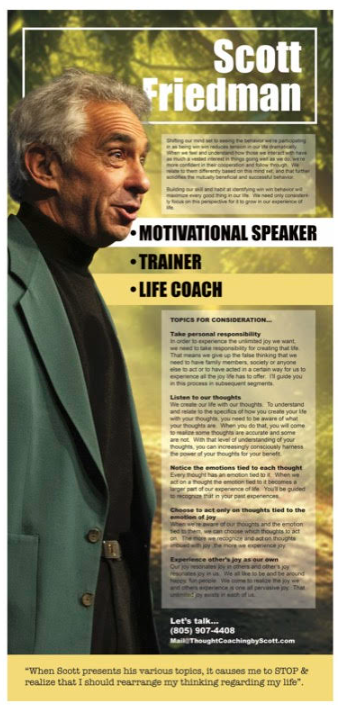
Scott Friedman has maintained a daily meditation practice for over 40 years and has authored 14 books on thought coaching and conscious leadership. His executive coaching model is unique: you pay nothing upfront. At the successful conclusion of coaching, you pay what you think it was worth. Learn more about Scott or book a free call.