After forty years of coaching people who ask this question, I can tell you the answer directly, and it has two parts. The first part is the standard answer, and it is correct as far as it goes. Three to six months of essential expenses. That is what the financial planning profession recommends, and it is a reasonable target for most people. Start with one thousand dollars, then build toward three months, then six if your income is variable or your household has a single earner. That is the math, and the math is not wrong.
The second part of the answer is the one nobody gives you, and it is the part that actually matters. The size of the fund is not what is producing the security you are looking for. I have coached people with three months saved who feel calm and people with twelve months saved who feel panicked. The difference between them is not the balance. The difference is the thought layer each one is running about the balance. The person asking how big of an emergency fund they need is usually not asking for a number. They are asking for relief from an anxiety that no number will satisfy. Until you understand that, you will build the fund and still feel the fear, and you will not know why.
The Standard Answer, and Why It Is Not Enough
The standard advice comes from the financial planning profession, and it is consistent across the major institutions. The Consumer Financial Protection Bureau, Fidelity, Bankrate, and USAA Educational Foundation all recommend three to six months of essential expenses. Start with a smaller goal, one thousand dollars, to get something in place. Then build toward three months. Then, if your situation calls for it, six months or more. The guidance is to count essential expenses only, not your full spending, because an emergency is not a vacation. It is rent, food, insurance, utilities, minimum debt payments, and anything you cannot stop paying without serious consequence.
That answer is sound. I am not going to tell you to ignore it. If you have nothing saved, start with one thousand dollars. If you have one thousand, build toward three months. If you have three months and your income is variable or you are the sole earner, build toward six. The math is a reasonable floor.
But here is what I have seen across forty years of coaching. The person who asks how big of an emergency fund they need is usually not at zero. They have something saved. Often they have more than the standard recommendation. And they are still anxious. They are asking the question because the amount they have is not producing the feeling they expected it to produce. They believed that reaching three months would feel safe. It did not. They believed that reaching six would feel safe. It did not. They are now wondering whether the problem is that they need more, and they are hoping that a bigger number will finally deliver the security that the smaller numbers failed to deliver.
It will not. And the reason it will not is the reason the standard answer is not enough. The security you are looking for is not produced by the size of the fund. It is produced by your relationship to the thoughts that are telling you the fund is not enough. Those thoughts do not go away when the balance goes up. They adjust. They raise the bar. They find a new emergency to worry about. You could have twelve months saved and the thought will say yes, but what if the emergency lasts thirteen. The thought is not responding to the balance. The thought is producing the anxiety, and it is using the balance as material.
The Real Question Behind the Question
When someone asks me how big of an emergency fund they need, I ask them a question back. I ask: what would you do with the number if I gave it to you? The answers are revealing. Most people say they would save toward it. Some say they would feel relieved. A few say they do not know, they just want to know they have enough. That last answer is the honest one, and it is the one that points to the real issue.
The real question is not how much do I need. The real question is how much is enough. And enough is not a number. Enough is a relationship to a thought. The thought says you do not have enough, and it says it regardless of the balance. The person with three months saved and the thought says you need six. The person with six months saved and the thought says you need twelve. The person with twelve months saved and the thought says you need twenty-four, because what if there is a recession, what if there is a medical emergency, what if there is a layoff and a medical emergency at the same time. The thought is not calibrating to reality. It is generating fear and then reaching for a number to justify it.
Research on scarcity mindset, beginning with the work of Eldar Shafir at Princeton and Sendhil Mullainathan at Harvard, found that perceived scarcity affects cognitive performance and pushes people toward short-term thinking over long-term planning. The key word there is perceived. The scarcity is not the actual shortage of money. It is the perception of shortage, and the perception can persist in the presence of ample resources. The researchers found that people can have a twelve-month emergency fund and still feel anxious about an eight-dollar coffee. The anxiety is not produced by the account balance. It is produced by the thought layer interpreting the balance as insufficient.
This is why the standard answer fails for the person who is actually asking. The standard answer gives a number. The person asking does not need a number. They need to see the thought that is making every number insufficient. Until they see it, no number will work.
Three Thought Patterns That Make No Amount Enough
After forty years, the patterns take a limited number of forms. Here are the three I see most often in people who can never feel that their emergency fund is sufficient.
1. The catastrophe thought
The thought says: the emergency that is coming is worse than anything you have planned for. This thought does not respond to the size of the fund. It responds to the size of the imagined emergency, and the imagined emergency grows to exceed whatever fund you have built. If you have three months, the thought imagines a six-month emergency. If you have six, it imagines twelve. The thought is not forecasting. It is generating fear and then constructing a scenario to match. The person experiencing this thought believes they are being prudent. They are not being prudent. They are being driven by a thought that uses prudence as its disguise. When the thought is seen as a thought, the person can plan for reasonable emergencies without being consumed by the planning. The fund gets built from a steady state rather than from a panicked one, and the panicked planning was never producing better preparation anyway. It was only producing more panic.
2. The inadequacy thought
The thought says: you are not the kind of person who handles money well, so no matter what you have saved, it is probably not enough because you will probably do something wrong. This thought is not about the fund. It is about the self. The person carrying this thought does not trust themselves with money, and the distrust extends to the emergency fund. They can have six months saved and still feel that something is wrong, because the thought says the problem is not the number, the problem is them. This is the cruelest pattern, because it turns every financial achievement into evidence of inadequacy rather than evidence of competence. The person saves three months and the thought says you got lucky. They save six and the thought says you will probably lose it. The fund grows and the feeling does not improve, because the feeling was never about the fund. When the thought is seen as a thought, the person can recognize that they have been handling money their entire life, that the fund itself is evidence of competence, and that the inadequacy was a story running underneath the saving rather than a fact about the saver.
3. The moving-target thought
The thought says: enough is just a little more than what you have. This thought is the reason the person keeps raising the target. Three months becomes six. Six becomes twelve. Twelve becomes twenty-four. Each milestone is reached and immediately reinterpreted as insufficient. The person believes they are being responsible by continually increasing the goal. They are actually being driven by a thought that has no stopping condition, a thought for which enough is always one step further. This pattern is invisible to the person carrying it, because each increase feels rational at the time. What if the economy turns. What if I get sick. What if both happen. Each what-if is individually plausible, and the accumulation of them feels like diligence. It is not diligence. It is a thought that uses diligence as its cover. When the thought is seen as a thought, the person can set a target, reach it, and stop. The stopping is the part that was never possible before, because the thought would not allow it. Seeing the thought is what makes stopping possible.
What Actually Works
The solution is not to stop building the fund. Build the fund. Three to six months of essential expenses is a reasonable target, and having it is better than not having it. The solution is to build the fund while also seeing the thought layer that has been making every amount insufficient. That seeing is what allows the fund to actually deliver the security it is supposed to deliver. Here is what that looks like in practice.
Step 1: Build the fund, and notice the thought that says it is not enough
Save toward the standard target. As you do, notice the thought that arises when you check the balance. The thought will say something like this is not enough, or you need more, or something could go wrong. Notice that the thought is a thought. It is not a measurement. It is not telling you something about the balance. It is telling you something about the pattern that is interpreting the balance. The noticing is what loosens the pattern. You do not need to argue with the thought. You do not need to replace it with a better one. You need to see it as a thought rather than as a fact.
Step 2: Set a real target and commit to stopping
Pick a number based on your actual situation. Three months if your income is stable and you have multiple earners. Six months if your income is variable or you are the sole earner. More than six only if your situation genuinely calls for it, not because the thought says you need more. Then commit to stopping when you reach it. The commitment to stop is the part the thought has been preventing. The thought says you can always need more, so you never have to arrive. Arriving is what reveals whether the thought was about the fund or about something else. When you arrive and the anxiety is still there, you have learned something the thought was hiding from you. The anxiety was never about the fund. It was about the thought layer. Now you know where to look.
Step 3: See the inadequacy thought when it arises
If you have reached your target and the feeling of not-enough persists, the thought at work is the inadequacy thought. It is telling you that the problem is not the number, the problem is you. This thought is the hardest to see, because it feels like an honest self-assessment rather than a thought. It is not an honest self-assessment. It is a pattern, and the pattern is older than your finances. It usually formed long before you had an emergency fund, often in childhood, and it has been applying itself to every area of your life, not just money. Seeing it as a thought rather than as a truth about yourself is what allows the fund to do its job. The fund is adequate. The thought saying you are not is what is inadequate.
Step 4: Let the fund be a tool, not a identity
An emergency fund is a tool. It is money set aside for a specific purpose. It is not a measure of your worth. It is not proof that you are responsible. It is not evidence that you are finally safe. When the fund becomes an identity, when you start to feel that you are a person who has an emergency fund and that this makes you secure, the fund has become another vehicle for the thought layer. The fund is just money. Let it be money. Use it when you need it. Replenish it when you can. Do not make it carry the weight of your security, because money cannot carry that weight, and asking it to is what produces the anxiety no balance can resolve.
What This Is Not
This is not an argument against saving. Saving is wise. Having three to six months of expenses set aside is a sound practice, and I am not suggesting you skip it. What I am pointing at is the difference between building a fund from a steady state and building a fund from a fearful one. The fund built from fear is never finished, because fear has no stopping condition. The fund built from clarity has a target, reaches it, and stops. Both produce a balance. Only one produces peace.
This is also not an argument that you should not prepare for real emergencies. Job loss, medical events, and major repairs happen, and having money set aside for them is one of the most practical things you can do. The point is that the preparation is more effective when it is not being driven by a thought layer that will never be satisfied. A steady mind makes better financial decisions than a panicked one. The fund benefits from the steady mind, and the steady mind is what the thought layer has been preventing.
What This Looks Like in Ventura County
I work with people across Ventura County who carry these patterns, and the context shifts by profession and life stage. In the tech and biotech corridors around Thousand Oaks and Agoura Hills, the moving-target thought is common. People with stable incomes and six months saved are still anxious, because the thought says the next layoff cycle could be worse than the last one. In the small-business and professional-services communities across Camarillo and Westlake Village, the inadequacy thought runs the show. Business owners who have built substantial reserves still feel they are one bad quarter away from disaster, because the thought says they are not the kind of person who handles money well, regardless of the evidence. In the healthcare and public-sector workforces concentrated around Ventura and Oxnard, the catastrophe thought is dominant. People with steady, secure jobs and decent savings are still preparing for emergencies that combine layoff, illness, and family crisis into a single event, because the thought constructs the worst-case scenario and then treats it as the likely one.
The content of the pattern changes by context. The mechanism does not. The mechanism is always a thought interpreting the balance as insufficient. The coaching I do does not change by profession. We look at the thought layer together. We do not try to replace the thoughts. We bring them into view so they stop producing the anxiety undetected.
Sessions are by phone or video. You do not need to leave your home. The work is interior, and it can be done from anywhere in the county or anywhere in the country.
How Money Mindset Coaching Addresses Emergency Fund Anxiety
Money mindset coaching, the way I practice it, is not about budgeting systems, spreadsheet templates, or savings challenges. I am not going to give you a new app or a new formula. Those approaches treat the problem as a system problem, and the system is not the problem. The problem is the thought layer that makes every system insufficient. The thought layer is where I work.
What I do is help you see the thoughts that have been producing the never-enough feeling. The catastrophe thought. The inadequacy thought. The moving-target thought. Once you see them as thoughts rather than as facts about your situation or yourself, the anxiety starts to decrease on its own. Not because you built a bigger fund. Because the thing that made the fund feel insufficient is no longer running. Your saving continues. Your planning continues. The suffering that accompanied them falls away. That is the work, and it is the work I have done for forty years.
If you want to explore this, learn more about money mindset coaching or book a free discovery call. You pay nothing upfront. At the successful conclusion of coaching, you pay what you think it was worth. That model exists because I am confident the work works, and I would rather you find out for yourself than take my word for it.
Frequently Asked Questions
How big of an emergency fund do I need?
The standard recommendation from the financial planning profession is three to six months of essential expenses. Start with one thousand dollars, build toward three months, then toward six if your income is variable or you are the sole earner. That is a reasonable target. But the size of the fund is not what produces the security you are looking for. The security is produced by your relationship to the thoughts telling you the fund is not enough. Build the fund, and also see the thought layer.
Why do I still feel anxious even though I have six months saved?
Because the anxiety was never produced by the balance. It was produced by a thought layer interpreting the balance as insufficient. The thought raises the target every time you reach it. Three months becomes six, six becomes twelve. The thought has no stopping condition. Seeing the thought as a thought rather than as a fact is what allows the fund to deliver the security it is supposed to deliver.
Should I save more than six months of expenses?
Only if your situation genuinely calls for it. Variable income, a single earner, health conditions, or an unstable industry can justify more than six months. But saving more than six because the thought says you need more is not prudence. It is a pattern. Set a target based on your actual situation, reach it, and commit to stopping. The commitment to stop is the part the thought has been preventing.
What counts as essential expenses for an emergency fund?
Essential expenses are the costs you cannot stop paying without serious consequence. Rent or mortgage, food, insurance, utilities, minimum debt payments, and required transportation. An emergency fund is not for vacations, dining out, or discretionary spending. The standard guidance is to calculate your essential monthly expenses and multiply by the number of months you are targeting.
Is it normal to feel like no amount is ever enough?
It is common, but it is not a fact about your finances. It is a thought pattern. Research on scarcity mindset shows that perceived scarcity can persist in the presence of ample resources. People with twelve-month funds can still feel anxious about small purchases. The feeling is produced by the thought layer, not the balance. Seeing the thought as a thought is what allows the feeling to shift.
How is this different from financial advice?
Financial advice addresses the math. How much to save, where to keep it, how to invest it. That is valuable and I am not suggesting you skip it. Money mindset coaching addresses the thought layer that makes the math feel insufficient no matter what it is. The two approaches complement each other. This is not a replacement for professional financial planning.
Do you work with people outside Ventura County?
Yes. Sessions are by phone or video. I work with people across the country. The thought patterns I see in Camarillo are the same patterns I see in people in New York, Chicago, and Seattle. The context varies. The mechanism does not.
How much does money mindset coaching cost?
You pay nothing upfront. At the successful conclusion of coaching, you pay what you think the work was worth and what you can afford. There is no set fee. The first discovery call is free and there is no obligation to continue. This model is not a marketing tactic. It is how I have practiced for forty years.
Ready to See What Is Actually Producing the Anxiety?
If you have been building the fund, reaching the targets, and still feeling that it is not enough, the reason is not that your fund is too small. The reason is that the thought producing the feeling was never about the fund. It was about a pattern that uses the fund as material. That pattern can be seen. And a thought that is seen is a thought that stops running your financial life from below awareness.
If you are ready to stop chasing a number that will never be enough and start seeing what is actually producing the anxiety, book a free discovery call. We will look at the thought layer together. You will see, probably for the first time, that the security you have been trying to buy with a bigger balance was never going to come from the balance. It was going to come from seeing the thought that was making every balance insufficient. Seeing it is the work. The work is what changes everything.
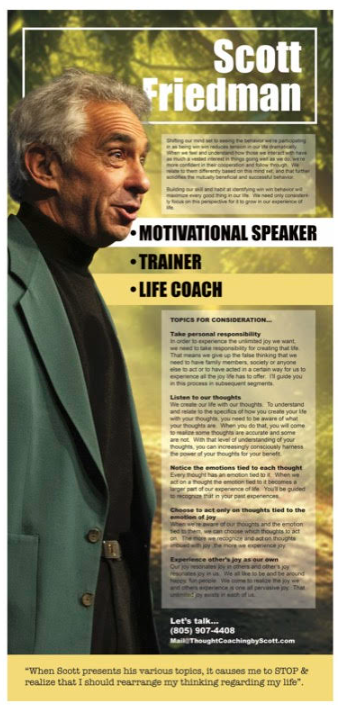
Scott Friedman has maintained a daily meditation practice for over 40 years and has authored 14 books on thought coaching and conscious living. His money mindset coaching model is unique: you pay nothing upfront. At the successful conclusion of coaching, you pay what you think it was worth. Learn more about Scott or book a free call.