After forty years of coaching people who are trying to become top performers, and coaching executives who are trying to build teams of them, I can tell you the answer directly. The reason most people plateau below their capacity is not that they lack talent, discipline, or work ethic. The reason is that a layer of thought is running underneath their performance, capping it, and they cannot see the layer because they have never been taught to look at thought as thought. Top performance is not produced by adding more effort. It is produced by removing the obstruction. The obstruction is thought. And a thought can be seen.
The standard advice on becoming a top performer is built on a false premise. The premise is that performance is a function of effort, and that more effort produces more performance. This is true up to a basic threshold. Past that threshold, more effort produces diminishing returns, then burnout, then decline. The people who break through to sustained top performance are not the ones who push harder. They are the ones whose pushing stopped being obstructed by a thought layer they had been carrying without knowing it. The effort did not change. The obstruction changed. That is the entire difference, and almost no one talks about it because almost no one is looking at the layer where the difference is made.
Why the Effort Approach Fails
The standard approach to top performance goes like this. You identify the traits of top performers. You adopt them. You work harder. You measure more. You optimize your habits. You read the books. You build the routines.
This approach treats performance as a behavior problem. It assumes that if you replicate the behaviors of top performers, you will replicate their results. The approach works for mechanical tasks. It does not work for performance at the level where it actually matters, because performance at that level is not mechanical. It is the output of a human being whose internal state determines whether their talent and effort can actually reach the surface.
Here is what I have seen across forty years. A capable professional reads that top performers have a growth mindset. They resolve to adopt one. They start framing challenges as opportunities. They tell themselves they are learning. But underneath the new framing, a thought is still running that says "if I fail at this, it means something about me." That thought was never examined. It was papered over with a growth-mindset label. The next time a real challenge arrives, the thought fires, the body tightens, the performance drops, and the person is confused because they were "doing growth mindset." They were doing the behavior. The thought producing the opposite was still running underneath.
The effort approach fails because it operates at the behavior level while the cap on performance operates at the thought level. You cannot out-effort a thought you cannot see. You can only perform up to the ceiling the thought sets, and the ceiling feels like your limit because the thought has been there so long you mistake it for reality. Top performers are not people who raised the ceiling. They are people whose ceiling dissolved because the thought producing it was seen as a thought.
Where Top Performance Actually Comes From
Let me be specific about what I mean by "the thought layer capping performance," because the phrase can sound abstract and I do not mean it abstractly. Every performance a person gives is preceded by thought. Most of those thoughts are automatic. The person did not choose them. They arise from patterns formed by the person's history, conditioning, and current stress level. The thought arises first. The person believes it. The performance follows. The person experiences the performance as their effort or their ability. They do not experience the thought that shaped it, because the thought was so fast and so familiar it did not register as a thought. It registered as reality.
Here is an example I have seen hundreds of times. A senior executive is preparing for a board presentation that will determine whether a major initiative gets funded. The night before, a thought arises: "if this goes badly, the board loses confidence in me, and my position becomes vulnerable." The thought is not examined. It is obeyed. The body responds to the thought as if the bad outcome has already happened. Cortisol rises. Sleep degrades. The executive wakes up tired, tight, and slightly defensive. They walk into the presentation carrying the physiological signature of a person who is under threat. Their delivery is competent but tight. The board reads the tightness as uncertainty. The initiative gets a cautious reception. The executive leaves believing the outcome was about the initiative. It was not. It was about a thought that arose the night before, was obeyed, and shaped the body that walked into the room.
Top performance is not the absence of thought. It is the presence of a different relationship to thought. The top performer in that scenario would have had the same thought arise. The difference is that the top performer has done enough interior work to see the thought as a thought rather than as a forecast. The thought is seen, not obeyed. The body does not tighten. Sleep is not lost. The executive walks into the room at baseline instead of in a threat state. The delivery is the same content, but the body carrying it is different. The board reads calm authority instead of tight competence. The initiative gets funded. Same person. Same preparation. Same content. Different relationship to one thought. That is the entire margin between good and top performance at the executive level, and it is made entirely at the layer most people never look at.
The Thought Patterns That Cap Performance
After forty years, I can tell you that the patterns take a limited number of forms. Here are the four I see most often in capable people who are stuck below their capacity.
1. The comparison thought
The thought says: "that person is ahead of me, and that means I am behind." This thought produces performance driven by insecurity rather than capacity. The person performs to close a gap they perceive between themselves and someone else. The performance can look impressive from the outside. It is exhausting from the inside, because the gap never closes. There is always someone ahead. The person runs faster and faster on a treadmill that moves with them. The comparison thought caps performance because the energy fueling it is finite and corrosive. Top performers are not free of comparison. They are free of the belief that comparison is a useful fuel source. When the thought is seen as a thought, the treadmill stops. The person performs from capacity instead of from deficit. The performance improves because the fuel changed.
2. The identity thought
The thought says: "I am my performance. If this goes badly, I am diminished." This thought produces performance under existential pressure. Every outcome carries the weight of the person's entire sense of self. A presentation is not a presentation. It is a referendum on whether the person is good enough. The pressure this creates does not produce top performance. It produces tight, careful, defensive performance that is designed to avoid failure rather than to create. The identity thought caps performance because the person cannot take the risks that produce breakthroughs when every risk feels like a threat to their existence. When the thought is seen as a thought, the person and the performance separate. The performance becomes a thing the person does, not a thing the person is. The pressure drops. The risk tolerance rises. The performance improves because the person stopped treating every outcome as a verdict on their worth.
3. The control thought
The thought says: "if I do not control every variable, something will go wrong." This thought produces performance that is thorough but narrow. The person checks everything, manages everything, refuses to delegate. Their individual output is high. Their leverage is zero. They are a top individual contributor trapped in a role that requires leverage, and they cannot understand why their hard work is not scaling. The control thought caps performance because it prevents the person from doing the one thing that multiplies output, which is trusting other people to do parts of the work. When the thought is seen as a thought, the person can let go without the letting go feeling like abandonment. Leverage appears. The person's impact multiplies without their hours increasing. The performance improves because the person stopped confusing control with quality.
4. The fuel thought
The thought says: "I need stress, pressure, or fear to perform. Without them, I will coast." This thought produces performance that is high in bursts and unsustainable across time. The person has learned to activate themselves through adrenaline. They perform well under deadline, poorly without one. They perform well under threat, flat without one. Over years, the adrenaline system degrades. The bursts get shorter. The recovery gets longer. The person attributes the decline to aging or circumstance. It is neither. It is the predictable output of running a human being on a fuel source that was never designed for sustained use. When the thought is seen as a thought, the person discovers that calm produces better performance than stress does, and that the stress was never the source of the performance. It was the noise on top of a capacity that was already there. The performance improves because the person stopped burning the wrong fuel.
What Top Performers Actually Do Differently
These are not habits you copy. These are the natural outputs of a person whose thought layer has stopped capping their capacity. Each one is what remains when the obstruction is removed.
Difference 1: They perform from capacity, not from deficit
Research on motivation distinguishes between people driven by what they lack and people driven by what they have to give. The first group performs to fill a hole. The second group performs because the work draws out something in them that wants to be expressed. The first group can produce strong results for a while. The second group produces strong results for decades. The difference is not willpower. It is the thought layer. The deficit performer is running a thought that says "I am not enough yet, and this performance will prove I am." The capacity performer has seen through that thought. They perform because the work is there and they are there and the two meeting is satisfying. The performance is lighter, more creative, and more durable. Not because they tried harder. Because the thought making it heavy is no longer running.
Difference 2: They separate self from outcome
The capacity to take a real risk requires the capacity to survive a real failure. People who cannot separate their identity from their performance cannot take the risks that produce breakthroughs, because a breakthrough requires a failure rate, and every failure feels personal. Top performers fail often. They do not enjoy it. But they do not experience it as a verdict on their being, because the thought that would make it a verdict has been seen through. This is not detachment. It is accuracy. A performance is a thing a person does. It is not a thing a person is. When that distinction is lived rather than asserted, the person can throw themselves at hard problems without the throwing feeling like self-destruction. The performance improves because the person can finally reach for outcomes that require risk.
Difference 3: They recover without guilt
Most capable people rest badly. They stop working but do not stop the thought that says "I should be working." The body is still running. The rest is not restorative. They return to work slightly more depleted than when they stopped. Over months, this compounds into a performance ceiling that looks like a talent limit. Top performers rest without the guilt-producing thought running underneath, because the thought has been seen. The rest is actual rest. The body actually recovers. They return to work at a higher baseline each cycle. The performance improves not because they worked more but because they finally let the work go during the hours that were supposed to be recovery. The thought that said resting is failing was the thing that made the rest fail.
Difference 4: They take feedback as information, not as judgment
Feedback is the fastest route to improvement, and most people cannot use it properly because the thought layer turns every piece of feedback into a verdict. A note on a presentation becomes "they think I am bad at this." A suggestion on a strategy becomes "they do not trust my judgment." The information in the feedback is lost because the thought about the feedback is louder than the feedback itself. Top performers hear the same words and extract the information, because the thought that would turn it into a verdict has been seen through. They improve faster not because they are more talented but because they can actually use the data that is already coming at them. The performance gap between people who can take feedback as information and people who cannot is enormous, and it is made entirely at the thought layer.
Difference 5: They perform in the present, not in the forecast
Most performance is degraded by thought about the performance. The person is in the meeting but their mind is running the next meeting, or replaying the last one, or forecasting how this one will be received. The actual moment is being skimmed. The performance in the moment is therefore partial. Top performers are not people who have trained themselves to focus. They are people whose thought layer has stopped pulling them out of the moment, because the thoughts that do the pulling have been seen. Presence is not a skill. It is the absence of the noise that covers it. When the noise is gone, presence is what is left, and it is complete. The performance improves because the person is finally entirely in the room they are in.
What This Is Not
This is not an argument against hard work, discipline, or good habits. Those matter. But they are downstream of the thought layer. A person running the comparison thought will work hard and burn out. A person running the identity thought will have good habits and perform tight. A person running the fuel thought will be disciplined and decline. The behaviors are correct. The thought layer underneath them is capping the return. When the thought layer is seen, the same hard work produces more, the same good habits produce looser, and the same discipline sustains longer. The work is not wasted. The obstruction was wasting it.
This is also not an argument that top performers are a different species. They are not. They are people who, through circumstance, practice, or grace, came to see thought as thought earlier or more often than the people around them. That capacity is not genetic. It is learnable. The learning is not a technique. It is a shift in relationship to the thoughts that have been running a person's performance without their awareness. That shift is what I do in coaching, and it is what I have done for forty years.
What This Looks Like in Ventura County
I work with executives and professionals across Ventura County, and the patterns show up in every sector. In the technology and biotech companies of Thousand Oaks and Agoura Hills, the identity thought is dominant. People who built their careers on being the smartest person in the room cannot let go of that identity as their teams grow, and their performance caps at the width of their own attention. In the financial and professional services firms of Westlake Village and Camarillo, the comparison thought runs through the culture. Partners measure themselves against other partners, and the measurement produces performance that looks competitive but is actually driven by insecurity, which is a finite fuel. In the healthcare and public sector organizations of Ventura and Oxnard, the control thought is common. Leaders who are excellent individual contributors cannot scale because letting go of control feels like letting go of quality.
The content of the pattern changes by sector. The mechanism does not. The mechanism is always the same. A thought arises, it is mistaken for a necessary response or a fixed reality, and a performance follows that is lower than the person's actual capacity. The coaching I do does not change by industry. We look at the thought layer together. We do not try to replace the thoughts with better ones. We bring them into view so they stop driving performance undetected. What is left when the obstruction is removed is the person's actual capacity, and it is almost always higher than they thought it was.
Sessions are by phone or video. You do not need to leave your office. The work is interior, and it can be done from anywhere in the county or anywhere in the country.
How Executive Coaching Addresses Performance
Executive coaching, the way I practice it, is not performance training. I am not going to give you a framework for peak performance or a set of habits that top performers use. Those approaches treat the symptom. They try to produce better performance to replace capped performance. The capped performance is not the problem. The thought producing the cap is the problem, and the thought is not addressable by trying to perform differently on top of it.
What I do is help you see the thought layer that has been capping your performance. Once you see it, the performance starts to change on its own. Not because I tell you it should. Because that is what happens when a thought is seen as a thought instead of experienced as a fixed limit. The coaching is not about adding anything to you. It is about removing the obstruction to the capacity you already have but cannot access because the thought layer is sitting on top of it.
If you want to explore this, learn more about executive coaching or book a free discovery call. You pay nothing upfront. At the successful conclusion of coaching, you pay what you think it was worth. That model exists because I am confident the work works, and I would rather you find out for yourself than take my word for it.
Frequently Asked Questions
What makes a top performer?
A top performer is not someone with more talent, discipline, or effort. A top performer is someone whose thought layer has stopped capping their capacity. The thoughts that produce comparison, identity-pressure, control, and stress-fueled performance run underneath most people's work without being seen. When those thoughts are seen as thoughts rather than as fixed realities, the obstruction dissolves and the person's actual capacity surfaces. Top performance is not produced. It is uncovered.
Can you become a top performer through hard work alone?
Hard work is necessary but not sufficient. Past a basic threshold, more effort produces diminishing returns because the thought layer capping performance is not affected by effort. You can work harder and still hit the same ceiling, because the ceiling is made of thought, not of insufficient effort. The people who break through to sustained top performance are the ones whose effort stopped being obstructed by unexamined thought. The effort did not change. The obstruction changed.
What is the difference between a high performer and a top performer?
A high performer produces strong results through effort, discipline, and often stress-based fuel. The results are real but often unsustainable and frequently driven by deficit. A top performer produces strong results from capacity, with the thought layer that would cap it seen through. The results are more durable, more creative, and less costly to the person producing them. The difference is not talent. It is the relationship to the thought layer underneath the performance.
How do I know if a thought is capping my performance?
You cannot know by introspection alone, because the thought is too familiar to register as a thought. It registers as reality. The signs that a cap is operating are performance that plateaus below your apparent capacity, performance that degrades under pressure that should not affect it, recovery that does not restore you, and feedback that lands as judgment instead of information. Each of these is the output of a specific thought pattern. Seeing the pattern is what loosens it.
Is this different from standard executive coaching?
Most executive coaching focuses on behaviors, skills, and frameworks. It helps you communicate better, prioritize better, manage your time better. Thought coaching goes one layer deeper. It looks at the thoughts producing the behaviors that the skills coaching is trying to correct. When the thought layer is seen, the behaviors improve without effort. When it is not seen, the behaviors improve temporarily and revert under pressure, because the thought producing them is still running underneath.
Do you work with people outside Ventura County?
Yes. Sessions are by phone or video. I work with executives and professionals across the country. The thought patterns I see in Camarillo are the same patterns I see in people in New York, Chicago, and Seattle. The industry context varies. The mechanism does not.
How much does executive coaching cost?
You pay nothing upfront. At the successful conclusion of coaching, you pay what you think the work was worth and what you can afford. There is no set fee. The first discovery call is free and there is no obligation to continue. This model is not a marketing tactic. It is how I have practiced for forty years.
Ready to Look at What Is Actually Capping Your Performance?
If you have been working hard and hitting a ceiling that will not move, the reason is not that you have not tried hard enough. The reason is that the ceiling is made of thought, and no amount of effort addresses a thought you cannot see. The performance you are reaching for is already in you. It is being obstructed by patterns you did not choose and have never been taught to look at. The patterns are not permanent. They are just unseen. And a thought can be seen.
If you are ready to stop trying to out-effort a ceiling and start seeing what is actually producing it, book a free discovery call. We will look at the thought layer together. You will see, probably for the first time, that the performance you have been chasing is being blocked by thoughts you did not know you were having. Seeing them is the work. The work is what changes everything.
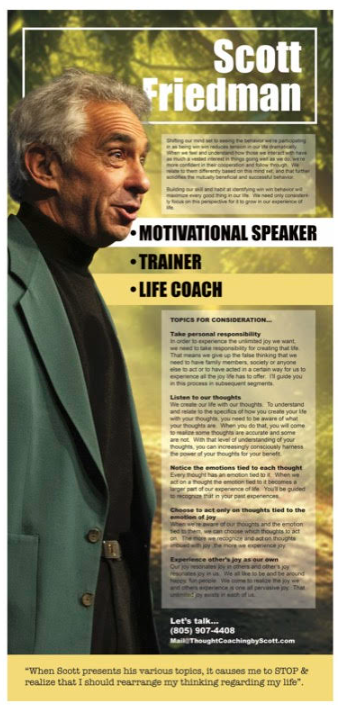
Scott Friedman has maintained a daily meditation practice for over 40 years and has authored 14 books on thought coaching and conscious performance. His executive coaching model is unique: you pay nothing upfront. At the successful conclusion of coaching, you pay what you think it was worth. Learn more about Scott or book a free call.