After forty years of coaching people who tell me that nothing feels meaningful anymore, I can tell you the answer directly, and it starts with a distinction that matters more than any advice I could give you. There are two things that produce the experience of nothing feeling meaningful, and they require completely different responses. The first is clinical. The second is what I work with. You need to know which one you are dealing with before you read any further.
The first is anhedonia. Anhedonia is the clinical term for a marked loss of the capacity to feel interest or pleasure, and it is recognized in the DSM-5 as a core feature of depressive disorders. Research suggests that up to seventy percent of people experiencing depression may have some degree of anhedonia, and a growing body of evidence indicates that anhedonia is at least partially independent from depression itself, meaning it can persist after depressive symptoms lift and may require targeted treatment. If what you are experiencing is anhedonia, the response is not self-help and it is not coaching. The response is a clinical evaluation. Talk to your doctor or a licensed mental health professional. I am going to say this again at the end of this piece, and I want you to hear it now: if the flatness you are feeling is clinical, the most useful thing you can do is get assessed. Nothing in this article is a substitute for that.
The second thing that produces the experience of nothing feeling meaningful is what I work with, and it is far more common than anhedonia. It is a thought problem. The flatness is real, but it is being produced by a layer of thought that is interpreting your experience as meaningless, and that thought layer is what is covering the meaning that is already present. The person experiencing this is not broken. They are running a pattern. The pattern can be seen. When it is seen, the meaning does not get manufactured. It gets uncovered. Those are different processes, and the difference is the entire answer to the question you are asking.
Why the Standard Advice Fails
The standard advice for someone who says nothing feels meaningful goes like this. Find your passion. Set meaningful goals. Practice gratitude. Serve others. Live with intention. Pursue purpose. Get into flow. Try new things. Break your routine.
This advice treats the problem as a motivation problem. The assumption is that meaning is something you produce through activity, and that if nothing feels meaningful, you are not doing enough of the right things, or you are not doing them with the right attitude. The solution, according to the advice, is to do more, do differently, or do with more intention.
Here is what I have seen across forty years. A person who is told to find their passion spends years searching for a passion they cannot locate, because the problem was never the absence of a passion. A person who is told to set meaningful goals sets goals and achieves them and still feels nothing, because the problem was never the absence of goals. A person who is told to practice gratitude writes gratitude lists and feels guilty that the lists do not produce gratitude, because the problem was never the absence of gratitude. The advice fails because it assumes the meaning is missing and needs to be added. The meaning is not missing. It is covered. And you cannot uncover something by adding more things on top of the covering.
There is a second reason the advice fails, and it is more subtle. The advice assumes that the person asking the question is accurately perceiving their experience. It assumes that when they say nothing feels meaningful, they are reporting a fact about reality. They are not. They are reporting a thought about reality. The thought says nothing feels meaningful. The thought is being experienced as a perception rather than as an interpretation. Until the person sees that the meaninglessness is a thought rather than a fact, every intervention aimed at adding meaning will be filtered through the thought and will come out the other side feeling meaningless. The thought converts everything it touches into evidence of its own truth. That is what thoughts do when they are not seen as thoughts.
The Real Mechanism
Let me explain what is actually happening, because understanding the mechanism is what makes the solution possible. Meaning is not a feeling. Meaning is not an emotion. Meaning is not a state you achieve. Meaning is what is present when the thought layer that is calling everything meaningless is not running. This is a different statement than you will find in most places, and it is the statement that forty years of practice has convinced me is accurate.
Consider what happens when you are fully absorbed in something. You are working on a problem, or you are in a conversation, or you are walking outside, and you are not thinking about whether the activity is meaningful. You are just doing it. In those moments, the question of meaning does not arise. It does not arise because the thought layer that asks the question is not active. You are present. Presence is meaningful. The meaning is not produced by the activity. It is produced by the absence of the thought that was questioning the meaning of the activity.
Now consider what happens when you are doing the same activity and the thought layer is active. You are walking outside, and the thought says this is pointless. You are in a conversation, and the thought says none of this matters. You are working, and the thought says what is any of this for. The activity is the same. The meaning is gone. What changed is not the activity. What changed is the thought layer. The thought layer arrived and interpreted the activity as meaningless, and you experienced the interpretation as a quality of the activity rather than as a thought about the activity.
This is the mechanism. The meaninglessness is not in the activities. It is in the thought layer that is interpreting the activities. The activities are neutral. The thought layer is what gives them the quality of meaning or meaninglessness. When the thought layer is seen as a thought layer rather than experienced as a perception, the meaning returns. Not because you added anything. Because you stopped believing an interpretation that was covering what was already there.
Three Thought Patterns That Produce the Flatness
After forty years, the patterns take a limited number of forms. Here are the three I see most often in people who say nothing feels meaningful.
1. The comparison thought
The thought says: this moment does not match what a meaningful moment is supposed to feel like, so this moment must be meaningless. This thought operates by holding a template of what meaning is supposed to look like, usually derived from a memory of a past peak experience or an image of how other people seem to experience their lives, and then comparing the current moment to that template. The current moment always loses the comparison, because the template is an ideal and the current moment is ordinary. The thought then concludes that the ordinary moment is meaningless. The conclusion is wrong. The ordinary moment is not meaningless. It is ordinary. Those are different things. Meaning is not the property of peak moments. Meaning is the property of presence, and presence is available in ordinary moments as fully as in extraordinary ones. When the comparison thought is seen as a thought, the template loses its authority, and the ordinary moment stops being measured against an ideal it was never going to match. The flatness lifts. Not because the moment changed. Because the measurement stopped.
2. The production thought
The thought says: meaning is something you have to produce, and if you are not producing it, you are failing. This thought turns meaning into a task. The person carrying this thought believes they should be generating meaning the way they generate income or generate results at work. They approach their life as a meaning-production problem. They try activities, practices, routines, and projects, and they evaluate each one by whether it produced the feeling of meaning they were expecting. None of them do, because meaning is not produced. The production thought keeps the person in a posture of effort toward something that cannot be reached through effort. It is like trying to fall asleep by trying to fall asleep. The trying is what keeps the sleep away. When the production thought is seen as a thought, the person stops trying to produce meaning, and the meaning that was being blocked by the trying becomes available. The irony is that the effort to produce meaning is one of the most reliable ways to ensure you do not experience it.
3. The numbness thought
The thought says: I am not feeling anything, so nothing is happening, so nothing is meaningful. This thought mistakes the absence of intense feeling for the absence of meaning. The person carrying this thought has a model of what meaning feels like, usually something intense and unmistakable, and when they do not feel that intensity, they conclude that meaning is absent. But meaning does not always feel intense. Often it feels quiet. Often it feels like nothing in particular. The person who is present with their life, who is not at war with their experience, who is simply here, is experiencing meaning. They just are not experiencing the dramatic feeling they have been taught to expect. The numbness thought tells them that the quiet is a problem. The quiet is not a problem. The quiet is what meaning feels like when the noise of the thought layer is not drowning it out. When the numbness thought is seen as a thought, the person stops requiring intensity as proof of meaning, and the quiet that was being interpreted as numbness is recognized as something else entirely.
What Actually Works
The solution is not a technique you apply to generate meaning. The solution is a shift in your relationship to the thoughts that are producing the meaninglessness. That shift is not forced. It is what happens when a thought is seen clearly as a thought rather than experienced as a fact. Here is what that looks like in practice.
Step 1: Notice the thought when it arises
The thought that says nothing feels meaningful arises in specific moments. It arises when you are doing something ordinary. It arises when you are between activities. It arises when you are alone. The thought is fast. It feels like perception. But it is a thought. You can learn to catch it. Not by arguing with it. By noticing it. The noticing is what loosens it. You do not need to replace it with a better thought. You do not need to generate a feeling of meaning to counter it. You just need to see it as a thought instead of as a fact about your experience. When you see it, it loses its authority to define your experience. The meaning it was covering becomes available.
Step 2: Stop trying to produce meaning
If you have been trying to produce meaning through activities, practices, and projects, stop. Not permanently. Long enough to see what is underneath the trying. The trying is being driven by the production thought, and the production thought is what is blocking the meaning. When you stop trying to produce meaning, you will feel uncomfortable. The discomfort is the production thought reacting to the withdrawal of its fuel. Let the discomfort be there. Do not fill it with a new activity. The discomfort will pass, and what is on the other side of it is the meaning that was being blocked by the effort to produce it. This is counterintuitive. It is also accurate. You cannot produce what is already present. You can only stop covering it.
Step 3: Let the ordinary be ordinary
The comparison thought demands that moments be extraordinary to count as meaningful. Let the ordinary be ordinary. Wash the dishes and let washing the dishes be washing the dishes. Walk to the car and let walking to the car be walking to the car. Sit with someone and let sitting with someone be sitting with someone. The meaning is not in the extraordinariness of the activity. The meaning is in the presence you bring to it. Presence does not require the activity to be special. Presence requires only that you are here, which you are, which is why the meaning is available in every ordinary moment the thought layer is not interpreting as insufficient.
Step 4: Stop requiring intensity as proof
The numbness thought requires a dramatic feeling as evidence that meaning is present. Stop requiring that evidence. The quiet is not numbness. The quiet is what remains when the noise of the thought layer subsides. Learn to recognize the quiet as meaning rather than as the absence of meaning. This takes practice, because you have been trained to look for intensity. The training is the problem. When you stop looking for intensity, the quiet begins to register as something else. Not as empty. As full. Not as flat. As alive. Not as meaningless. As the meaning that was always there, underneath the thought that was saying it was not.
What This Is Not
This is not an argument against activity. Doing things is fine. Engaging with life is fine. Pursuing interests is fine. The point is not to stop doing. The point is to stop requiring the doing to produce a feeling it was never going to produce. When the requirement drops, the doing becomes more enjoyable, not less, because you are no longer evaluating every activity against a standard of meaning it was never designed to meet.
This is also not an argument against purpose. Having a sense of purpose is valuable. But purpose is not the source of meaning. Purpose is a direction. Meaning is what is present while you move in the direction. If you believe the meaning is only at the destination, the journey will feel meaningless, and you will arrive at the destination and find that it feels meaningless too, because the thought that made the journey feel meaningless will make the destination feel meaningless. The thought travels with you. Seeing the thought is what allows both the journey and the destination to be meaningful.
And this is not a replacement for clinical care. If the flatness you are experiencing is persistent, if it is accompanied by other symptoms such as changes in sleep, appetite, energy, or concentration, if it is affecting your ability to function, or if you have any thoughts of harming yourself, the first and most important step is a professional evaluation. Anhedonia is a real condition with real treatments. Thought coaching addresses a different layer. The two are not in competition. They address different things. Know which one you are dealing with.
What This Looks Like in Ventura County
I work with people across Ventura County who carry these patterns, and the context shifts by life stage and profession. In the tech and professional-services corridors around Thousand Oaks and Agoura Hills, the production thought is dominant. People who have been high achievers their entire lives arrive at a point where the achieving has stopped producing the feeling it used to produce, and they conclude that something has gone wrong. Nothing has gone wrong. The production thought has simply run out of fuel. The meaning was never in the production. In the healthcare and caregiving professions concentrated around Ventura and Oxnard, the comparison thought runs the show. People who entered their work out of genuine calling have been comparing their daily experience to an idealized version of what meaningful work should feel like, and the daily experience has been losing the comparison for years. The daily experience is not the problem. The comparison is. In the creative and retirement communities of Ojai and Santa Barbara, the numbness thought is common. People who have the time and resources to do what they want are finding that what they want does not produce the intensity they expected, and they are interpreting the quiet as a problem. The quiet is not a problem. The interpretation is.
The content of the pattern changes by context. The mechanism does not. The mechanism is always a thought layer interpreting experience as meaningless. The coaching I do does not change by profession. We look at the thought layer together. We do not try to replace the thoughts. We bring them into view so they stop producing the flatness undetected.
Sessions are by phone or video. You do not need to leave your home. The work is interior, and it can be done from anywhere in the county or anywhere in the country.
How Life Coaching Addresses the Experience of Meaninglessness
Life coaching, the way I practice it, is not about goal-setting, habit-building, or accountability frameworks. I am not going to give you a purpose-finding exercise or a meaning-generation worksheet. Those approaches treat the problem as a production problem, and the problem is not a production problem. The problem is a thought layer that is covering meaning that is already present. The thought layer is where I work.
What I do is help you see the thoughts that have been producing the flatness. The comparison thought. The production thought. The numbness thought. Once you see them as thoughts rather than as facts about your experience, the flatness starts to lift on its own. Not because you generated meaning. Because the thing that was covering the meaning is no longer running. Your life continues. Your activities continue. The suffering that accompanied them falls away. That is the work, and it is the work I have done for forty years.
If you want to explore this, learn more about life coaching or book a free discovery call. You pay nothing upfront. At the successful conclusion of coaching, you pay what you think it was worth. That model exists because I am confident the work works, and I would rather you find out for yourself than take my word for it.
Frequently Asked Questions
Nothing feels meaningful. What can I do?
First, rule out the clinical layer. If the flatness is persistent, accompanied by other symptoms, or affecting your ability to function, get a professional evaluation. Anhedonia is a real condition with real treatments. If the flatness is not clinical, the issue is a thought layer interpreting your experience as meaningless. The standard advice fails because it treats the problem as a production problem. Meaning is not produced. It is uncovered when the thought layer covering it is seen as a thought.
Is feeling like nothing matters a sign of depression?
It can be. Loss of interest or pleasure is a recognized symptom of depressive disorders, and research suggests up to 70% of people with depression experience some degree of anhedonia. If the feeling is persistent, accompanied by changes in sleep, appetite, energy, or concentration, or affecting your ability to function, the first step is a professional evaluation. Thought coaching addresses a different layer and is not a replacement for clinical care.
Why does finding my passion not work?
Because the problem was never the absence of a passion. The problem is a thought layer that interprets experience as meaningless regardless of what you are doing. A person who finds a passion and still carries the thought layer will experience the passion as meaningless. The passion is not the problem. The thought interpreting the passion is. Seeing the thought as a thought is what allows the passion, and everything else, to be meaningful.
Is meaning something you produce or something you uncover?
It is uncovered. The production model, which says you generate meaning through activity, effort, and intention, is the source of much of the suffering around this question. The person trying to produce meaning is like a person trying to see through a window by painting on it. The meaning is already present. The thought layer is what is covering it. Seeing the thought layer is what allows the meaning to be uncovered.
What if I am just numb and not feeling anything?
The numbness thought mistakes the absence of intense feeling for the absence of meaning. Meaning does not always feel intense. Often it feels quiet. The person who is present with their life, who is not at war with their experience, is experiencing meaning. They are just not experiencing the dramatic feeling they were taught to expect. The quiet is not numbness. The quiet is what meaning feels like when the noise of the thought layer is not drowning it out.
How is this different from therapy?
Therapy can address the clinical layer, including anhedonia and depressive symptoms, and it can help with the emotional and historical roots of the flatness. Thought coaching addresses the thought layer that is producing the interpretation of meaninglessness in the present moment. The two approaches can complement each other. This is not a replacement for professional mental health care, and if you suspect the clinical layer is involved, start there.
Do you work with people outside Ventura County?
Yes. Sessions are by phone or video. I work with people across the country. The thought patterns I see in Ojai are the same patterns I see in people in New York, Chicago, and Seattle. The context varies. The mechanism does not.
How much does life coaching cost?
You pay nothing upfront. At the successful conclusion of coaching, you pay what you think the work was worth and what you can afford. There is no set fee. The first discovery call is free and there is no obligation to continue. This model is not a marketing tactic. It is how I have practiced for forty years.
Ready to See What Is Actually Covering the Meaning?
If you have been trying to produce meaning through activities, passions, and practices, and the meaning has not arrived, the reason is not that you have not found the right activity. The reason is that meaning is not produced. It is uncovered. And it is covered by a thought layer that you have been experiencing as perception rather than as thought. That thought layer can be seen. And a thought that is seen is a thought that stops defining your experience from below awareness.
If you are ready to stop trying to produce what is already present and start seeing what is actually covering it, book a free discovery call. We will look at the thought layer together. You will see, probably for the first time, that the meaning you have been chasing was never going to come from an activity or a passion or a practice. It was going to come from seeing the thought that was telling you it was absent. Seeing it is the work. The work is what changes everything.
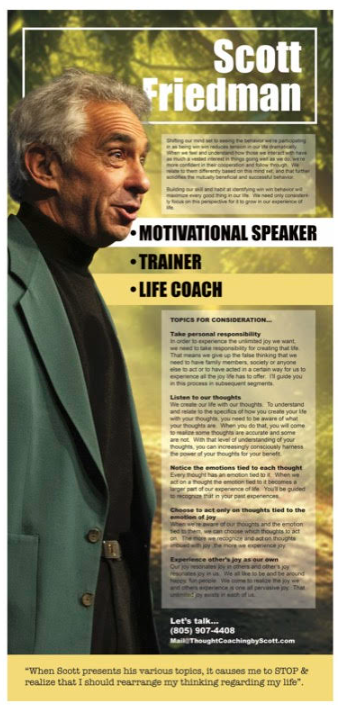
Scott Friedman has maintained a daily meditation practice for over 40 years and has authored 14 books on thought coaching and conscious living. His life coaching model is unique: you pay nothing upfront. At the successful conclusion of coaching, you pay what you think it was worth. Learn more about Scott or book a free call.