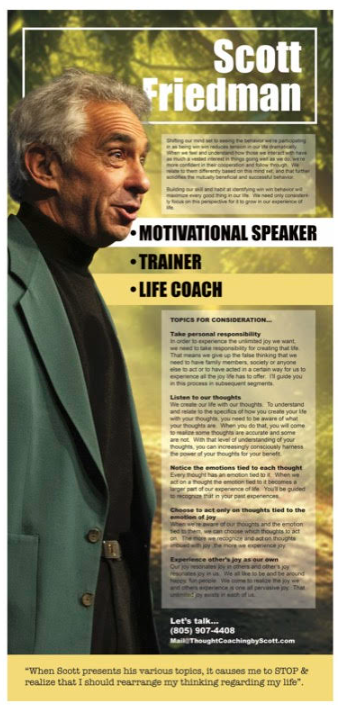
After forty years of coaching people who ask this question, I can tell you the answer directly. The obstacle to making more money is almost never what you think it is. It's not a lack of strategy. You already know more strategies for increasing income than you'll ever use. It's not a lack of effort. Most of the people who ask me this question work harder than anyone I know. The obstacle is a specific set of thought patterns running below the level of your awareness, directing your financial decisions in ways you can't see, and producing outcomes you keep attributing to bad luck or external circumstances. Until you see those patterns, no income strategy works. Once you see them, the strategies you already know start producing different results.
The Question Is Backwards
The question "how can I make more money?" assumes the problem is on the income side. It isn't. Or rather, it usually isn't. The people I've worked with over four decades who ask this question almost always already have the capacity to earn more. What they don't have is access to that capacity, because something between the capacity and the action is intercepting the signal.
Think about it this way. If I asked you right now to list ten ways to increase your income, you could do it in under a minute. Ask for a raise. Change jobs. Start something on the side. Learn a higher-paying skill. Move to a company that pays better. Cut expenses to free up capital. Invest what you have. Build a network of people who can refer you opportunities. Negotiate better on every contract. Price your work higher if you're self-employed.
You know all of that. Everyone knows all of that. The information is not the bottleneck. The bottleneck is that you know these things and you're not doing most of them. Or you're doing them and they're not producing the results they should. That gap between knowing and doing is where the actual problem lives, and it's not a willpower problem or a discipline problem. It's a thought problem.
The thought patterns running in that gap were installed long before you started thinking about income strategy. They were formed in childhood, in early career experiences, in moments of financial stress or shame that you may not even remember consciously. They present as personality. "I'm not good with money." "I don't like selling." "People who care about money are shallow." "I'll figure it out later." "I'm not the kind of person who charges that much." Each of those is a thought, not a fact. But it feels like a fact because it's been running so long it's become invisible.
Here's what I've seen consistently across forty years: when someone examines the thought layer underneath their financial decisions, the income strategies they already know start working. Not because the strategies changed. Because the person stopped unconsciously sabotaging the strategies. The same raise conversation that felt impossible before the examination feels manageable after. The same pricing that felt greedy before feels fair after. The strategy didn't change. The thought running underneath it did.
What's Actually Running Underneath
Let me be specific about what I mean by "the thought layer" because the phrase gets used vaguely and I don't mean it vaguely. Every financial decision you make is preceded by a thought. Most of those thoughts are automatic. You don't choose them. They arise, and you act on them, and you experience the action as your own choice. But the thought came first, and the thought was produced by a pattern, and the pattern was formed by your history with money.
Here's an example I've seen hundreds of times. A person decides they're going to raise their rates. They've been undercharging for years. They know the market supports a higher price. They calculate the number. They prepare the conversation. And then, in the moment, they don't do it. Or they do it but they undercut themselves with a discount they weren't planning to offer. Or they send the email and then immediately send a follow-up with a lower price "just in case."
What happened in that moment? The person will tell you they chickened out. Or that they felt bad. Or that it didn't seem like the right time. Those are descriptions of the surface. What actually happened is that an automatic thought arose in the moment of the decision, and that thought was produced by a pattern, and the pattern was formed by something earlier. The thought might have been "they'll say no and I'll lose the client." Or "charging that much means I'm greedy." Or "who do I think I am to charge that." The thought felt like reality in the moment. It wasn't reality. It was a thought. But the person couldn't distinguish the two, so they acted on the thought as if it were information about the situation rather than information about their own pattern.
This is what I work with. Not income strategies. The capacity to see a money thought as a thought rather than as a fact. That capacity is what changes financial outcomes, because once you can see the thought, you stop automatically obeying it. You don't have to fight it. You don't have to replace it with a better thought. You just have to see it clearly enough that it stops being the invisible director of your financial decisions.
The reason this works where strategy-only approaches fail is simple. A strategy operates at the behavioral level. The thought pattern operates below it. If you install a new strategy on top of an old thought pattern, the thought pattern will override the strategy under pressure. Every time. The strategy says "charge more." The thought says "charging more means I'm greedy." The thought wins because it's deeper and faster and feels like truth. The only way the strategy sticks is if the thought underneath it gets seen for what it is.
Three Relationships That Cap Your Income
After forty years of working with people across the full economic spectrum in Ventura County, I've identified three specific relationships to money that consistently cap income. Not one of them is about skill or market conditions. All three operate at the thought level. All three feel like personality to the person running them.
The first is money as identity. For some people, their income level is not just a number. It's a statement about who they are. The person who believes "I'm a $60,000 a year person" will find a way to stay at $60,000 even when the market is offering $90,000. Not because they can't earn $90,000. Because earning $90,000 would require becoming a different person, and that feels threatening. The identity is "someone who earns this much." Changing the number changes the identity. The thought pattern protects the identity by redirecting opportunities, self-sabotaging negotiations, and avoiding positions that would require a different self-concept.
This pattern is remarkably common among people who grew up in families where income was tied to social class. "Our family isn't the kind of family that has money like that." The statement sounds like a description of reality. It's a thought. But it's been running since childhood, and it produces a ceiling on income that the person experiences as "just how things are for me."
The second is money as threat. For some people, the prospect of earning more triggers a threat response. This sounds counterintuitive. Why would making more money feel dangerous? But I've seen it repeatedly, and the mechanism is specific. The person who grew up in financial instability learned that money is volatile. More money means more to lose. The threat response isn't to poverty. It's to the exposure that comes with higher stakes. Earning more means the fall is further. The thought pattern, formed in genuine precarity, produces risk aversion that caps income at a level that feels "safe" even when the person's actual circumstances no longer require that level of caution.
The tell for this pattern is consistent: the person has opportunities to earn more and turns them down, and the reasons they give sound reasonable but don't hold up under examination. "I don't want the stress." "The commute would be too much." "I like the flexibility I have now." Those may be true. But they're also serving a thought pattern that's protecting the person from the perceived danger of higher stakes. The reasons are real. The function they're serving is invisible.
The third is money as proof of worthiness. This is the most subtle and the most common. The person who needs income to prove they're worthy, competent, or valuable has a relationship to money that makes earning more feel urgent but also makes every financial decision loaded with identity stakes. The pattern produces two specific behaviors. First, working harder than the income justifies, because the work isn't about the money. It's about the proof. Second, chronic dissatisfaction with income regardless of the level, because no amount of money can actually prove worthiness. The need isn't financial. It's psychological. And money can't fill a psychological need, which is why the person keeps earning more and feeling the same.
This pattern is everywhere in Ventura County. The professional who earns $180,000 and feels like they're falling behind. The business owner whose revenue grows but whose anxiety doesn't shrink. The executive who got the promotion and the raise and felt relief for two weeks before the old feeling returned. The income went up. The thought pattern didn't. And the thought pattern is what was producing the feeling, not the income.
Why Working Harder Doesn't Work
This is the part that frustrates people the most. They've been told their whole life that the answer to making more money is to work harder. And they've been working harder. And it hasn't produced the income they expected. So they conclude either that they're not working hard enough, or that the system is rigged, or that they're missing some secret strategy.
None of those conclusions is correct. The problem is that working harder operates at the behavioral level, and the cap on your income is operating at the thought level. Working harder at the behavioral level while the thought-level cap is in place produces exactly what I see in session after session: more effort, more hours, more stress, and income that stays in the same range or grows much more slowly than the effort would predict.
Think of it like driving with the parking brake on. You can press the accelerator harder. You'll burn more fuel. You'll generate more heat. But you won't go faster, because the brake is engaged. The solution isn't to press the accelerator harder. The solution is to release the brake. The parking brake, in this analogy, is the thought pattern. The accelerator is your effort. Most people who ask "how can I make more money" are pressing the accelerator harder and wondering why they're not moving faster. They don't know the brake is on. They can't see it. It's been on so long it feels like the normal driving position.
I've worked with people who doubled their income within a year of starting this work. Not one of them worked harder. Several of them worked less. What changed was not their effort. What changed was the thought pattern that was capping the return on their effort. The same hours, the same skills, the same market produced different income because the person was no longer redirecting, sabotaging, or avoiding the opportunities that were already in front of them.
This is why the personal finance industry's framing of the problem is so unhelpful for most people. The framing says: work harder, save more, invest consistently, learn high-income skills. All correct. All behavioral. None of them addresses the thought layer that determines whether those behaviors actually get executed and whether they produce the results they should. It's like telling someone with the parking brake on to just drive more aggressively. The advice isn't wrong. It's incomplete in a way that makes it useless for the people who need it most.
What Actually Moves Income
What moves income, in my experience, is not more strategy and not more effort. It's the capacity to observe the thought layer that's directing your financial decisions without being governed by it. That capacity is what I've spent forty years developing in myself and teaching to others. It's not a trick. It's not an affirmation. It's a specific skill that gets stronger with practice.
Here's what the skill looks like in practice. You're in a conversation about money. Maybe you're negotiating a salary. Maybe you're setting a price for your work. Maybe you're deciding whether to invest in something. A thought arises. "I can't ask for that much." "This is too risky." "They'll think I'm greedy." "I'll figure it out later." The thought feels like reality. It feels like information about the situation.
The skill is pausing in that moment and recognizing: that's a thought. It's not a fact. It's not information about the situation. It's information about my pattern. The thought may or may not be true. But the point is that I don't know whether it's true until I see it as a thought rather than as reality. Once I see it as a thought, I have a choice. I can act on it or not. When I don't see it as a thought, I have no choice. I act on it automatically because it feels like truth.
This is the core of what I teach. Not what to think about money. The capacity to see what you think about money. That distinction sounds small. It changes everything. Because the thoughts that cap your income are not going to stop arising. They've been running for decades. They'll keep arising. But when you can see them as thoughts rather than as reality, they stop being the invisible director of your financial decisions. You start making money decisions based on the actual situation rather than on the thought pattern's interpretation of the situation.
The results are specific and consistent. People who develop this capacity negotiate differently. They price their work differently. They take opportunities they would have avoided. They stop self-sabotaging when things start going well. They stop turning down raises because the thought "I don't deserve this" arises and they see it as a thought rather than as a verdict on their worth. The income strategies they already knew start working because the thought layer that was intercepting them is no longer running the show.
Five Shifts That Change How Money Works for You
- Stop trying to think positive about money. The positive-thinking approach to money says: replace your negative money thoughts with positive ones. "I am a money magnet." "Wealth flows to me." That approach fails because it treats the negative thoughts as the problem. They're not the problem. The problem is that you can't see them as thoughts. Replacing one invisible thought with another doesn't build the capacity that actually changes outcomes. It just installs a new pattern on top of the old one. What works is seeing the original thought clearly enough that it stops running your decisions automatically. You don't need a better thought. You need to see the one you have.
- Find the thought underneath the behavior. Every financial behavior you're unhappy with has a thought underneath it. The behavior is the output. The thought is the input. When you find yourself avoiding a money conversation, underselling your work, or spending in a way you didn't plan, ask: what thought just arose? Not "why am I doing this" but "what thought produced this action?" The thought is usually simple and old. "I'm not good with money." "Asking for more is rude." "I'll deal with this later." Seeing the thought is the first step to not being governed by it.
- Separate money from identity. This is the hardest shift and the most productive. Your income is a number. It is not a statement about who you are. The entanglement between money and identity is the single most common cap on income I've seen in forty years. The person who believes "I'm a $60,000 person" will stay at $60,000 regardless of what the market offers. The work is not to adopt a new identity. The work is to see that the old identity is a thought, not a fact, and to develop the capacity to act on opportunities that don't fit the old self-concept.
- Examine what money is doing for you emotionally. Money has a practical function: it's a tool for converting effort into optionality. But for most people, money is also doing emotional work. It's providing a sense of safety. Or proof of worthiness. Or status. Or belonging. When money is doing emotional work, the financial decisions you make are serving the emotional function, not the practical one. And no amount of money can fulfill an emotional need, which is why the people doing this pattern keep earning more and feeling the same. Seeing what money is doing for you emotionally is what allows the practical function to operate without the emotional charge.
- Develop the capacity to sit with money discomfort. Every consequential money decision involves discomfort. Raising your rates is uncomfortable. Having the salary conversation is uncomfortable. Investing in something with an uncertain return is uncomfortable. The person who can't tolerate discomfort avoids the decisions that would increase income. The capacity to sit with discomfort without acting to relieve it is a skill. It develops through practice. And it's one of the most practically useful things that comes out of working on the thought layer, because it's the difference between knowing what to do and actually doing it.
What This Looks Like in Ventura County
The patterns I'm describing show up differently depending on context, and Ventura County has specific contexts that produce specific versions of them.
In the biotech corridor around Thousand Oaks and Camarillo, I work with professionals earning strong salaries who still can't build wealth. The income is high. The thought patterns cap it anyway. Lifestyle inflation tracks income perfectly because the spending is doing identity work, not consumption work. The person earns more and spends more because the thought pattern says "people at my level live like this." The spending isn't a choice. It's an identity maintenance program running below awareness.
In the agricultural communities around Oxnard and Santa Paula, the patterns are different and the work is different. Generational financial precarity produces genuine wisdom about survival alongside thought patterns that limit growth once the survival context changes. The person who grew up watching their parents struggle has a relationship to financial risk that was adaptive then and is limiting now. The work is not to overwrite that wisdom. It's to examine whether the patterns still apply to current conditions, and to develop the capacity to choose which patterns to act from.
In Westlake Village and the wealth management community, I see a paradox worth naming. People who understand portfolio theory, tax strategy, and investment mechanics at a sophisticated level still make financial decisions driven by status and identity rather than strategy. The sophistication is real. The thought patterns underneath it are the same ones running in people with a fraction of the financial knowledge. Higher dollar amounts. Same patterns. The knowledge doesn't protect against the patterns because the patterns operate below the level where knowledge functions.
In the small business and entrepreneurial community across Camarillo, Moorpark, and Simi Valley, the difference between businesses that grow and businesses that plateau is almost always found in the owner's thought relationship to risk, pricing, and their own financial identity. The market opportunity is there. The thought pattern produces the plateau before the market does. The owner who can't raise prices because "my clients can't afford it" is running a thought, not reading a market. The owner who can't delegate because "no one does it as well as I do" is running a thought that caps the business at the size of their own capacity. The business plateaus where the thought pattern plateaus.
A Note for Ventura County Professionals
If you're working in the 101 corridor and earning well but not building wealth, the pattern is likely lifestyle inflation doing identity work. The income is high enough. The thought layer directing the spending is where the work is.
If you're in a family where money was always tight, the thought patterns that kept your family afloat may be the same ones capping your income now. Those patterns were right then. They may not be right now. Examining them is not disloyal. It's practical.
If you understand money well and still make decisions you know are wrong, you're not lacking knowledge. You're running a thought pattern underneath the knowledge. The knowledge can't fix it because the pattern operates below the level where knowledge functions.
If you own a business that has plateaued, the plateau is almost certainly in your thought relationship to pricing, delegation, or growth, not in the market. The market is offering more than your thought pattern is letting you reach for.
How Money Mindset Coaching Addresses This
Money mindset coaching, as I practice it, is not financial advice. I don't look at your spreadsheets. I don't tell you what to invest in or how to budget. What I do is work with the specific thought patterns around money that are producing your current financial outcomes. The work is at the level where those patterns operate, which is below the level where strategy and behavior operate.
Most people who come to this work don't arrive framing it as a money problem. They arrive because something in their financial life keeps repeating. A pattern of getting close to a financial goal and then losing ground. A chronic tension around money despite adequate income. A feeling that their financial situation doesn't reflect their effort or intelligence. Working on those patterns almost always reveals a specific set of thought relationships to money, risk, and identity that have been operating below awareness and producing the outcomes the person has been attributing to circumstances.
The circumstances are real. But they're being interpreted and responded to through a thought layer that predates the circumstances, and that layer is where the actual work happens. Once the layer is visible, the person stops being automatically governed by it. The financial strategies they already know start working. The income opportunities they were avoiding start becoming accessible. The self-sabotage that was undercutting their progress loses its grip.
This is not quick work. The patterns that feel most like personality are the ones that have been running longest, and they don't shift overnight. But they do shift. And the shift is durable because it's not a new behavior installed on top of an old pattern. It's the capacity to see the old pattern as a pattern, which is what allows different decisions to be made from the same person rather than requiring a new person.
My model is simple. You pay nothing upfront. At the successful conclusion of coaching, you pay what you think it was worth. That model exists because I'm confident in the work. It also exists because it's a direct expression of the thing I teach: the thought patterns around money, including the patterns around paying for help with money, are worth examining. The person whose pattern says "I can't afford this" is running a thought, not reading a fact. The free call costs you nothing but the time to see whether what I'm describing applies to your situation.
| Approach | What It Does | What It Misses |
|---|---|---|
| Budgeting apps and personal finance books | Provides correct behavioral prescriptions and tracking tools | Doesn't address the thought patterns that override correct behavior under pressure |
| Financial advisor | Optimizes investment allocation and tax strategy | Not designed to address the psychological relationship to money driving financial decisions |
| Income strategy content (side hustles, skills) | Provides specific tactics for increasing revenue | Tactics don't execute themselves; the thought layer determines whether they get used |
| Therapy | Addresses historical sources of money dysfunction | Not primarily designed to develop the day-to-day capacity to observe money thoughts as they arise |
| Money mindset coaching | Works directly with the thought patterns producing current financial outcomes | Requires genuine willingness to examine what the patterns are protecting |
Frequently Asked Questions
Is making more money really just about mindset?
No. Circumstances matter. Access to opportunity is not equally distributed. Structural barriers are real. This is not an argument that mindset is the only factor. It's an argument that among people with access to opportunity who are still not earning what they could, the thought-level patterns I'm describing are usually the primary thing in the way. If you have marketable skills, live in an area with opportunity, and still can't increase your income, the bottleneck is almost always internal, not external.
How long does it take to see changes in income?
The internal shift, how money decisions feel, often changes within weeks of genuinely engaging with the thought layer. The external results, the income number, follow as the new thinking produces different actions. For most people I've worked with, meaningful change in how financial decisions feel happens within the first month. Visible income changes typically follow within three to six months as the person starts acting on opportunities they were previously avoiding and stops sabotaging the ones they were already pursuing.
What if I don't know what my money thoughts are?
Almost no one does when they start. The thoughts are unconscious. That's the whole point. They were formed early and have been running so long they feel like personality. The work of money mindset coaching is making them visible. You don't need to know what they are before you start. You need to be willing to look at what they are once they surface. Most people are surprised by how simple and how old the thoughts turn out to be.
Can this work if I grew up poor?
Yes, and the path is specific. The thought patterns formed in genuine financial precarity were adaptive. They were correct responses to real conditions. Changing them is not about deciding they were wrong. It's about examining whether they still apply to your current conditions and developing the capacity to choose which patterns to act from. That examination, done with respect for the history that produced the patterns, produces durable change. Bypassing the history and just prescribing different behaviors does not.
I already make good money. Is this still relevant?
Often the people who need this work most are the ones already earning well. High income with chronic financial stress, lifestyle inflation that tracks income, the feeling that no amount is enough, or self-sabotage when things are going well are all patterns operating at the thought level. The income is high. The thought layer capping the return on that income is the issue. I work with plenty of people earning in the top percentile who have the same patterns as people earning a fraction of their income, just at higher dollar amounts.
How is this different from financial planning?
Financial planning tells you what to do with your money. Money mindset coaching works with why you're not already doing it. The two are complementary, not competing. A financial plan is only as good as your capacity to execute it, and your capacity to execute it is determined by the thought layer that directs your financial decisions. Most people who come to me have already tried the planning approach and found that the plan was correct but the execution kept falling apart. That gap is where this work lives.
Ready to Look at What's Actually Happening?
If you've been working hard and not getting ahead, and you've already tried the strategies and the budgeting and the side hustles, there's usually something at the thought level that hasn't been examined. A 30-minute conversation costs you nothing. Pay nothing upfront. Pay nothing until coaching concludes, and only what you think it was worth.
Book a Free 30-Minute Call