After forty years of coaching people who have stopped wanting to participate in society, I can give you the answer directly, and it begins with a distinction that almost no advice on this subject makes. The feeling is real. The withdrawal is real. The exhaustion with the social contract is real. What is not real, though it feels more real than anything, is the interpretation your mind has produced about what the feeling means and what you need to do about it. The standard advice tells you to push through it, find your community, or get professional help. Some of that advice is appropriate in some cases. But the advice fails for a specific reason. It treats the withdrawal as the problem, when the withdrawal is the symptom. The problem is the thought layer that has been producing the withdrawal, and the thought layer is not a perception of society. It is an interpretation of society that runs fast and below awareness and feels like a perception. Seeing the thought layer as a thought rather than as a perception is what changes the relationship to the feeling, and the change in relationship is what allows the feeling to move.
Let me explain what I mean, because the distinction is the entire answer. The feeling of not wanting to participate in society has been growing more common, and the research on it is solid. A 2024 survey by the Pew Research Center found that a rising share of adults under thirty report having few or no close friends, and the General Social Survey has tracked a steady decline in social trust across all age groups over the last four decades. The loneliness research from the late John Cacioppo at the University of Chicago established that social isolation is not just unpleasant but carries measurable health consequences. The research is descriptively accurate. People are withdrawing, the withdrawal is increasing, and the withdrawal has costs. The problem is that the research describes what is happening. It does not describe what is producing it. And the standard advice, which tells you to join a group, rebuild your social life, or find meaning in connection, treats the withdrawal as a behavior you can reverse, when the withdrawal is actually what is left when a thought layer has been covering the natural capacity for engagement.
The research from the clinical side points at the same thing from a different angle. Studies on social anhedonia, the reduced capacity to experience pleasure from social interaction, found that the withdrawal is often driven not by a lack of desire for connection but by a protective mechanism gone into overdrive. The mind interprets social situations as requiring more energy than they return, and the interpretation produces the withdrawal, and the withdrawal produces the isolation, and the isolation confirms the interpretation. All of this is accurate. But notice what every one of these findings has in common. They are all descriptions of a condition that is present when something is absent. The desire to participate is present when the thought layer producing the withdrawal is absent. The capacity for connection is present when the thought layer producing the self-protection is absent. The engagement is not an addition. It is what is left when the subtraction happens. And the subtraction happens not by effort but by seeing the thought layer that has been producing the addition's opposite.
Why the Standard Advice Fails
The standard advice for not wanting to participate in society goes like this. Push yourself to socialize. Join a club or a group. Rebuild your social network. Find your community. Volunteer. Get involved in something larger than yourself. Practice self-care. Seek professional help if it persists.
Some of this advice is behaviorally accurate, in the sense that social connection does matter and isolation does carry costs. But the advice fails for a specific reason. It treats the withdrawal as a behavior you can reverse, and it ignores the thought layer that is producing the withdrawal. A person who is told to push themselves to socialize pushes themselves to socialize, and the socializing feels effortful and depleting, and the effortfulness is the problem. The people around them can tell the engagement is forced, because forced engagement has a quality that organic engagement does not. The forced version is effortful. The organic version is effortless. And the person experiencing the effort is experiencing the thought layer that is producing it, not the social situation itself. The standard advice gives the person the behavior without addressing the thought layer producing the effort, and the effort is what makes the behavior feel worse than not doing it.
Here is what I have seen across forty years. A person who is told to join a group joins a group, and the group feels like an obligation, because the thought layer producing the obligation is still running. A person who is told to find their community looks for a community, and the looking reads as a performance, because the thought layer producing the performance is still running. A person who is told to volunteer volunteers, and the volunteering feels hollow, because the thought layer producing the hollowness is still running. The advice produces a performance of participation, and the performance is detectable by the person doing it, and the detection is what makes the person withdraw further. The participation is not produced by performing it. It is produced by the absence of the thought layer that has been covering it.
There is a second reason the advice fails, and it is the one that matters most. The advice keeps the person in what one assessment framework usefully calls the comparison register. The comparison register is the mode of operating where you are measuring your social life against an imagined norm, evaluating your engagement against what you think it should be, and monitoring your participation for adequacy. The comparison register is what produces the exhaustion that the withdrawal is trying to escape. And the comparison register is produced by a thought layer that says you should be different from how you are, that your level of participation is a problem to fix, that other people are doing it right and you are doing it wrong. The standard advice does not address this thought layer. It gives you behaviors to perform on top of it, and the thought layer continues running underneath the behaviors, and the behaviors feel depleting because the thought layer is still producing the comparison. The person who returns to organic participation is the person who has shifted out of the comparison register, and the shift happens not by performing different behaviors but by seeing the thought layer that has been keeping them in the register.
The Real Mechanism
Let me explain what is actually happening, because understanding the mechanism is what makes the shift possible. The desire to participate in society is the default capacity of a mind that is not being obstructed by a layer of self-referential thought. The mind, when the obstructing layer is thin, naturally settles into a state of openness, curiosity, and engagement with what is around it. This is not something the mind has to do. This is what the mind does when it is not being interfered with. The interference is the thought layer, and the thought layer is not a perception of society. It is an interpretation of society that runs fast and below awareness and feels like a perception.
Consider what happens when you watch a person who has the quality you are trying to recover. They walk into a room, and they are interested in the people in it. They join a conversation, and the joining is effortless. They participate in a group activity, and the participation is genuine rather than performed. The standard analysis says they are social and extroverted and connected. But watch more carefully. What you are actually seeing is the absence of something. You are seeing the absence of the self-referential thought layer that produces the self-protection, the comparison, and the overwhelm. The person is not adding sociability. They are not performing participation. They are simply present, without the thought layer running that would otherwise be telling them they are inadequate, that the situation is a threat, or that the effort is not worth the return. The presence, without that layer, is what reads as engagement. The quality is not an addition. It is what is left when the subtraction has happened.
The Thought Patterns That Produce the Withdrawal
After forty years of coaching people through this experience, I can tell you that the withdrawal from society is produced by a small number of thought patterns that run below awareness, and the patterns are more visible in the person experiencing them than in the situation they are interpreting. Here are the ones I see most often.
The first is the threat thought. The thought says: society is hostile, or people are judging me, or social situations are dangerous. The thought produces the withdrawal, and the withdrawal produces the isolation, and the isolation confirms the thought. The threat thought can be activated by anything. A social interaction that went badly. A news cycle that painted the world as dangerous. A workplace that felt competitive. A relationship that ended badly. The content varies. The mechanism does not. The mechanism is the mind interpreting a neutral or manageable social situation as a threat, and the interpretation produces a physiological activation that is incompatible with the openness that participation requires. When the threat thought is seen as a thought, the activation drops, the withdrawal loosens, and the engagement that follows reads as natural rather than forced. The engagement was not produced by effort. It was produced by the absence of the thought that had been producing the withdrawal.
The second is the comparison thought. The thought says: everyone else is doing it right and I am doing it wrong, or my social life is not what it should be, or I am behind. The thought produces the self-monitoring that makes social interaction exhausting, and the exhaustion produces the withdrawal, and the withdrawal produces more comparison, because the person withdrawing is comparing their withdrawal to the participation they imagine in others. The comparison thought is what the social media era has amplified, and the amplification is one reason the withdrawal has increased. When the comparison thought is seen as a thought, the self-monitoring drops, the exhaustion goes, and the social interaction that follows costs less energy than it returns.
The third is the overwhelm thought. The thought says: it is too much, or I do not have the energy, or the demands are greater than I can meet. The thought produces the retreat, and the retreat is appropriate in the short term and corrosive in the long term. The overwhelm thought is activated by genuine exhaustion, by life transitions, by grief, by the pace of modern life. The content varies. The mechanism does not. The mechanism is the mind interpreting a manageable level of demand as an unmanageable one, and the interpretation produces a retreat that becomes self-reinforcing. When the overwhelm thought is seen as a thought, the retreat can become a rest rather than a withdrawal, and the rest restores the capacity the participation requires.
The fourth is the meaninglessness thought. The thought says: what is the point, or none of this matters, or participation is a performance without substance. The thought produces the disengagement, and the disengagement is the one that feels most philosophical and most defensible, which is what makes it the hardest to see as a thought. The meaninglessness thought is not a perception of society. It is an interpretation of society that the mind produces when the thought layer has thickened to the point where the natural capacity for meaning is being covered. Meaning is not produced. It is uncovered when the thought layer covering it is seen as a thought. When the meaninglessness thought is seen as a thought, the covering thins, and the meaning that was always there becomes available again.
What Actually Works
The standard advice tells you to push yourself to socialize, join a group, and find your community. The direct answer is that you do not produce participation by performing it. You stop obscuring it. The desire to participate is the default capacity of a mind in which the obstructing thought layer has thinned, and the thinning happens by seeing the thought layer as a thought rather than as a perception. This is the work, and it is the work whether the withdrawal is mild or severe, because the thought layer runs the same way in every case and the capacity is the same in every person.
Here is what I tell the people I coach. Start by noticing the thought layer in yourself, because the thought layer is the one thing you can see directly, and it is the one thing producing the withdrawal. When you feel the urge to withdraw, notice the thought that says the situation is a threat. When you feel the exhaustion after a social interaction, notice the thought that says you are doing it wrong. When you feel the overwhelm, notice the thought that says the demand is unmanageable. When you feel the meaninglessness, notice the thought that says none of it matters. The thought is not a perception. It is an interpretation. And an interpretation that is seen as an interpretation stops producing the behavior that was covering the capacity the participation requires.
Then notice what happens when the thought is seen. The threat thought, seen as a thought, stops producing the withdrawal. The comparison thought, seen as a thought, stops producing the exhaustion. The overwhelm thought, seen as a thought, allows the rest that restores the capacity. The meaninglessness thought, seen as a thought, allows the meaning that was covered to become available. This is not a technique. It is a seeing. And the seeing is what coaching develops, because the seeing is the one capacity that the standard advice does not teach.
The research confirms this without naming it. The Cacioppo loneliness research found that social isolation is driven not just by external circumstances but by the internal interpretation of social situations. The clinical research on social anhedonia found that the withdrawal is driven by a protective mechanism, and the protective mechanism is a thought pattern, and the thought pattern can be seen. The Pew research on declining social trust found that the decline correlates with changes in how people interpret social situations, not just with changes in the situations themselves. The conditions are produced by seeing the thoughts, and seeing the thoughts is what coaching does.
A Note on Mental Health
There is a distinction that matters and that I want to make clearly. The withdrawal from society can be produced by thought patterns, and it can also be produced by clinical conditions that require professional care. Depression, social anxiety disorder, and other conditions can produce the same feeling, and those conditions are not thought problems that coaching can address. If you are experiencing persistent low mood, loss of pleasure in activities you used to enjoy, changes in sleep or appetite, or thoughts of self-harm, the appropriate response is to consult a licensed mental health professional. Coaching and therapy are different layers, and both may be needed. What I am describing in this article is the thought layer that produces the withdrawal in people who are not in a clinical condition, and the seeing that thins the layer. If you are unsure which applies to you, a professional can help you make that determination.
What This Means for You
If you are someone who has stopped wanting to participate in society, the standard analysis says you have a social problem. The direct answer is that you have a thought problem, and the thought problem is running in you, and the withdrawal is the visible output of the invisible pattern. The increase in social withdrawal across the population is not a failure of society. It is a thickening of the thought layers in the people in society, and the thought layers are the one variable that the standard advice does not address.
The people I coach across Ventura County and the rest of the country are dealing with this every day. In the technology and professional-services corridors around Thousand Oaks and Agoura Hills, the comparison thought is dominant. People who are high achievers arrive at a point where the self-monitoring that produced their success has become the thing producing their withdrawal, because the comparison register never turns off and the exhaustion becomes unbearable. In the healthcare and helping-profession communities around Ventura and Oxnard, the overwhelm thought is common. People who have spent years caring for others carry a depletion that they mistake for a permanent condition, and the depletion produces a withdrawal that the withdrawal then deepens. In the contemplative and creative communities of Ojai and Santa Barbara, the meaninglessness thought runs. People who have done deep inner work arrive at a layer where the meaning they had found thins, and the thinning produces an interpretation that says the meaning was never real, when the reality is that a new layer of thought has covered it.
If you want to explore this, learn more about spiritual coaching or book a free discovery call. You pay nothing upfront. At the successful conclusion of coaching, you pay what you think it was worth. That model exists because I am confident the work works, and I would rather you find out for yourself than take my word for it.
Frequently Asked Questions
Why do I not feel like participating in society?
The feeling is real, but the interpretation your mind has produced about what the feeling means is not. The withdrawal is produced by a thought layer that interprets social situations as threats, comparisons, overwhelm, or meaninglessness. The thought layer is not a perception of society. It is an interpretation that runs below awareness and feels like a perception. Seeing the thought layer as a thought is what thins the layer and allows the natural capacity for engagement to return.
Is not wanting to participate in society a mental health problem?
It can be. Depression, social anxiety disorder, and other clinical conditions can produce the same feeling, and those conditions require professional care from a licensed mental health provider. If you are experiencing persistent low mood, loss of pleasure in activities, changes in sleep or appetite, or thoughts of self-harm, consult a professional. Coaching addresses the thought layer that produces the withdrawal in people who are not in a clinical condition. The two are different layers, and both may be needed.
Why does forcing myself to socialize make me feel worse?
Because forced engagement is effortful, and the effort is produced by the thought layer that is also producing the withdrawal. A person who pushes themselves to socialize is performing participation on top of the thought layer, and the thought layer continues running underneath the performance, and the performance costs more energy than it returns. Organic engagement is effortless because it is the default state of a mind that is not running the obstructing thought. When the thought is seen as a thought, the effort drops, and the engagement that emerges is natural.
What is the comparison register and how does it affect social participation?
The comparison register is a mode of operating where you are measuring your social life against an imagined norm, evaluating your engagement against what you think it should be, and monitoring your participation for adequacy. It is produced by a thought layer that says you should be different from how you are. The comparison register is what produces the exhaustion that the withdrawal is trying to escape, because the self-monitoring never turns off. Seeing the comparison thought as a thought is what shifts the mind out of the register.
Is the increase in social withdrawal a sign that society is getting worse?
The research shows that social withdrawal is increasing. The Pew Research Center found a rising share of adults under thirty report few or no close friends, and the General Social Survey has tracked a decline in social trust across all age groups over four decades. The increase is real. The direct answer is that the increase is driven by a thickening of the thought layers in the people in society, not just by changes in society itself. The comparison register, amplified by social media, is one example. The thought layers are the variable that the standard advice does not address.
Can spiritual coaching help with social withdrawal?
Yes, when the withdrawal is produced by thought patterns rather than by a clinical condition. Spiritual coaching helps you see the thought layer that is producing the withdrawal, and the seeing is what thins the layer. The approach is non-religious and grounded in forty years of daily meditation practice. It does not replace professional mental health care when that care is needed. The two are different layers, and both may be appropriate.
What is the difference between solitude and social withdrawal?
Solitude is a choice. Withdrawal is a compulsion. Solitude restores. Withdrawal depletes. The difference is the thought layer. A person who chooses solitude is resting from social engagement, and the rest restores the capacity for engagement. A person who is withdrawing is being driven by a thought layer that interprets social situations as threats or obligations, and the driving produces an isolation that deepens the thought layer. Seeing the thought layer is what turns the withdrawal back into a rest.
How much does spiritual coaching cost?
You pay nothing upfront. At the successful conclusion of coaching, you pay what you think the work was worth and what you can afford. There is no set fee. The first discovery call is free and there is no obligation to continue. This model is not a marketing tactic. It is how I have practiced for forty years.
Ready to See What Is Actually Covering Your Capacity to Participate?
If you have been trying to force yourself back into participation, and the participation has not become organic, the reason is not that you have not found the right group or the right community. The reason is that the participation is not produced by forcing. It is produced by subtraction, and the subtraction is done by seeing the thought layer that has been covering it, not by adding more behaviors on top of it. That thought layer can be seen. And a thought that is seen is a thought that stops covering the capacity from below awareness.
If you are ready to stop forcing your way back into society and start seeing what is actually covering your capacity to participate, book a free discovery call. We will look at the thought together. You will see, probably for the first time, that the participation you have been chasing was never going to be reached by performing it. It was going to be uncovered by seeing the thought that was telling you society was a threat, that you were doing it wrong, that it was too much, and that none of it mattered. Seeing it is the work. The work is what changes everything.
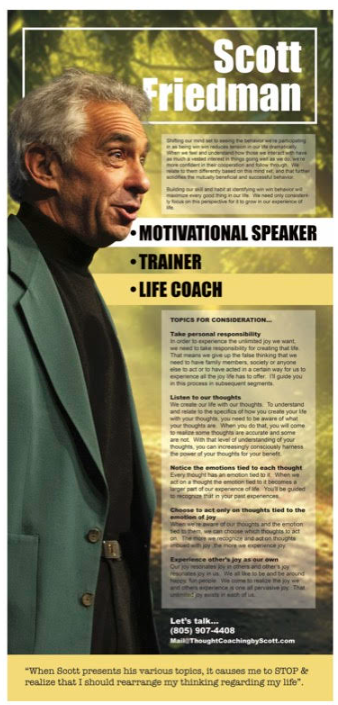
Scott Friedman has maintained a daily meditation practice for over 40 years and has authored 14 books on thought coaching and conscious living. His spiritual coaching model is unique: you pay nothing upfront. At the successful conclusion of coaching, you pay what you think it was worth. Learn more about Scott or book a free call.