What Port Hueneme Understands About Leadership That Most Cities Don't
Port Hueneme sits in the shadow of Naval Base Ventura County — and that proximity shapes the city's culture in visible ways. The people here understand discipline. They understand mission. They understand what it means to lead under pressure, to operate within structure, to do the work whether or not you feel like it.
That foundation is extraordinary. It produces some of the most capable, reliable, and mission-focused professionals I've ever worked with.
But it also produces a specific, underreported challenge: the gap between military leadership and civilian leadership.
“The skills that made you exceptional in uniform are real. The challenge is learning how to apply them in environments where the structure, the language, and the rules are different — and often unspoken.”
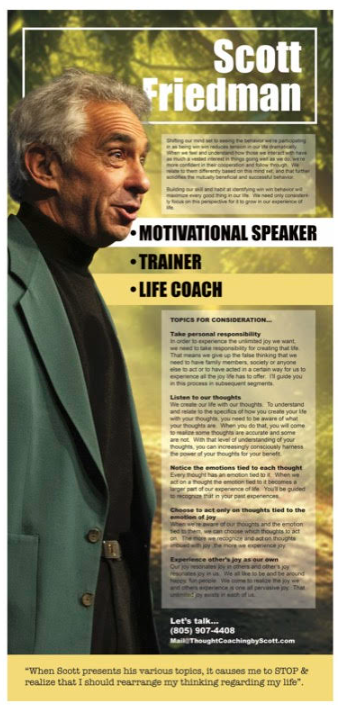
— Scott Friedman
The Transition Gap Nobody Talks About
Most transition support for veterans focuses on the practical: resume writing, interview skills, networking, translating military experience into corporate language. That help has real value.
But there's an inner dimension of the transition that rarely gets addressed — and it's often where the real friction lives:
- Identity shift — When your role was a huge part of who you were, losing the uniform means losing an identity. That's not trivial. It's disorienting at a deep level.
- Authority without rank — Civilian leadership doesn't come with built-in deference. Influencing people who don't have to follow you requires a completely different set of internal tools.
- Ambiguity tolerance — Military environments are built around clarity of mission and chain of command. Civilian workplaces are often ambiguous, political, and structurally loose. That ambiguity can be genuinely stressful for people trained to operate in structured systems.
- Suppressed processing — Military culture prizes composure. But composure over long periods — without genuine processing of difficult experiences — can create an internal pressure that eventually shows up as irritability, disconnection, or burnout.
What Thought Coaching Offers That Career Coaching Doesn't
Career coaching helps you figure out what to do next. Thought coaching helps you figure out who you're being as you do it — and whether your inner operating system is aligned with the life you're trying to build.
For veterans and naval professionals in Port Hueneme, the practical skills are rarely the issue. The thinking patterns — the self-limiting beliefs, the identity confusion, the unconscious resistance to a different kind of leadership — are where the real leverage lives.
Rebuilding Identity Beyond the Role
We work to articulate who you are as a leader and a person — separate from the role that previously defined you. This creates the psychological foundation for what comes next.
Translating Values Into Civilian Leadership
The values you developed in service — discipline, mission focus, accountability, care for your people — are extraordinary assets. Thought coaching helps you apply them fluently in civilian contexts.
Processing What Was Never Processed
Military culture discourages vulnerability. But unexpressed experience doesn't disappear — it just becomes background noise that affects your leadership in ways you may not fully recognize.
From a Port Hueneme Client
“Transitioning out of the Navy, I needed a different kind of leadership framework. The tactical skills transferred. The identity piece didn’t. Scott helped me understand who I was as a leader outside the uniform — and that clarity made everything else easier.”
— Naval Veteran, Port Hueneme, CA
This Isn't Soft Work
Let me be direct, because I know the audience: thought coaching isn't about sitting in a circle and sharing feelings. It's precise, disciplined, and demanding in its own way — just like the training you've already done.
It requires honesty. It requires the willingness to examine things you'd rather not examine. It requires a commitment to genuine change, not just surface adjustment.
If you brought that same rigor to your service, you can bring it to this. And the results will be just as significant.
How to Get Started
Your first call is free. No sales pitch, no pressure, no commitment required. We talk for 30 minutes, and you decide whether to continue.
And the financial model is simple: you pay nothing upfront. At the successful conclusion of coaching, you pay what you believe the work was genuinely worth — and what you can genuinely afford.
Book your free discovery call here or reach out at (805) 907-4408.
Scott Friedman serves Port Hueneme, Oxnard, Ventura, and all of Ventura County. 40+ years of daily meditation. 13 published books. Pay nothing upfront.