Exploring Life Coaching in Thousand Oaks
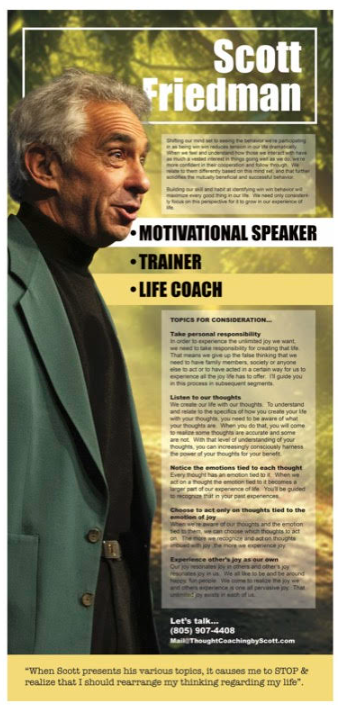
Life coaching can offer space to reflect on work pressures, relationships, or a feeling of being stuck. In Thousand Oaks, Scott Friedman offers phone and video sessions focused on thought awareness and personal growth. The first step is deciding whether the approach is right for you.
What they often have in short supply is the specific kind of clarity that allows high intelligence and high ambition to actually produce fulfillment.
The clients I work with from Thousand Oaks aren't confused about their goals. They're confused about why achieving their goals doesn't feel like enough. They're skilled at execution and often blind to the beliefs that determine what they're willing to execute toward. They've mastered the outer game and are ready to look at the inner one.
This is where thought coaching lives.
What's Actually Different About Coaching in Thousand Oaks
Search for a life coach in Thousand Oaks and you'll find: Psychology Today directory listings, Zencare profiles, and a small number of solo practitioners with websites that could be copied-and-pasted from any city in America.
What you won't find is a practitioner who writes substantively about the specific professional culture of Thousand Oaks — the particular pressures of leading inside a biotech giant, the experience of being a high performer who feels inexplicably stuck, the transition from Amgen employee to entrepreneur that a surprising number of local professionals eventually contemplate.
I've been working with this community long enough to understand its specific textures. This post is an attempt to speak directly to the kind of person Thousand Oaks actually produces.
The Amgen Effect: High Achievement, Specific Blind Spots
The concentration of world-class scientists, engineers, and executives in Thousand Oaks creates a particular coaching profile. These are people who are:
- Rigorously analytical — which is a strength and, in certain areas, a limitation
- High-functioning under pressure — which can mask internal conflict for years before it surfaces as burnout, disengagement, or a sudden clarity that something fundamental needs to change
- Accomplished by most measurable standards — which can make it feel illegitimate to say "I'm stuck" or "something isn't working"
- Accustomed to solving problems with more information — which doesn't work when the problem is the way you're framing the problem
I'm not describing weakness. I'm describing the occupational hazard of high-performing people in high-complexity environments. The analytical mind that makes someone exceptional at their work is the same mind that can over-analyze personal challenges to paralysis.
Thought coaching is unusually effective with this population because it works at the level of the framework itself, not the conclusions the framework generates.
The Thought Coaching Methodology
My approach is built on a foundational premise: a thought is a thought. It is not a fact.
For analytically minded professionals, this isn't a mystical claim. It's a practical one. The thought "I'm not ready for this role" is not a fact. It's a hypothesis. A well-calibrated scientist would not treat an untested hypothesis as established truth. And yet most high-achieving professionals do exactly this with their most important self-assessments.
The thought coaching process:
- Awareness — Learning to observe your thoughts rather than automatically acting from them. This is a trainable skill, grounded in 40+ years of daily meditation practice. For analytically minded clients, framing it as developing observational capacity for internal states tends to land well. It's not soft. It's precision work applied to the most important system you run: your mind.
- Acceptance — Not fighting the unhelpful thought, not replacing it with a positive affirmation, but accepting it as one possible interpretation of reality that doesn't require action. The thought loses its authority without a battle. In my experience, this step is where the most sophisticated clients initially resist — because it seems too passive. What they discover is that it's actually the most efficient intervention available.
- Automatic Improvement — When awareness and acceptance are consistently practiced, behavior changes without willpower. The decisions align more naturally with what you actually want. The leadership presence becomes more consistent. The actions follow the values rather than the fear.
Common Situations That Bring Thousand Oaks Professionals to Coaching
- The senior leader who's technically excellent but plateauing — Not because of skill gaps, but because the next level of leadership requires a different quality of self-awareness than got them here.
- The high earner asking harder questions — Substantial income, good family life, respected career — and a persistent sense that something essential is missing. These clients often feel guilty for being unsatisfied. Thought coaching helps them take the question seriously without pathologizing the discomfort.
- The professional contemplating a transition — Whether from Amgen to a startup, from corporate to independent consulting, from a career that made sense at 30 to one that makes sense now. These transitions are as much identity work as strategy work.
- The entrepreneur building something new — Thousand Oaks produces a steady stream of biotech and professional services entrepreneurs. The technical domain expertise is usually strong. The leadership and psychological dimensions of building a company are where most of them need support.
- The leader dealing with team dysfunction — When a team isn't performing, the instinct is to look outward: the wrong people, the wrong structure. Sometimes that's accurate. Often, what's most available to change is the leader's own patterns of communication, expectation, and response — which are downstream of thought patterns.
What Makes This Different From Executive Coaching Programs
Thousand Oaks executives often have access to corporate coaching through their organizations. These programs are typically structured, competency-based, and time-limited. They work for specific developmental goals within specific frameworks.
What they don't typically do is address the foundational beliefs that determine whether any competency development actually sticks. A leader can learn a new framework for difficult conversations in a corporate coaching program and still revert to their old patterns under pressure — because the belief that makes the old pattern feel necessary hasn't changed.
Thought coaching isn't a complement to corporate coaching — it's a different layer. It works on the substrate that determines whether any development at the surface level actually holds.
40 Years, 13 Books, One Approach
The methodology I bring to Thousand Oaks clients didn't come from a certification program. It came from 40+ years of daily meditation practice — which is a serious commitment to observing one's own mind — and 13 published books that represent decades of translating that practice into teachable frameworks.
This is relevant because mindset and coaching work done without genuine depth of practice is easy to spot. It's technically correct but experientially thin. The clients who come to me after trying other coaches often describe previous coaching as "feeling like being given a better to-do list." What they were looking for — and what thought coaching offers — is a different quality of understanding about what's actually running the show.
The Fee Model
Nothing upfront. At the successful conclusion of coaching — when the change you came for has happened — you pay what you think it was worth and what you can afford. For Thousand Oaks professionals who are used to evaluating ROI carefully before committing, this removes every financial barrier to finding out whether this approach is right for your situation.
Frequently Asked Questions
How much does a life coach in Thousand Oaks cost?
Most Thousand Oaks coaches charge $200–$500 per session, often in advance packages of 3–6 months. Scott Friedman charges nothing upfront — payment comes only at the successful conclusion of coaching, at whatever value you genuinely experienced.
Is there a good life coach near me in Thousand Oaks?
Most of what comes up in a Thousand Oaks life coach search is directory listings from Psychology Today or Zencare — therapists who also do coaching. Scott Friedman is a dedicated coaching practitioner with a specific methodology, 40+ years of practice, and 13 published books.
What makes thought coaching different from regular life coaching in Thousand Oaks?
Most life coaching focuses on goals and accountability. Thought coaching works on the beliefs that determine whether goals are achievable — addressing the source of behavior rather than the behavior itself.
Do you work with Amgen employees or biotech executives?
Yes. The Thousand Oaks biotech and pharma community is a significant part of Scott's practice. The analytical, high-achieving profile common in this industry is particularly well-suited to thought coaching.
How many coaching sessions does it take to see results in Thousand Oaks?
Most clients notice a meaningful shift within 2–3 sessions. Complete coaching engagements typically run 2–4 months, though this varies based on what's being addressed.
Can I do life coaching remotely while in Thousand Oaks?
Yes — all sessions are by phone or video. For busy professionals in Thousand Oaks, this means sessions fit around work schedules without adding commute time.
The First Conversation Is Free
Thirty minutes. A real conversation about your situation and whether thought coaching is the right tool. No pitch, no package presentation.