Finding a Life Coach Who Is Right for You
Life coaching is not licensed in the same way as mental health therapy in most U.S. jurisdictions, and coaches have a wide range of training and experience. That means it's worth taking time to understand how someone works, what they offer, and whether you feel comfortable talking with them.
Here are a few practical things to consider before choosing a coach. It's fine to ask questions, compare approaches, and decide that someone isn't the right fit.
“The most important question to ask a potential coach isn’t ‘what are your credentials?’ It’s ‘how does your approach actually produce change — and can you explain the mechanism clearly?’”
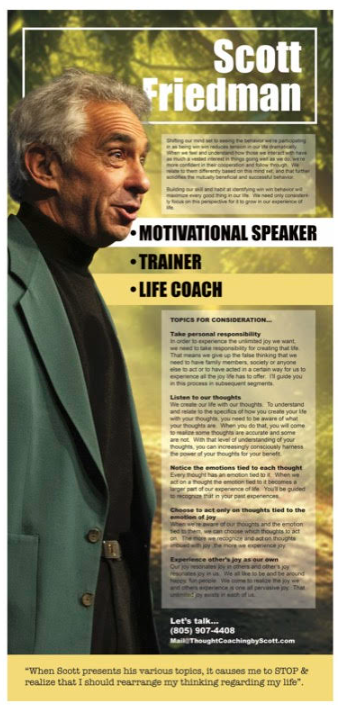
— Scott Friedman
What Credentials Actually Mean (and Don't Mean)
There are legitimate coaching certification programs — the International Coaching Federation (ICF) being the most widely recognized. ICF-certified coaches have completed structured training and passed assessments. That's worth something.
But it doesn't guarantee effectiveness. A credential tells you a coach has been trained in a methodology. It doesn't tell you whether that methodology is the right fit for your specific problem, whether the coach has real depth from experience, or whether the relationship will be the right one for how you learn and grow.
I'm not ICF certified. I've been doing this work for over 40 years, have published 14 books, and have worked with clients across Ventura County and beyond. Credentials and depth of experience are not the same thing.
The 5 Questions to Ask Before You Hire a Coach
"How does your approach actually work?"
A coach should be able to explain their methodology clearly — not in buzzwords, but in terms of what happens in sessions and why it produces change. If the answer is vague, that's a red flag.
"Who is your approach NOT a good fit for?"
Any honest coach should be able to answer this. If a coach says their approach works for everyone, that's a significant warning sign. Every methodology has its fit — and its limitations.
"Can you give me an example of someone you couldn't help?"
This question reveals intellectual honesty. A coach who claims a 100% success rate either hasn't worked with enough people or isn't being straight with you. Real coaches know their limitations.
"What does the first session actually look like?"
This reveals whether the coach is process-driven or person-driven. A good coach tailors their approach to you. A less effective coach follows a script regardless of who's in front of them.
"How will we know coaching has been successful?"
This reveals whether the coach thinks about outcomes or just process. The answer should include something specific to your situation — not generic descriptions of what "transformation" looks like.
Red Flags to Watch For
- Vague promises of "transformation" without explaining the mechanism. What, specifically, happens in sessions? How does the change actually occur?
- Rigid packages that don't adapt to your actual situation. If the coach is selling you a 6-month program before understanding your situation, the program is the product — not your results.
- High-pressure sales tactics. Discounts that expire today, "limited spots," urgency created artificially. A coach confident in their work doesn't need pressure tactics.
- No real intake process. If a coach is willing to work with you before genuinely understanding your situation, that's not good judgment.
- Testimonials as the primary evidence of effectiveness. Testimonials are selection-biased. Ask for specifics about what changed and how.
What to Look For Instead
- A coach who asks more questions than they answer in the first conversation
- Clear explanation of their methodology and honest assessment of its fit for your situation
- Willingness to say "I'm not sure I'm the right fit for this" when that's true
- Real-world experience — not just certification, but actual work with actual people over meaningful time
- A pricing model that aligns their incentives with your results
How My Model Works
You pay nothing upfront. At the successful conclusion of coaching, you pay what you believe the work was genuinely worth — and what you can afford. This model only works if coaching actually produces results. My incentive and yours are perfectly aligned from day one.
Finding a Life Coach in Ventura County
If you're in the Ventura County area — Camarillo, Thousand Oaks, Ojai, Ventura, Oxnard, Simi Valley, or surrounding communities — or if you're open to phone and video sessions anywhere, the most efficient way to assess fit is a free 30-minute discovery call.
That conversation gives you a chance to ask questions and decide whether the approach and relationship seem right for you.
Book your free discovery call here, or reach me directly at (805) 907-4408.
Scott Friedman is a life coach and leadership coach serving Ventura County, CA and clients nationwide. 40+ years of daily meditation. 14 published books. Pay nothing upfront.