If you keep saying yes when you want to say no, start by noticing what makes the answer difficult. You may be worried about disappointing someone, appearing selfish, or losing an opportunity. You can care about another person and still be honest about what you can reasonably do.
Why a simple no can feel complicated
Imagine a colleague asks you to take on another assignment at the end of an already full week. Before you answer, a thought appears: “If I say no, they will think I am not a team player.” That possibility might matter, but it is not the same as knowing how your colleague will react.
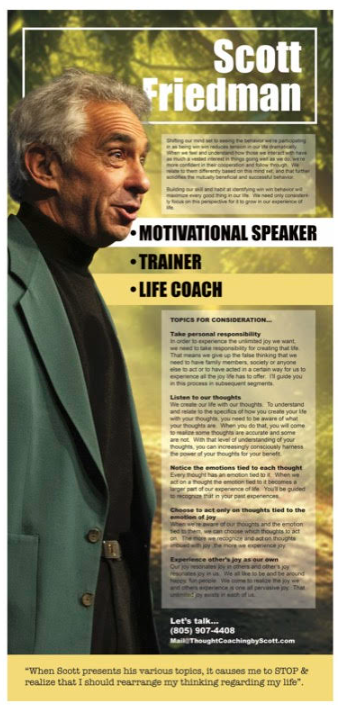
Scott Friedman writes about self-awareness as learning to notice the thoughts that shape our reactions. In his thought-coaching approach, seeing an assumption more clearly can make it easier to choose a response rather than react automatically. This is a personal coaching perspective, not a clinical treatment or a claim that difficult circumstances are imaginary.
Be clear about what you can offer
A useful boundary is specific enough that the other person knows what to expect. “I can't take on the report this week” is clearer than an uncertain “Maybe later.” You can be warm without supplying a long defense: “Thanks for thinking of me. I don't have room to do that well right now.”
If you want to help in a smaller way, you might offer a realistic alternative. “I can't lead the project, but I can review the outline on Thursday.” Only offer that alternative if you actually have the time and desire. A boundary that creates another unwanted obligation will not solve the problem.
Notice guilt without letting it make the decision
Feeling guilty does not automatically mean you have done something wrong. Sometimes guilt points to a responsibility you want to honor. Sometimes it comes from an old expectation that you must always be available. Instead of trying to push the feeling away, ask what it is telling you and whether that message fits the situation.
Scott's discussion of staying calm emphasizes observing thoughts rather than fighting feelings. You can apply that gentle curiosity when a boundary feels uncomfortable: “I'm noticing the thought that this person will be upset. I don't yet know that.” Then consider the real commitments, risks, and relationships involved.
Consider the relationship, not just the request
Boundaries work best when they leave room for honest conversation. A friend may genuinely need help, and you may genuinely be exhausted. You could say, “I care about what you're going through, but I can't talk tonight. Could we connect tomorrow afternoon?” That response respects both people.
Some requests involve obligations that cannot simply be declined, such as caring for a dependent or meeting essential job requirements. In those situations, the question may be how to negotiate support, share responsibilities, or make a workable plan. Thought awareness is helpful, but it does not replace resources, practical action, or professional advice when needed.
What if someone reacts badly?
A disappointed reaction does not always mean your boundary was unkind. Listen for any reasonable concern, and correct misunderstandings where you can. You can acknowledge someone's feelings without reversing your decision. “I understand this creates a challenge. I still can't commit to it” may be enough.
If someone repeatedly punishes you for saying no, the issue may be more than communication style. Seek trusted support, especially if there is coercion, intimidation, or a safety concern. Coaching can help with everyday reflection and choices; therapy, legal advice, or other specialist help may be appropriate for more serious situations.
Scott's perspective: choosing which thoughts to act on
In the written description of How To Choose What To Focus On, Scott says he reminds himself that he can notice his thoughts and related emotions, then choose which thoughts to act on. Applied to a request you cannot accommodate, you might notice “They'll be disappointed if I say no” without letting that prediction decide for you. This is an application of his stated idea, not a claim that the video specifically teaches boundary-setting.
Scott also writes in the description of Using Fear As An Asset about engaging with a fear rather than ignoring it. When guilt or worry appears before a difficult conversation, it may be useful to ask what concern deserves attention and what practical step would respect both people. That is a reflective exercise inspired by his description, not a substitute for setting boundaries or addressing an unsafe situation.
Try one small boundary this week
Choose a low-stakes request that you would normally accept out of habit. Before answering, ask: What do I actually have capacity for? What am I afraid will happen if I decline? What would an honest, considerate answer sound like? Then respond in a sentence or two and notice what really happens.
You do not need to become perfectly comfortable with every no. You are practicing a way of being truthful with yourself and respectful toward others. Over time, that can make your commitments more meaningful because you are choosing them with greater care.
To explore Scott's ideas further, see his original self-awareness writing, learn about Scott, or read how to approach a difficult decision. If a conversation would help, you can explore a free introductory call.