The Honest Answer Most Coaches Won't Give You
I've been doing this work for over four decades. I've worked with executives, entrepreneurs, parents, teachers, athletes, and artists — hundreds of people across every kind of life situation you can imagine. And when people ask me "is life coaching worth it?" I give them an honest answer, which is this:
It depends on two things: what kind of coaching, and what kind of problem.
That's not a dodge. It's the most useful thing I can tell you. Because the word "coaching" covers an enormous range of approaches, and not all of them are suited for all kinds of problems. Getting the match wrong wastes time and money and can leave you more skeptical than when you started.
“The real question isn’t whether coaching works. It’s whether the coaching you’re considering addresses the actual source of the problem you’re trying to solve.”
— Scott Friedman
When Life Coaching Is Absolutely Worth It
Coaching produces its best results when the primary obstacle is internal. Specifically, when the block is one of these:
You know what you should do — but keep not doing it
The information isn't the problem. The thinking is. You need something that addresses why the gap between knowing and doing persists — not more strategies to close it through willpower.
The same patterns keep showing up in different contexts
A different job, a different relationship, a different city — but somehow the same dynamic. That's the signature of a thought pattern, not a circumstance problem.
You're performing well externally but paying a high internal cost
The numbers look good. The career is moving. But the anxiety, the exhaustion, the sense that it's never quite enough — that's not a productivity issue. That's a thinking issue.
You sense the obstacle is internal — but can't quite see it clearly
The frustrating thing about blind spots is that they're, by definition, blind. A good coach helps you see what you can't see from the inside.
When Life Coaching Is NOT Worth It
Life coaching is probably not the right tool if:
- You're dealing with clinical depression, anxiety disorder, trauma, or other mental health conditions that require therapeutic intervention. Coaching is not therapy and not a substitute for it.
- You need specific technical expertise — a business consultant, financial advisor, or legal expert. Coaching is a thinking and awareness process, not expertise delivery.
- You're looking for someone to tell you what to do. Coaching helps you develop your own clarity. If you want instructions, a consultant is a better fit.
- You're not actually willing to examine your own thinking. Thought coaching requires honest self-reflection. If that's not possible right now, that's worth knowing upfront.
Why "Is It Worth the Cost?" Is Often the Wrong Question
The real cost of not addressing a self-limiting thought pattern isn't zero. It's the compounding cost of continuing to operate from that pattern — in your relationships, your career, your health, your leadership.
One executive I worked with had been carrying a particular fear-based pattern for over a decade. By the time we identified and cleared it, she could estimate conservatively what it had cost her in missed promotions, strained relationships, and reduced capacity. The number was well into six figures. The coaching cost her nothing upfront.
The Model That Removes the Risk
I work on a pay-what-it-was-worth model. You pay nothing upfront. At the successful conclusion of coaching, you pay what you believe the work was genuinely worth — and what you can afford. No packages. No retainers. No financial risk.
What I've Seen Work in Over Four Decades
Awareness-based change outlasts willpower-based change. When you genuinely see a thought pattern for what it is — a thought, not a fact — its hold on you loosens automatically.
The quality of the coaching relationship matters enormously. The specific approach has to fit the specific person and the specific problem. I've seen people go through years of coaching with minimal results because the fit wasn't right. I've seen people shift profoundly in weeks when the fit was exactly right.
The client's willingness is the limiting factor, not the coach's skill. The most important variable in coaching outcomes isn't the coach — it's whether the client is genuinely willing to look at their own thinking honestly.
Is Life Coaching Worth It For You?
The best way to answer that question for your specific situation is a free 30-minute conversation. No pitch, no agenda, no pressure.
Book your free discovery call here, or call directly at (805) 907-4408.
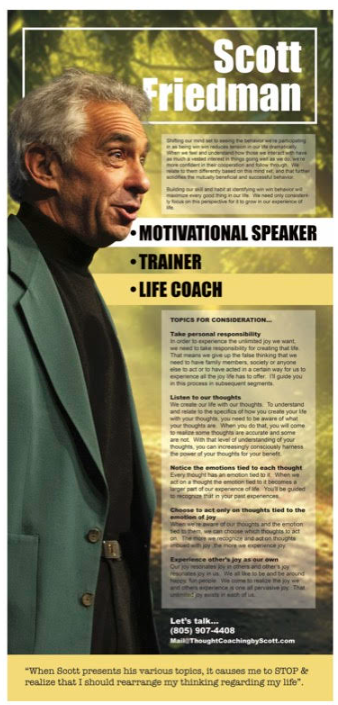
Scott Friedman is a life coach and leadership coach serving Ventura County, CA and clients nationwide. 40+ years of daily meditation. 13 published books. You pay nothing upfront.