Choosing the Support That Fits You
"Should I see a life coach or a therapist?"
It's a thoughtful question, and there's no single answer for everyone. The right support depends on what you're experiencing and what you hope will change.
I've been coaching for over 40 years. I'm not a therapist, and I don't pretend to be. But I've worked alongside therapists, referred clients to therapists, and received referrals from therapists throughout my career. So I'll give you the clearest answer I can.
A helpful distinction: A therapist can help with mental health concerns and challenges from the past, present, or future. A life coach can support reflection, goal setting, and personal growth without providing mental health treatment. These forms of support can complement one another.
What a Therapist Does
Therapists are licensed mental health professionals trained to diagnose and treat mental health conditions. Depending on a person's needs, therapy can address present-day concerns, coping skills, relationships, future goals, difficult past experiences, and emotional patterns.
Therapy is built for:
- Clinical depression, anxiety disorders, panic disorder, OCD, PTSD, and other diagnosable conditions
- Unresolved trauma actively interfering with daily functioning
- Grief, major loss, or acute crisis
- Relationship patterns rooted in early childhood attachment
What a Life Coach Does
A life coach is not a licensed mental health professional. Coaching is a forward-focused process oriented toward goals, growth, and change.
Good coaching is built for:
- Feeling stuck despite knowing what you want to do
- Habits or recurring patterns you want to understand, when clinical treatment isn't needed
- Leadership challenges, career transitions, or professional growth
- Life decisions that feel unclear or overwhelming
- The desire to live, lead, or work more consciously and intentionally
The Core Difference: Where the Work Is Oriented
Therapy
- Can address past experiences, current challenges, and future goals
- Focused on understanding patterns and healing wounds
- Requires a licensed professional with clinical training
- Can diagnose and treat mental health conditions
- Approach and pace vary depending on the person's needs and treatment
Life Coaching
- Oriented primarily toward the future and what you want to build
- Focused on clarifying goals and removing obstacles
- Does not require a clinical license
- Cannot diagnose or treat mental health conditions
- Progress depends on the fit, goals, and circumstances; results are not guaranteed
The Gray Area: When Both Might Be Relevant
Many people benefit from both therapy and coaching — at the same time, or in sequence. They're not mutually exclusive. A person might work with a therapist on deep relational patterns while also working with a coach on how those patterns show up in their leadership today.
When I Refer to a Therapist
I refer people to therapists when what they’re carrying requires clinical support. I’ll be direct about that in a first conversation. My goal is for you to get the right help — not to make you a coaching client regardless of what you actually need.
How to Decide Which One Is Right for You
Choose therapy first if: You're experiencing significant depression or anxiety, you've experienced unresolved trauma, you're in active crisis, or a medical professional has recommended it.
Choose coaching first if: You're generally psychologically stable but stuck in specific patterns, you know what you want but can't make consistent progress, or the issue feels more like a "thinking problem" than an emotional wound.
Consider both if: You're already in therapy and ready to also work on practical forward movement, or you want depth (therapy) and traction (coaching) simultaneously.
What Makes Thought Coaching Different From Generic Life Coaching
Thought coaching goes deeper than goal-setting and accountability. It addresses the underlying thought patterns generating your current results. A thought is a thought — it may or may not be true. When you learn to see thoughts as thoughts rather than reality, the grip of self-limiting patterns loosens automatically.
Your Next Step
If you're still not sure which is right for you, a free discovery call is the simplest next step. I'll give you an honest assessment of whether coaching is a fit — and if it isn't, I'll tell you directly.
Book a free discovery call here, or reach me at (805) 907-4408.
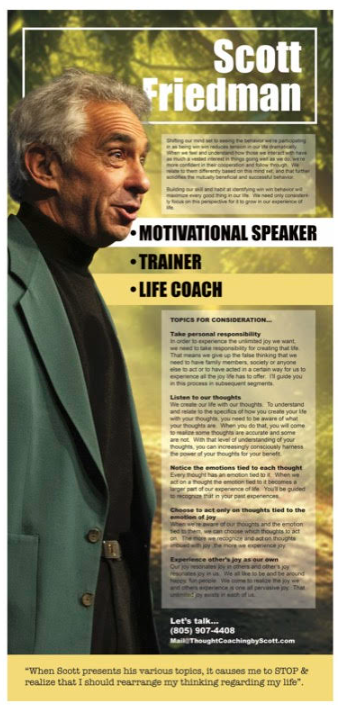
Scott Friedman is a life coach and thought coaching practitioner serving Ventura County and clients nationwide. 40+ years of daily meditation. 13 published books. Pay nothing upfront.