Why Career Changes Feel So Hard
On paper, a career change seems like a strategic challenge: assess the options, evaluate the risks, build a transition plan, execute. Plenty of books and career coaches will walk you through exactly that framework.
But if you're in the middle of one — or standing at the edge of one — you know it doesn't feel like a strategic challenge. It feels like a self challenge. The questions aren't just "what should I do next?" They're "who am I outside this role?" and "what if I make the wrong call?" and "how do I know this is the right move versus just running away from something?"
That's not a strategy problem. That's a thinking problem. And that's exactly where coaching lives.
“Most career change anxiety isn’t about the destination. It’s about the identity you’re being asked to leave behind — and the thought patterns that have been defining ‘safe’ for years.”
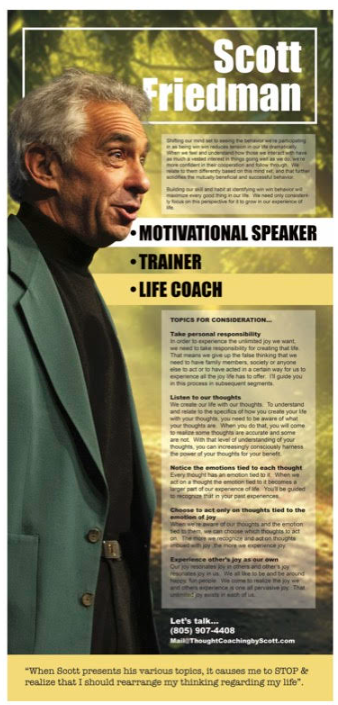
— Scott Friedman
The Real Obstacle in Most Career Changes
I've worked with people navigating career transitions for over four decades. The external circumstances vary — leaving a corporate career to build a business, moving from one industry to another, transitioning out of leadership into something more aligned with values, returning to work after a break. The external stories are different. But the internal story is usually remarkably similar.
The real obstacle is almost never about capability or opportunity. It's about one or more of these:
- Identity attachment: "If I'm not [this role/title/company], who am I?" The career has become so fused with the sense of self that the transition feels like a loss of self — not just a job change.
- Fear of judgment: What will colleagues, family, or social networks think? For high achievers especially, the perceived social cost of a downward or sideways move can feel prohibitive.
- The "what if I'm wrong" spiral: The mind generates an infinite regression of worst-case scenarios. Each one is theoretically possible. None of them are likely. But they feel real enough to create paralysis.
- The "golden handcuffs" rationalization: The current situation isn't what you want, but the stability, income, or status makes it feel dangerous to leave. This often feels like prudence. Sometimes it is. Often it's fear wearing the costume of practicality.
What Life Coaching for Career Change Actually Looks Like
When someone comes to me navigating a career transition, the work doesn't start with "here are your options" or "let's map out a timeline." It starts with the thinking.
Separating the fear-based thoughts from the genuine ones
Not every concern about a career change is fear. Some are legitimate signal. The work is learning to tell the difference — so you can honor the genuine concerns and release the fear-based ones that are just noise.
Getting clear on what you're actually moving toward — not just away from
Action taken to escape a situation is very different from action taken toward something genuinely desired. The distinction determines whether the change actually resolves the underlying issue or just relocates it.
Building the internal stability to navigate uncertainty
Career transitions involve genuine uncertainty. You can't eliminate it. But you can develop the thinking foundation that makes uncertainty navigable rather than paralyzing.
From a Client in Transition
“I’d been thinking about leaving my corporate career for two years. I was paralyzed. After a few sessions with Scott, I realized the paralysis wasn’t about the decision — it was about a story I’d been telling myself about what ‘success’ looked like. Once I saw that clearly, the path forward was obvious.”
— Senior Manager, Ventura County
When Is the Right Time to Start Coaching for a Career Change?
Most people wait until the anxiety peaks — until they're miserable enough that staying feels impossible. That works. Coaching can help at that point.
But coaching is actually most effective before the situation becomes acute. When you have some breathing room to think clearly, when the decision isn't being made under maximum stress, the quality of the work — and the quality of the outcome — is significantly better.
If you're starting to feel the pull toward change — even if it's just a vague sense that something is off — that's the right time to start a conversation.
Start With a Free Discovery Call
Whether you're in Ventura County or anywhere in the country, a 30-minute call is the most efficient way to assess whether coaching is the right support for your transition — and what that work would look like.
Book your free discovery call here, or call me directly at (805) 907-4408.
Scott Friedman is a life coach and leadership coach serving Ventura County, CA — Camarillo, Thousand Oaks, Ojai, Ventura, Simi Valley, and beyond — and clients nationwide. 40+ years of daily meditation. 13 published books. Pay nothing upfront.