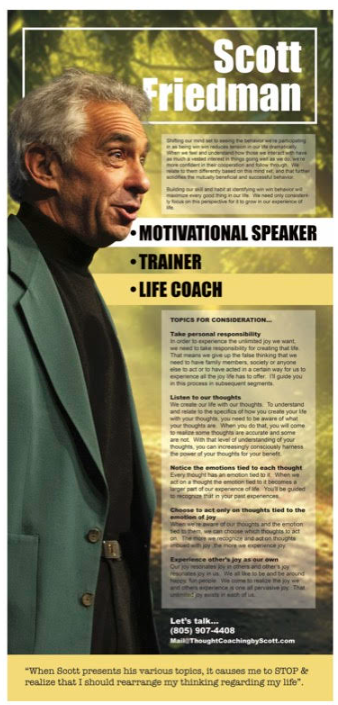
Most leaders I work with in Ventura County don't have a skill problem. They have a thought problem. The Amgen director who snaps at his team in meetings isn't missing a communication framework — he's running on an unexamined thought that says his value depends on being the smartest person in the room. The AgTech founder in Oxnard who can't delegate isn't short on tools — she genuinely believes, somewhere underneath all the productivity language, that no one else will care as much as she does. Until that thought is seen for what it is — just a thought, not a fact — no leadership course, no 360 review, no executive coach with a Harvard credential is going to move the needle.
Leadership Is a Thought Problem, Not a Skill Problem
I've been coaching leaders for over four decades. I've worked with Navy officers at NBVC transitioning to civilian management, with scientists at Amgen who suddenly had to run departments instead of experiments, with Westlake Village financial advisors managing multimillion-dollar client relationships, and with first-generation business owners in Oxnard who built something real from nothing and now can't figure out why it stopped working. Across every single one of these situations, the presenting problem is almost never what it appears to be.
Someone will tell me they have a communication problem. When we sit with it, it turns out they have a thought that says conflict means failure, so they avoid direct conversations until the pressure is unbearable — then they explode. That's not a communication problem. It's a thought problem. And no amount of communication training is going to fix a thought you've never examined.
This is the core of thought coaching: a thought is a thought, not a fact. Your brain produces thousands of them a day. Most of them you've never questioned. Many of them are driving your leadership behavior — your decisions, your reactions, your blind spots — without your knowledge or consent. The work is to see the thought, not fight it or replace it with a better one, but simply see it. That's Awareness. From Awareness comes Acceptance — not agreement, but the capacity to sit with what's true without being run by it. And from Acceptance, almost automatically, behavior changes. I call it Automatic Improvement because that's what happens: you don't force a behavior change. The change arises naturally when the thought driving the old behavior is no longer invisible.
Forty years of daily meditation practice is what gave me this framework. Not a certification program. Not a methodology I learned from another coach. Sitting with my own thoughts every morning for four decades taught me what thoughts actually are — and how much of what we call leadership ability is really just a set of unexamined assumptions running on autopilot.
Is Leadership Coaching Actually Worth It?
This is the question I see on Reddit constantly, and I appreciate the skepticism. There's a lot of bad coaching in the world. Coaches who hand you a framework, ask you to write down your goals, check in monthly, and call it transformation. Coaches who've never run anything, managed anyone, or sat with genuine uncertainty about whether they're good enough at what they do. I understand why people are skeptical.
Here's what I know from working with hundreds of leaders: the ROI of coaching is almost entirely dependent on whether you're doing the right kind of coaching. If you're working with someone who helps you install better behaviors on top of the same thoughts that were already limiting you, you'll get marginal improvement at best. If you're working with someone who helps you see the thoughts that are actually running the show, the change can be significant and permanent.
The leaders I've worked with who got the most from coaching share a few traits:
- They were already performing well — coaching accelerated and deepened what was already working
- They were willing to look honestly at their own thinking, not just their behavior
- They had a specific challenge that wasn't resolving through their usual approach
- They didn't need to be fixed — they needed a clear mirror and someone with enough experience to know what they were looking at
- They were tired of carrying the weight of leadership alone with nowhere safe to be honest
And here's the thing about my fee model: you pay nothing upfront. At the successful conclusion of coaching, you pay what you think it was worth — and what you can afford. That's not charity. It's a bet on the work. If I'm not willing to stake my income on whether what I do produces real results, why would you stake your time and energy on it?
What's the Difference Between Coaching and Therapy?
I get this question from almost every new client, and it matters. Therapy and coaching are genuinely different, and conflating them leads people to either avoid coaching ("I'm not broken, I don't need therapy") or to bring therapy-level expectations to a coaching relationship.
The distinction I use: therapy deals with what happened. Coaching deals with what's next. Therapy is primarily retrospective — understanding the roots of your patterns, processing past experiences, building psychological health. Important work. Genuinely valuable. But that's not what I do.
Coaching is prospective. We're looking at where you are now and where you're trying to go. The question isn't "Why am I this way?" It's "What am I thinking that's making this harder than it needs to be?" The focus is on the present moment and the near future, not on the history that created your current patterns.
That said, thought coaching does involve examining thoughts that have deep roots. When an Amgen manager discovers that his difficulty giving feedback comes from a thought that says "a good leader doesn't make people feel bad," we're touching something that was probably formed long before his career. I don't need to process the origin of that thought to work with him on it. We see it, name it, and watch what happens to his behavior once it's no longer invisible. That's coaching, not therapy.
Why Ventura County Leaders Face Specific Challenges
Generic national content talks about "executives" in the abstract. I work with specific people in a specific place, and that specificity matters.
A Note for Ventura County Professionals Specifically
Amgen and the Thousand Oaks biotech corridor: The transition from technical expert to people leader is one of the most psychologically difficult transitions in professional life. Scientists and engineers are trained to be certain, to be right, to have data. Leadership requires comfort with ambiguity and influence over people who have their own views of what's right. I've worked with multiple Amgen managers and directors who are brilliant scientists and struggling leaders — not because they lack skill, but because their identity is built on a foundation that doesn't translate cleanly to management.
NBVC and the veteran-to-civilian transition: Military leaders at Naval Base Ventura County face a specific disorientation when they enter civilian management. The command-and-control structures they excelled in don't map onto civilian teams that expect to be persuaded, not ordered. The authority that came with rank has to be rebuilt from scratch through relationship and credibility. I've worked with several veterans navigating this shift, and the core challenge is almost always identity, not tactics.
Oxnard and Santa Paula AgTech founders: The first-generation founder who built something from nothing often has a profound thought that says "I'm the only one who really understands this business." It's usually partially true, and that partial truth makes it harder to examine. But it's also the thought that prevents scaling — because you can't build an organization larger than your capacity to be present in it, and your capacity to be present has hard limits.
Westlake Village wealth management: Financial advisors managing large books of business carry a specific anxiety: one bad conversation, one wrong move, and a relationship worth millions of dollars walks out the door. This creates a leadership style that's often overly accommodating, conflict-averse, and exhausting to sustain. The thought underneath it is usually something like "being liked is the same as being trusted" — which is not true, and which tends to produce relationships that are pleasant but not deep.
The commute factor: Ventura County professionals who commute to Los Angeles or the Conejo Valley are often doing 60 to 90 minutes each way. They are time-starved in a way that professionals in walkable urban centers are not. This is why all of my coaching is done by phone or video — it fits into a commute, a lunch break, or a quiet hour at the end of a long day. No drive to an office, no scheduling around traffic, no performance of professionalism in a conference room.
The Thought Coaching Methodology: Awareness → Acceptance → Automatic Improvement
I've written 13 books. The framework I keep coming back to, the one that actually works, has three steps. They're simple to describe and require real practice to embody.
- Awareness: See the thought. Not judge it, not explain it, not replace it — see it. Most of what drives our behavior is invisible to us. The thought "I need to have the answer" runs silently in the background of hundreds of leadership decisions. Until you can see it, you can't do anything with it. The first and most important work in coaching is developing the capacity to observe your own thinking in real time.
- Acceptance: This is not agreement. Acceptance means acknowledging what's true without being controlled by it. "I have a thought that says I need to be in control of this situation" is awareness. Accepting that thought — sitting with it without fighting it or immediately acting on it — creates space between the thought and the behavior. That space is where leadership lives.
- Automatic Improvement: When you see a thought clearly and accept it without being run by it, behavior changes without force. You don't have to manufacture a better response. You don't have to follow a script. The old behavior, which was automatic because the thought was invisible, becomes optional — and you naturally choose differently. This is why I call it automatic improvement. The improvement isn't effortful. It arises from the seeing.
This is what 40 years of daily meditation taught me. Not the thought coaching framework specifically — but the underlying reality that thoughts are events in the mind, not facts about the world. That distinction, practiced daily, changes how you lead, how you make decisions, how you handle conflict, and how you experience the weight of responsibility that comes with any leadership role.
Who Benefits Most from Leadership Coaching?
Let me be honest here, because the coaching industry often isn't. Not everyone benefits equally from coaching, and pretending otherwise is a disservice.
The people who get the most from thought coaching tend to share these characteristics:
- They're already effective. Coaching is not remediation. If someone is genuinely struggling to perform in their role, they may need training, mentorship, or a different role — not coaching. The leaders who benefit most are already doing reasonably well and want to go further.
- They're curious about their own thinking. If you're not interested in examining how you think, thought coaching is not going to land for you. The work requires a genuine willingness to look, not just a desire to improve outcomes.
- They have a specific friction point. Vague goals produce vague results. The leaders who make the fastest progress come in with something concrete: "I avoid difficult conversations until I blow up." "I can manage my team but freeze presenting to the executive committee." "I've been promoted three times and I still feel like I'm faking it."
- They don't need to be talked into the value of self-reflection. If you need to be convinced that examining your thinking might change your behavior, you're probably not ready for this work yet.
- They're willing to be honest in a way they can't be with their team. One of the most underrated values of coaching is the safety of the relationship. You can say things to a coach that you cannot say to your boss, your peers, or the people who report to you. That honesty is what makes the work possible.
How Do I Stop Second-Guessing Every Decision I Make?
This is the question I hear most often from leaders who've recently been promoted or who've taken on significantly more responsibility. And it's the right question — not because second-guessing is always a problem, but because the particular flavor of second-guessing that most leaders experience is driven by a specific thought that's worth examining.
The thought is usually some version of: If I'm wrong, something bad will happen and it will be my fault.
That thought is always true to some degree. Leaders are responsible for outcomes. Being wrong does have consequences. But the thought usually has an emotional amplifier attached to it — something that makes the stakes feel catastrophic even when the actual risk is moderate. And it's the amplifier, not the actual risk assessment, that produces the paralysis.
What I do with leaders who struggle with decision confidence isn't teach them a decision-making framework. It's help them see the thought that's amplifying the stakes, and sit with the discomfort of uncertainty long enough to recognize that they can tolerate it. Most leaders, when they're honest with themselves, already know what the right decision is. The coaching isn't about finding the answer. It's about reducing the noise around the answer long enough to hear it.
After 40 years of meditation, I can tell you: the thoughts that feel most urgent are often the ones most worth pausing on. Speed of response is a leadership virtue, but so is the capacity to not be hurried by your own anxiety.
Common Misconceptions About Leadership Coaching
People on Reddit say this to me in different forms all the time: "Coaching is for people who are struggling." Or: "If I need a coach, it means I'm not good enough." Or: "I've been doing this for 15 years — what's a coach going to tell me that I don't already know?"
Let me address these directly.
"Coaching is for people who are failing." The opposite is closer to the truth. The highest-performing athletes, executives, and performers in the world use coaches not because they're broken, but because excellence requires an outside perspective that is impossible to generate for yourself. You cannot see your own blind spots. By definition. A coach isn't there to fix you — they're there to show you what you can't see from where you're standing.
"Leadership coaching is just therapy with a better name." Different tools, different focus. Therapy is retrospective — it helps you understand and process your history. Coaching is prospective — it helps you work with your thinking to change your behavior going forward. Both are valuable. They're not the same thing.
"I've been doing this for 15 years — what can a coach tell me?" A coach doesn't tell you things. That's not the job. The job is to ask the questions you haven't asked yourself and create the space for you to see what's already there. Fifteen years of experience means you have fifteen years of patterns — some serving you, some not. The ones that aren't serving you are invisible precisely because they've been around for fifteen years and feel completely normal.
"You need to be a senior executive to benefit." Wrong. The best time to do this work is earlier in your career, when the patterns are less calcified and the stakes of changing them are lower. By the time someone is a C-suite executive, the thought patterns driving their leadership style have been reinforced for decades and are significantly harder to work with.
Thought Coaching vs. Traditional Leadership Coaching
| Dimension | Thought Coaching (Scott Friedman) | Traditional Leadership Coaching |
|---|---|---|
| Core focus | The thoughts driving behavior | Behavior change and skill development |
| Mechanism of change | Awareness → Acceptance → Automatic Improvement | Goal-setting, action plans, accountability check-ins |
| Durability of results | Permanent — the thought pattern shifts | Variable — behaviors can revert under stress |
| Fee model | Pay nothing upfront; pay what it was worth at conclusion | Typically $300–$600/hour or retainer upfront |
| Format | Phone or video; no commute; fits your schedule | Often requires in-person or fixed-time video sessions |
| What success looks like | Behavioral change you didn't have to force | Documented goal achievement |
| Who it works best for | Leaders curious about their own thinking | Leaders who need structured accountability and skill-building |
Frequently Asked Questions
How is leadership coaching different from executive coaching?
The terms are often used interchangeably, but in practice, executive coaching tends to focus on the most senior leaders in an organization — C-suite, VP-level — and often involves organizational context, stakeholder management, and succession planning. Leadership coaching is broader and applies to anyone in a leadership role, regardless of title. In my work, I don't make this distinction. The thought patterns that drive leadership behavior don't care about your level in the org chart.
How long does leadership coaching take to work?
Depends entirely on what you're working on and how willing you are to look at it honestly. Some leaders have significant shifts in perspective in the first few sessions. For deeper, more calcified patterns — the ones that have been around for decades and feel completely normal — it takes longer. What I can tell you is that this isn't a year-long program by default. We work until the work is done, and you only pay when it's complete.
Does leadership coaching work for introverts?
Yes, and often better. Introverts are frequently more comfortable with the introspective work that thought coaching requires. The leaders who struggle most with this approach are often the highly extroverted ones who are more comfortable taking action than sitting with discomfort. Introversion is not a leadership liability — it's a different style, and the thought coaching approach works with any style.
What if I can't afford leadership coaching right now?
My fee model was designed specifically for this. You pay nothing upfront. At the successful conclusion of coaching, you pay what you think the work was worth — and what you can afford. I've worked with founders who were genuinely cash-constrained and executives at Fortune 500 companies. The model is the same for both. If the coaching didn't produce real value, you don't pay for it.
My boss is technically brilliant but a terrible manager — would coaching help them?
Possibly, but only if they're willing to do the work. Coaching requires genuine participation from the person being coached. You can't send someone to coaching as a corrective measure and expect it to stick — they have to actually want to look at their own thinking. If your technically brilliant boss is open to examining how their thoughts are affecting their leadership, then yes, thought coaching can help with exactly this pattern. The technically brilliant people are often the hardest to coach because their identity is so strongly tied to being right.
Do you work with leaders outside of Ventura County?
Yes. All sessions are by phone or video. I work with clients across Southern California and nationally. That said, my deepest familiarity is with the professional landscape of Ventura County — the industries, the culture, the specific pressures that come with working in this market — and that local context often makes the work more specific and grounded.
How is this different from just talking to a mentor or trusted colleague?
A mentor gives you advice based on their experience. A trusted colleague gives you perspective from inside your world. Both are valuable. What a coach provides that neither of them can is a perspective that is completely outside your organizational context, with no stake in your decisions or your identity, and with specific training in noticing the thinking patterns that are invisible to the person inside them. The honest conversation you can have with a coach is simply not available with people who are invested in the outcome.
Ready to Find Out If This Is Right for You?
I offer a free 30-minute call — no sales pitch, no commitment. We'll talk about what you're working on, I'll tell you honestly whether I think this kind of coaching is a fit, and you can decide from there. You pay nothing upfront. If the coaching doesn't produce something real, you don't pay for it.
Book a Free 30-Minute Call